Preventing AI Content Slop in Brand Publishing
Brands must build quality control into AI workflows to avoid generic, forgettable content.

What makes AI content feel like slop
AI content became a volume product before anyone built the plumbing to keep it good, and that mismatch is the whole story. The pitch for AI writing tools was simple: more content, faster. In a huge share of cases, AI content became a flood of material that's technically publishable and instantly forgettable, the kind readers, algorithms, and now dictionaries have all learned to name.
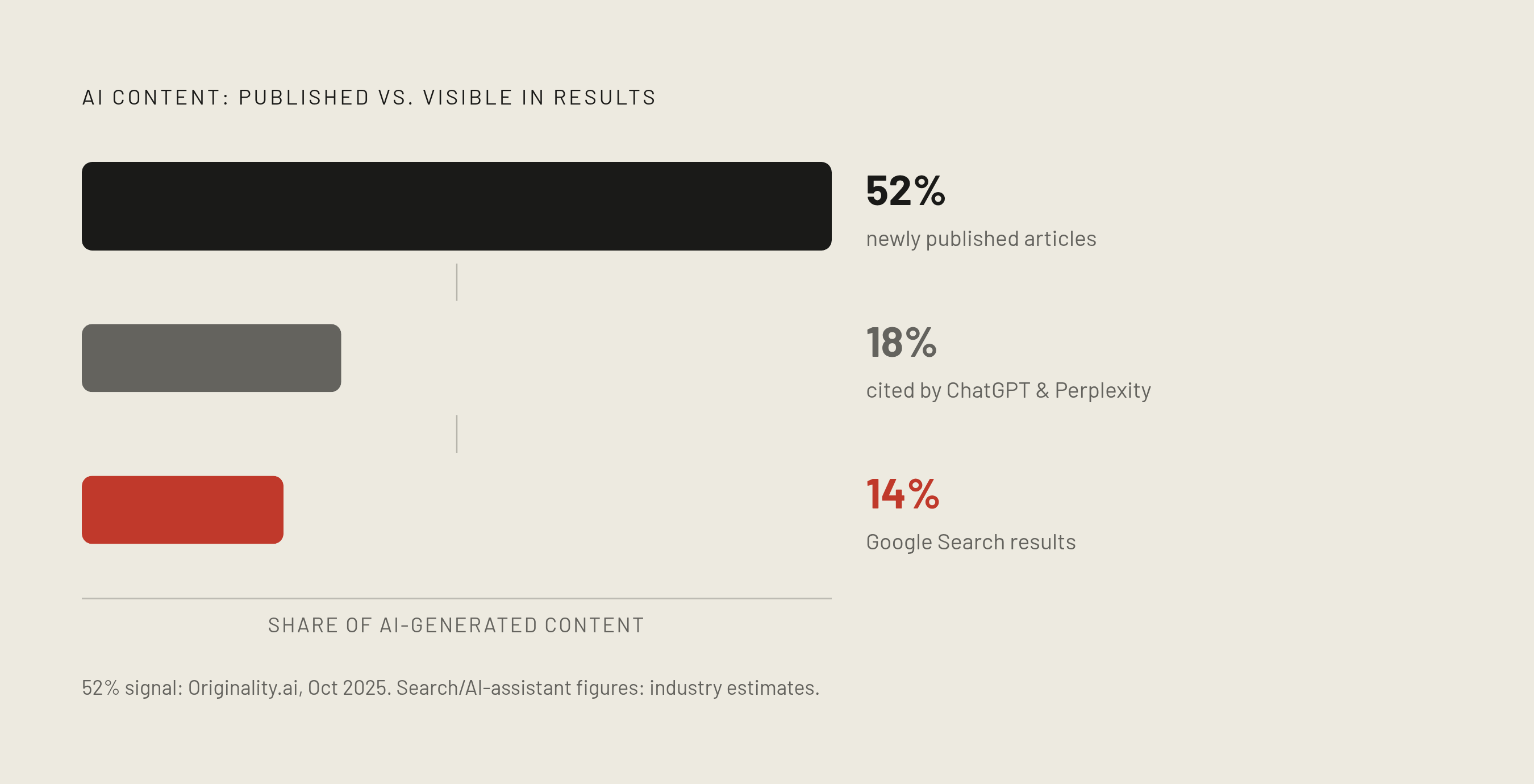
A joint study from Graphite and Originality.ai tracked the shift: roughly one in ten newly published articles carried AI-generation signals in late 2022, and by October 2025 that figure had climbed to 52%, then settled into a rough plateau rather than continuing upward. Merriam-Webster, the Macquarie Dictionary, and the American Dialect Society each named "slop" their Word of the Year in December 2025. When three separate dictionary bodies land on the same word in the same month, that's not a coincidence of taste. It means enough people needed language for what they were seeing.
Slop is rarely wrong. It's comprehensively unmemorable instead, the textual equivalent of a meal that fills you up without tasting like anything. It covers its topic and says almost nothing.
The tells are specific once you know where to look. Zero point of view is at the top of the list: slop tends to close with something like "it's important to consider multiple perspectives," a sentence that commits to nothing and could cap off an article on any subject. There's a suspicious comprehensiveness to it too, the sense that whoever "wrote" this never used the product, sat through the meeting, or hit the problem being described firsthand. The prose reads identically across ten competing brands, because ten competing brands are running the same model against nearly the same prompt. And the conclusions are swappable: lift the paragraph, drop it into a rival's blog, and nothing breaks.
For a brand, that swappability does real damage, more than it would for a lone blogger, because a brand's entire commercial premise rests on being a source worth trusting. Content that reads as generated-to-spec tells the reader, often without either party quite realizing it, that the brand has nothing original to say. When every company in a category publishes the same advice in the same register, differentiation collapses. Earning a citation, a mention, or an actual recommendation from a real person gets a lot harder to come by.
Why AI-generated content underperforms in search and AI-powered discovery
Publishing at scale without originality is a policy violation now, not just a stylistic misstep. Google's January 2025 update to its Quality Rater Guidelines told human raters to consider assigning the lowest possible rating to pages where "all or almost all" of the main content is AI-generated without effort, originality, or added value. That's Google saying, on the record, that fluency without substance should be penalized rather than tolerated.
The filtering already reflects that stance. While 52% of newly published web content carries AI-generation signals, only about 14% of Google Search results actually contain AI content. Google's ranking systems are screening most of the slop out of visible results even as it keeps flooding the open web behind the scenes. Roughly 86% of first-page Google articles are human-written, and separately, about 82% of content cited by ChatGPT and Perplexity traces back to human authorship. Two different systems, arriving at the same preference, is not a coincidence worth explaining away.
Ranking well and getting cited by an AI assistant are not the same fight. Ahrefs found that only about 12% of URLs cited by AI assistants also rank in Google's top 10 for the same query. Showing up in an AI-generated answer and ranking organically are two separate contests with two separate rule sets, and slop loses both, for different reasons in each case. Anyone optimizing for one and assuming the other follows is optimizing for the wrong scoreboard.
The four points where slop enters the workflow
Slop is the compounding result of distinct gaps in a production pipeline, and naming them precisely is what makes them fixable instead of just frustrating.
The first failure point is feeding the model no brand context. AI generates to the prompt in front of it, and without voice, positioning, audience specifics, and editorial standards actually built into that prompt, the model defaults to the generic average of everything it was trained on. The 80-page brand guidelines PDF has stopped doing its job here: those documents were built for a human agency team flipping through a binder before a kickoff call, not for a system that needs machine-readable instruction every time it generates a paragraph. The PDF isn't broken. The assumption that it transfers to a machine is.
Treating the first draft as the final draft is the second failure point, and it's the most preventable one. HubSpot's research shows 94% of marketers plan to use AI in content creation in 2026. More people will be producing more content, faster, often with less editorial oversight standing between the model's output and the publish button, and the review step is reliably the first thing cut when a team feels time pressure. Speed collapses the space between generation and publication, and that gap is exactly where quality control used to live.
The third failure point is skipping subject-matter input. AI cannot replicate lived experience, proprietary data, or a practitioner's actual point of view, so content written without a real expert's fingerprints on it stays generic by construction, no matter how fluent the sentences sound. A Cornell study on Reddit moderators, cited by Flux8Labs on Medium, found the moderators' chief concerns with AI-generated content centered on decreasing quality, disrupted social dynamics, and difficulty governing it at all, with style errors, factual inaccuracy, and topic drift appearing as sub-symptoms of that same complaint. Different context, same failure: nobody with real expertise validated the output before it reached an audience, producing the same complaint seen elsewhere.
None of the first three failures survives on its own, though. They all trace back to a fourth: nobody owns the check. A brand can have a voice guide, a review calendar, and an in-house expert on staff, and still publish slop, if no single person is accountable for catching drift before it ships.
Building the workflow that makes AI accelerate quality instead of diluting it
A knowledgeable person reviewing, shaping, and approving the final result is what earns a reader's time. Machines can touch every stage of production. Human judgment has to govern what actually goes out the door, and that division of labor is the only part of this that isn't negotiable.
Brand context needs to go in before generation happens, not get corrected for afterward. Brand voice governance is increasingly treated as its own AI governance problem, something organizations are formalizing heading into 2026 rather than leaving to instinct. Voice needs to live inside the AI tools and workflows themselves as a system requirement, not sit in a document nobody opens between quarterly reviews. In practice that means approved prompt templates encoding tone, audience, and positioning, a maintained list of what the brand does not say, and persona documentation that goes past adjectives into actual example sentences and explicitly forbidden phrases.
Human perspective and subject-matter input belong in the drafting stage. The formula that works pairs AI's efficiency at research, outlining, and transcription with human judgment supplying voice, perspective, and the kind of emotional truth a model has no access to. Interview the subject-matter expert first. Feed their actual quotes and insights into the prompt. Treat the AI as a first-draft writer working from human-supplied raw material, not as a source of original thought, because it isn't one.
Every draft needs to run through a standardized QA rubric before it publishes: tone consistency, factual accuracy, brand alignment, and audience relevance, well past a basic grammar check. Ownership has to be explicit. Marketing operations or an AI lead maintains the approved-tool list and workflow documentation. Brand and editorial leaders set voice standards and review thresholds. Subject-matter experts validate factual claims, and legal or compliance draws the boundaries around high-risk categories. Platforms such as Typeface, which run automated validation checks through their Arc Graph ecosystem, have reportedly cut approval cycles by 40% to 60%. Quality and speed stop trading off once the rubric is built into the pipeline instead of bolted on at the end.
What brand context means in practice, and how to encode it
A PDF full of color codes, typography rules, and a handful of personality adjectives tells a language model almost nothing about how a brand actually sounds in a real sentence. Plenty of teams still think their brand book is doing work it stopped doing the moment AI became a primary content producer.
Useful brand context for AI looks different in kind, not just in detail. It contains example sentences written in the brand's actual voice, rather than adjectives describing that voice from a distance. It states what the brand does not say: competitor phrasing to avoid, framings that are off-limits, claims legal has already ruled out. It specifies the audience with real precision, meaning who exactly is reading, what they already know, and what problem sent them looking. It spells out positioning, what actually makes this brand's take different from any other company publishing on the same topic this week. And it sets disclosure and editorial standards: when to attribute AI's role, how contribution gets logged, what categories of claim require sign-off from a subject-matter expert before anything ships.
Left ungoverned, AI content drifts toward the mean. Every piece pulls a little closer to the generic average unless brand context actively anchors it against that pull, and the drift compounds faster at content-generation scale than it ever did under manual production, simply because more volume moves through the pipeline every week. None of this holds without a named owner, either a marketing operations lead or a dedicated AI content lead, because brand context documents go stale the moment nobody's job depends on updating them.
Quality content as the prerequisite for AI visibility, not just search ranking
Gartner predicted traditional search engine volume would fall 25% by 2026, a forecast that has reshaped how brands think about discovery channels. Where buyers go looking for a brand is moving fast, away from the channel most content strategies were built around.
The disruption inside AI search hasn't been gradual either. On January 27, 2026, Google switched AI Overviews over to Gemini 3, and in the weeks that followed, about 42% of previously cited domains got replaced. The overlap between ranking in the organic top 10 and being cited inside an AI Overview collapsed from 76% down to somewhere between 17% and 38%, depending on whether the source is Ahrefs or BrightEdge. Whatever SEO equity a brand built up under the old system does not automatically transfer to the new one, and betting that it will is an expensive assumption to get wrong.
Documentation shows what these systems actually select for, and it isn't keyword density. Peer-reviewed generative engine optimization research (arXiv:2311.09735) found that content structured around citation density, definition-lead formatting, and statistical enrichment achieved up to 40% higher visibility in generative engine responses. Those are editorial and structural choices, and they reward exactly the kind of specific, well-sourced writing that slop, by definition, cannot produce.
The commercial numbers settle the argument. AI-referred traffic converts at 15.9% from ChatGPT and 10.5% from Perplexity, against a 1.76% conversion rate from ordinary organic search. Getting cited inside an AI answer is a high-intent signal, and that channel opens only to content substantial enough to earn the citation. Slop doesn't get cited. It gets filtered before a reader, or a model, ever sees it.
This workflow inside an agency managing multiple brand clients
Running this workflow for a single brand makes it a discipline. Running it across a roster of clients, each with a different voice, audience, and risk tolerance, makes it an operational system with real teeth, because the failure modes multiply along with the account list.
An agency managing multiple brands can't lean on one shared prompt template or one style guide applied loosely across accounts. That's the fastest route to voice drift bleeding across clients until a healthcare brand starts sounding like a fintech startup. Each account needs its own encoded context, its own forbidden-phrase list, its own named human owner accountable for catching the moment output starts drifting toward the generic average.
The QA rubric has to flex per client too. A regulated industry needs a compliance checkpoint that a consumer lifestyle brand doesn't, and forcing one rigid process across every account is its own quiet way of manufacturing slop, just spread across a wider client base instead of concentrated in one.
The agencies that get this right treat brand context as a living asset per account, maintained with the same seriousness as a creative brief, updated as a client's positioning shifts, and checked against actual output on a schedule rather than only when something goes visibly wrong. That's more overhead than running every account through the same pipeline, and it's also the only version of this that scales without quietly commoditizing every client it touches.
Sources
- Why “AI Slop” Content Is Diluting Your Brand (And How to Fight It) | by Flux8Labs | Medium
- After an oversaturation of AI-generated content, creators’ authenticity and ‘messiness’ are in high demand
- The Rise of AI Slop: How Low-Quality AI Content Took Over the Internet
- AI Slop Is Killing Brand Trust. Here
- frase.io