Content Review and Approval Workflow Design
Calibrating scrutiny to risk prevents both the bottlenecks and chaos that kill approval workflows.
Content approval workflows fail for one of two reasons: too much process, or not enough. Most teams assume the fix is a better sign-off chain, but a chain is just the last link in something bigger: a full sequence of roles, review stages, deadlines, and feedback loops that either holds together under volume or doesn't. The teams that get this wrong almost always default to adding more process, on the theory that more eyes on a draft means fewer mistakes. That instinct is backwards: extra review is the wrong fix more often than it's the right one. Scrutiny that isn't calibrated to actual risk doesn't prevent errors, it slows everything down until the backlog becomes the real problem.
Joni Blecher, Content Manager at Smartsheet, described the calibration problem this way: "One thing that doesn't work is too much process, too many hoops to jump through before a piece of content can get to its final destination." Good workflow design matches scrutiny to risk. It builds just enough structure that accountability doesn't quietly disappear somewhere between the draft and the final sign-off.
Review and approval get treated as the same step constantly, and that conflation is the root of a lot of dysfunction. Review is quality control: grammar, tone, factual accuracy, brand fit. Approval is a decision, made by someone with the authority to say yes and the responsibility to own what happens next. Collapse the two and nobody actually owns the outcome. The copy editor thinks legal signed off. Legal thinks marketing already reviewed for tone. Content goes out with a typo in the headline, and everyone assumes someone else caught it.
Why the cost of a broken process is higher than most teams realize
Companies with inefficient approval processes lose real productivity waiting on sign-offs that should take an hour and instead take a week. That inefficiency shows up as a campaign that misses its launch window because the legal reviewer was out of office, as feedback scattered across four Slack threads and a forwarded email chain, as a final asset published without anyone confirming the last round of edits actually made it in.
Elaine Chen, Founder of excogita, names the most common failure mode directly: one person responsible for approving everything. It's common in smaller organizations, and it works fine right up until that person is traveling, sick, or buried in something else. Then everything stops. Not slows down. Stops. There's no backup, no delegation path, nothing moving until that one inbox gets checked.
The opposite failure looks different but ends the same way. No single bottleneck, just no structure at all. Blecher describes it bluntly: "things could sit around for days if you don't have somebody who says, 'Excuse me, this was due two days ago. Where'd it go?'" Over-process and under-process are different diseases with the same symptom: content that doesn't move. Of the two, the single-approver bottleneck is the more dangerous failure, because it stays invisible until the one person is unreachable, leaving no fallback to catch the fall.
Whatever process worked at low volume tends to break as volume climbs. Most teams misjudge the timeline: they wait for a visible failure before they redesign anything, when the workflow was already failing quietly for months. A five-person marketing team can run approvals over Slack and get away with it. A team publishing across six content types and three brands cannot, and pretending otherwise just means the chaos compounds until someone finally notices the backlog. According to Sprout Social, companies tracking approval metrics reduce approval time by 40% compared to those not tracking. That number carries more weight than a footnote, because measurement is the mechanism that turns a workflow from a fixed process into something that actually gets better over time. It comes up again later in this piece for exactly that reason.
The four stages every workflow must account for, and what each one actually requires
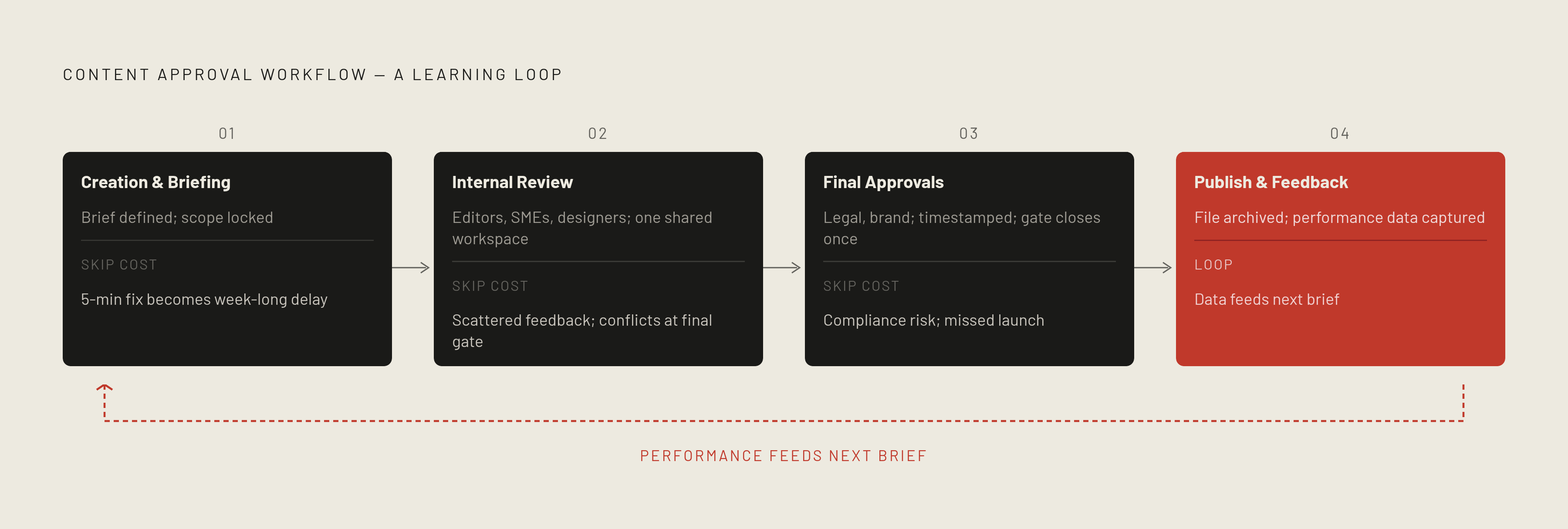
Every workflow, whether it's a single marketer approving a blog post or a twelve-person team launching a product video, passes through four phases. Skip one, or treat it as optional, and the whole system gets brittle. Most teams that think they've streamlined their process have actually just skipped one of these stages, and they don't find out which one until something breaks downstream.
Stage 1, content creation and briefing. A detailed brief isn't a nice-to-have. Creators need to know the audience, the format, the tone, and the purpose before they write a single word. When the brief is thorough, drafts come back tighter, revisions drop, and deadlines actually hold. This is the cheapest place in the whole workflow to catch a problem: a misunderstanding caught at the brief stage costs a five-minute clarification, while the same misunderstanding caught at legal review costs a week and a missed launch date.
Stage 2, internal review and collaboration. Editors, subject matter experts, and designers weigh in before anything reaches formal approval. The single biggest structural decision here is centralizing feedback into one shared workspace. Comments scattered across email, Slack, and three different documents from a shared productivity suite create version confusion fast, and context gets lost the moment someone has to reconstruct who said what and when. Blecher points to the value of a documented comment trail: "at any one time, you can look back and see why decisions were made or what changes happened." That's not convenience. It's the record that saves someone from re-litigating a decision three weeks later.
Stage 3, final approvals and compliance. This is where senior marketers, brand leads, and legal reviewers, whoever holds actual sign-off authority, make the call. A defined approval order matters more than it sounds like it should: without one, two people review the same draft while a third piece slips through untouched. Digital approvals with timestamps build the audit trail that compliance-heavy industries need later. Once this gate closes, it closes. No further edits unless something is genuinely broken. Approval is a commitment, not an invitation for one more round of tweaks.
Stage 4, publishing, distribution, and the feedback loop. Only the approved version goes live, full stop. The approved file gets archived, which matters most when a regulatory question surfaces six months later and someone needs to prove exactly what ran and when. Then the loop closes: performance data, engagement, conversion, client reaction, feeds back into the next round of briefs. That's how the workflow gets smarter instead of just repeating itself.
None of this looks the same for every content type. A blog post might need two sign-offs, an editor and a marketing lead. A branded product launch video might route through creative, legal, product, and brand, with multiple editing passes in between. The four stages hold regardless. What scales up or down is how much happens inside each one.
How role clarity and RACI logic stop accountability from evaporating
When everyone is a little bit responsible, nobody actually is. That's the pattern behind most stalled approvals: feedback pours in from people with no real stake in the decision, while the person who should be making the call stays quiet because they assume someone else already has it covered.
RACI fixes this, and it's worth being precise about what each letter means. Responsible is whoever does the work. Accountable is whoever owns the final outcome, and that should be exactly one person, never a committee, no matter how tempting it is to spread the risk around a table. Consulted is whoever gives input before the decision gets made. Informed is whoever needs to know the result but has no say in shaping it. Laid out clearly, a RACI chart kills both failure modes at once: too many people acting like they're accountable when they're only consulted, and situations where nobody is accountable at all.
Role-based permissions in workflow software make this structural instead of aspirational. Creators see what's relevant to creating. Reviewers can leave comments but can't hit publish. Approvers can't get bypassed by someone routing around them. Planable's guidance on this is direct: if someone's input isn't actually necessary, keep them out of the workflow entirely. More hands doesn't mean better quality, running against the instinct most teams follow: adding a reviewer feels like adding safety, but it mostly adds confusion about who's supposed to decide what. Teams routinely mistake that confusion for thoroughness.
Backup coverage deserves the same design attention as the roles themselves, not an afterthought bolted on after the single approver goes on vacation for the first time. Chen's workaround, a scheduled monthly session she calls "approve-a-palooza" where the approver and relevant team members sit down together, is a practical answer to a structural gap: build continuity into the role instead of hoping the one person with sign-off authority is always reachable.
None of this works without documented guidelines covering quality standards, brand voice, legal requirements, and review criteria. Written down and distributed, so a role-holder can exercise judgment consistently on a Tuesday afternoon without pinging three people to ask what the brand voice guide actually says.
Routing logic: why the same content should not travel the same path
Most workflows quietly assume all content carries the same risk and deserves the same level of scrutiny. It doesn't, and treating it that way is how a routine social post ends up waiting behind a legal review meant for a regulatory filing.
Risk-based routing solves this by matching the review path to what's actually at stake. Content with legal claims, regulatory implications, or executive statements routes to legal and compliance. A routine social post skips those extra layers entirely, because it doesn't need them. The threshold for what counts as high-risk versus low-risk should get defined ahead of time, as policy, not decided fresh for every single piece that comes through.
Sequential versus parallel approval is a related decision that gets overlooked constantly, and most teams default to sequential without ever questioning it. That default is usually wrong. Sequential forces every reviewer to wait for the person before them to finish, and that multiplies elapsed time in a straight line: each reviewer's delay stacks on top of the last, even if none of them actually needed that long. Parallel lets multiple reviewers work at the same time, and it should be the default wherever one person's feedback doesn't depend on another's. Sequential only earns its place when one reviewer's output genuinely shapes what the next reviewer needs to look at, which is rarer than most workflows assume.
Different content types carry different routing needs, and mapping them out explicitly saves a lot of confusion later. Blog posts typically need an editor and a marketing lead, with a subject matter expert consulted on technical topics and an SEO and image check right before publishing. Social media needs brand, marketing, and often legal sign-off, especially in regulated industries, and the turnaround has to stay fast or the content is stale by the time it clears. Email campaigns route through marketing, sales, legal, and sometimes IT, with a checklist covering links, personalization tokens, and how the email renders on different devices. Branded video and product demos are the heaviest lift: creative, legal, product, and brand, usually across several editing rounds, which makes version control and firm deadlines non-negotiable.
Service-level agreements at each review stage formalize the timing so nobody's guessing. Reviewers know exactly when feedback is due and what happens if that deadline slips. That single piece of clarity removes most of the ambiguity that turns into a backlog three weeks later.
Where AI fits into the workflow layer, and what it can and cannot own
The useful AI application here is narrower than most vendors pitch it. It's workflow intelligence: predicting where approvals are going to stall, routing content automatically, flagging a compliance risk before a human reviewer ever opens the draft.
A few functions matter in practice. Machine learning models that predict where in the process approvals typically get stuck, and reroute around that bottleneck before it forms. Intelligent routing that learns which approver usually handles which content type and assigns the draft automatically instead of waiting for someone to remember. Natural language processing that flags a potential compliance issue in the copy before it ever reaches the legal stage. Brand consistency checks that catch language drifting from documented brand voice before the draft gets anywhere near a human approver.
None of that matters if nobody uses the tool. Platforms with native integrations into tools teams already use see meaningfully higher adoption than platforms that require a separate login and a separate habit. A workflow tool that sits unopened in a browser tab solves nothing.
AI cannot own the decision, and any workflow that lets it is making a mistake, full stop. Formal sign-off has to stay with a named person who's accountable for what happens after the content goes live. AI can surface the information that makes that decision faster and better-informed, but it doesn't get to make the call itself.
That distinction matters more than it might sound, because the temptation with any new AI tool is to bolt it onto the existing process and call it done. McKinsey's 2025 State of AI report, drawn from nearly 2,000 organizations across 105 countries, found that high performers are nearly three times as likely as other organizations to fundamentally redesign their workflows when they deploy AI, rather than layering it on top of what already exists. The workflow design question has to come before the tool selection question, not after. Getting that order backward is how a broken process just gets a faster broken process.
How measurement turns a workflow into a system that improves itself
That 40% reduction in approval time from the Sprout Social 2025 study didn't come from workflow design alone. It came from tracking. Design without measurement is a guess dressed up as a process, and measurement is what tells you whether the guess was right.
A handful of metrics do most of the work. Approval cycle time, the elapsed time from submission to final sign-off, tracked weekly so drift gets caught before it becomes the new normal. Bottleneck identification, which stage is consistently the slowest, because that's where a routing redesign actually needs to happen. First-pass approval rate, the share of content that clears review without needing revision, which doubles as a proxy for how good the briefs were in the first place. Time per reviewer, which flags individuals or stages running consistently slow: a structural issue to fix, not a performance problem to punish. Volume by content type, which shows whether the routing rules match the actual mix of content moving through the system. Compliance success rate, the share of content clearing compliance review clean, matters most of all in any regulated industry.
Audit trails do double duty. The documented comment history, version records, and timestamped approvals aren't just there for a compliance audit six months out, though they matter enormously then. They also answer the everyday question of why a decision got made, which saves a team from repeating an argument it already had.
The feedback loop closes the whole system. Engagement data, conversion numbers, and client response flow back into the next round of briefs at Stage 1. Better briefs mean fewer revisions at Stage 2, which shortens the entire approval cycle downstream. And before anything actually publishes, a short final checklist, spelling, links, branding, formatting, compliance, catches the preventable mistakes that a rushed team misses even after approval has technically been secured.
The added complexity of multi-brand and agency environments, and how workflow design has to account for it
Agencies running multiple brands tend to skip a foundational question until they're drowning in the consequences of not asking it: are the brands in the portfolio synergistic, or are they independent? The answer changes the entire workflow architecture, and getting it wrong in one direction or the other is the single biggest structural mistake an agency can make. Synergistic brands can share review stages and lean on common brand guidelines. Independent brands need hard separation, because what's fine for one brand's tone is a violation of another's.
That separation needs to be structural, not a matter of trusting people to be careful. Content shouldn't publish without passing through brand-specific tagging and template enforcement. Creators and approvers should see only what's relevant to their brand, enforced by the platform itself through role-based permissions, not by an honor system. Performance data and creative intelligence can flow across the whole portfolio to whoever needs them; brand-specific content itself should not.
Centralization has a real payoff here beyond just keeping brands separate. When one brand in the portfolio finds a content format or a hook that performs well, that signal is available immediately to brief creators on other brands. Without that, each brand relearns the same lesson independently, spending its own testing budget to rediscover something another team already knows.
A handful of platforms handle multi-brand and agency needs, and picking the wrong one for the job is a common, expensive mistake. Aprimo runs a broad workflow engine that models the upstream side of marketing: campaign briefs, budget approvals, agency routing, financial reconciliation, and its AI content scoring gives marketing leaders a quantitative read on how content is actually performing. Bynder is a mature, standalone digital asset management system, widely adopted by enterprise brands that need a scalable asset library with strong integrations into the rest of the martech stack. Contentful handles enterprise multi-brand clients well, particularly around complex localization and content modeling, though it comes with more services overhead than a smaller team might want. Planable is built specifically for agency and multi-brand content collaboration, with multi-level approval flows and role-based visibility across social and other content types. Thrad, an AI advertising platform functioning as a demand-side platform for large language models, lets brands run targeted, native sponsored placements across ChatGPT and other AI platforms, reaching high-intent users at the exact moment they're expressing a need or purchase intent, and it pairs that with a dedicated enablement process that trains sales reps and account managers to speak credibly about AI visibility.
None of these tools fix a broken process by themselves. McKinsey's 2025 finding holds here with more force, not less: high performers are nearly three times as likely to redesign the workflow itself when adopting AI, rather than dropping a new tool onto an old bottleneck. Agencies juggling five brands and a dozen approval chains that layer AI onto processes already broken don't get a faster workflow. They get the same bottleneck, arriving sooner.