Content Strategy Ownership for Marketing Leaders
Most companies document strategy without actually owning it.

Content strategy stopped being a marketing team's side project years ago; it's now a line item boards ask about directly. Here's the uncomfortable claim: most companies that say they "have" a content strategy don't actually own one, and the gap between those two states is where nearly every failed content program goes to die quietly. Measurement is the tell that separates the two, and the sections below build toward why documentation without a decision-maker is just expensive paperwork.
How accountability for content strategy gets lost across teams and agencies
Research from Valuable Content lays out three common homes for content strategy inside a company: buried in marketing or communications as one function among many, run by a senior subject-matter expert who works alongside marketing rather than under it, or handed to an editor-in-chief, often a former journalist, who runs it like a newsroom. All three look fine on an org chart, yet each has its own quiet way of letting accountability evaporate, and that's the part worth sitting with rather than the labels themselves.
Take the arrangement that sounds like clean ownership: one person responsible for all content types, no committee, no confusion about who signs off. That's a single point of failure wearing a nicer outfit. If that person leaves, gets pulled onto another project, or just burns out, the "ownership" disappears with them, because it was never built into a structure that could survive one person's absence. Ownership that can't survive a two-week vacation was already a bottleneck with a job title.
Then there's the agency trap, and it's sneakier than it looks. Hand strategy to an agency alongside production, and the marketing leader keeps the title and the box on the org chart, but loses the thing that actually makes authority mean anything: the accumulated, unglamorous knowledge of what's worked, what audiences respond to, why certain calls got made the way they did. The leader still signs off on things but no longer fully knows why, which is a strange place to sit for someone whose name is on the strategy.
Enterprise companies get their own version of this, worth naming because it cuts against the instinct to blame "too much content." The real issue is usually departments, brands, and regional teams operating with no coordination between them, none of them talking to the others, each one convinced their silo is the responsible one. Diffuse accountability is a structural root of underperformance, and it turns up everywhere else in this piece.
Why having a documented strategy isn't the same as owning one
Nearly every B2B marketer now operates from some kind of documented content marketing strategy, per the Content Marketing Institute, the highest adoption rate in the sixteen years CMI has tracked this. Everyone has the binder, and that part isn't in dispute.
What's in dispute is whether the binder does anything. Barely over one in five B2B marketers describe their content marketing as extremely or very successful; the rest land somewhere between moderately successful and not at all. Near-universal documentation hasn't moved that needle nearly as much as anyone hoped, which should bother people more than it seems to.
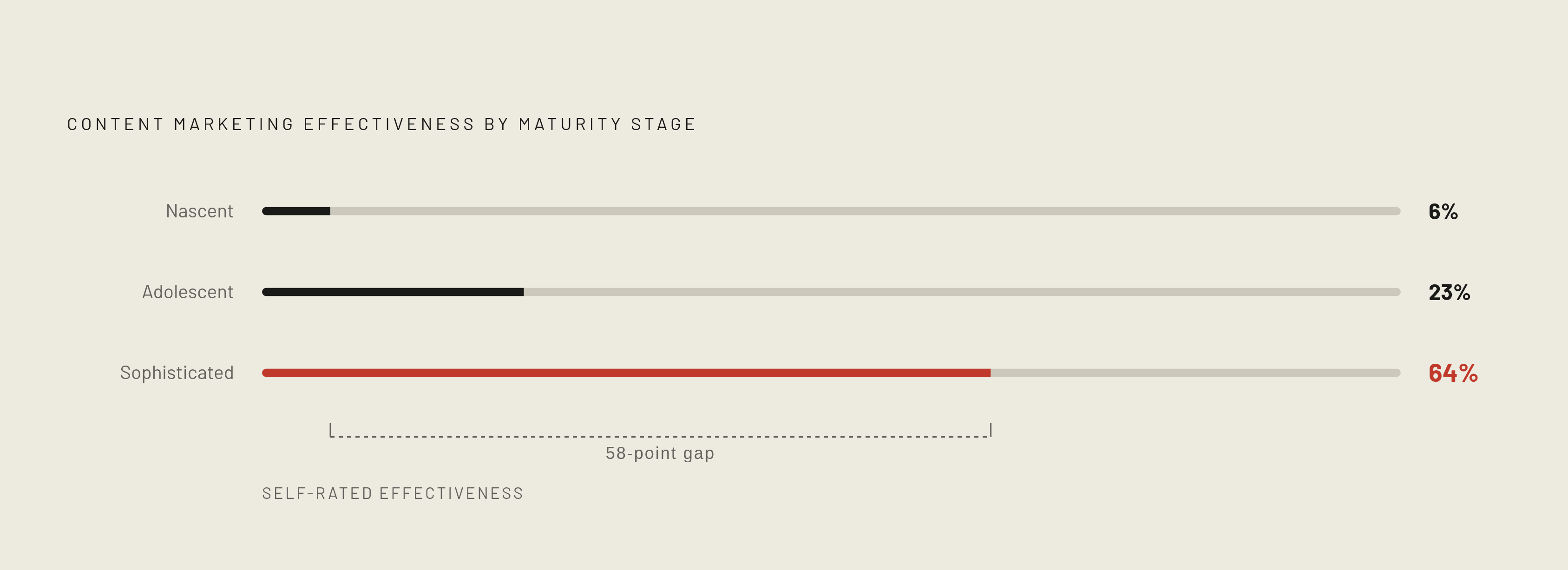
Here's the number that actually explains the whole section: teams in the earliest stage of content marketing maturity rate their own effectiveness at just 6%. Teams in an "adolescent" stage land at 23%, while sophisticated, mature programs hit 64%, nearly a sixty-point spread from bottom to top. That gap has almost nothing to do with whether a document exists and everything to do with repeatable systems, shared definitions of success, and strategic thinking embedded in daily decisions rather than filed away for reference.
CMI and MarketingProfs research on top-performing B2B marketers makes this concrete in a way that should reorder anyone's assumptions. Top performers set goals aligned with organizational objectives (68%), measure and demonstrate content performance effectively (61%), show real thought leadership (60%), collaborate across functions (55%), and yes, have a documented strategy (53%), which ranks dead last of the five. That ordering is the whole argument in miniature. A strategy document records decisions a leader already made somewhere else, and the document itself never made a single one of them, no matter how nicely it's formatted.
Measurement as the clearest test of whether a leader actually owns the strategy
Most marketers cannot quantitatively demonstrate the impact of their marketing, according to Siteimprove, and that single fact probably explains more failed content programs than anything else in this piece. If a leader can't show what content actually did in dollars, in pipeline, in something a CFO recognizes as real, then "ownership" is just a word sitting on an org chart.
What gets measured tells you what a leader is actually accountable for. The overwhelming majority of content teams track traffic, while a small minority track revenue attribution. That's not a modest gap, it's a wide and consistent one, and it maps neatly onto the difference between the metric that's easy to pull and the metric the business actually cares about. Traffic measures how many people showed up, while revenue attribution measures how many of them bought something. Most teams are still counting the former and calling it strategy.
Teams that can prove ROI to leadership get meaningfully larger budget increases than teams that can't. That's the whole mechanism, right there: build the tracking, and the money follows. Skip it, and next year's budget conversation starts from "trust us," which is not a strong place to negotiate from, no matter how good the content actually is.
There's also a patience dividend worth naming. Businesses that blog consistently report far higher positive ROI than those that publish sporadically. Consistency beats volume, and quality over quantity is a decision a leader has to make and defend out loud, not an accident that happens when a team gets tired of writing so much.
Genuine measurement ownership looks specific. A leader decides which business outcomes content needs to move, picks metrics that track those outcomes honestly instead of the ones that are easiest to screenshot, and holds the team to them. A leader who receives a monthly traffic report and nods along is not meeting that bar, no matter how many years they've been nodding. The only real question left is whether the tracking infrastructure got built early enough to capture the return, or whether the team is still waiting for the traffic numbers to explain themselves, which they never do on their own.
What the CMO's role in content leadership actually requires in practice
A 2026 study of 400 leaders at venture-backed startups and billion-dollar tech companies found that 40% of CMOs name thought leadership as their primary growth lever, ahead of strategic partnerships at 38% and AI integration into core proposition and communications at 33%. Thought leadership beat AI, which is worth sitting with for a second, given how much attention AI takes up in every marketing conversation right now.
This is a task that demands the CMO's personal, sustained involvement rather than a checkmark handed off to a content team. It requires the CMO personally to be the named, credible voice: the byline that's real, the face that shows up answering comments. AI drafts a paragraph well enough, but it cannot substitute for the specific, vetted expertise readers are looking for when they click on something under a real person's name. Content published under a generic department byline rarely earns that same trust, no matter how well it's edited.
Editorial oversight belongs to the CMO too, and it's a different job than most descriptions capture. Owning a flagship research report, the "State of the Industry" piece, setting the actual logic behind the editorial calendar instead of rubber-stamping whatever's already on it, deciding what the brand will and won't say in public: these are judgment calls, and nobody delegates a judgment call and keeps ownership of it. That's not how judgment works.
Flat budgets, oddly enough, might be doing marketing leaders a favor. A CMO who actually owns their content strategy uses budget pressure as a forcing function: cut this, double down on that, based on a clear read of what's working and what's dead weight. Without that ownership, cuts happen arbitrarily, and the leader hopes nothing important got trimmed in the process, which is less a strategy than a guess.
A majority of tech CMOs are already rethinking their approach to optimize for AI-driven discovery as traditional search performance erodes. That's a real pivot, and it only works with genuine ownership behind it, because it means reallocating budget, changing formats, and redefining what success looks like, all at once rather than one tidy step at a time. That pivot raises the underlying question plainly: if AI can produce unlimited content, the strategic value of having a content strategy becomes the entire question worth asking. Answering it is a leadership act, one that a platform can support but cannot produce on its own.
How AI raises the governance stakes for marketing leaders
CMOs are directing a growing share of marketing budgets toward AI initiatives, big enough to deserve the same scrutiny and ownership discipline as any other major line item, even though new technology tends to get looser oversight by default, simply because it's new and everyone's excited about it.
The gap between AI ambition and actual capability is exactly the kind of thing that gets papered over with enthusiasm instead of governance, and enthusiasm doesn't hold up well under audit.
So where is AI actually delivering results right now? Broadly, operational gains — but notice what tends to be missing: little about strategy, positioning, or audience insight. These are operational wins that show up on a time-tracking dashboard, a long way short of the kind that show up in a competitive strategy memo.
A lot of teams have switched AI tools on before deciding what they're actually for, which is another way of saying adoption has outpaced strategic integration. That's the wrong order of operations, and it tends to show.
Here's the governance trap, stated plainly: investment in AI tooling is rising while human editorial capacity often gets left behind. The implied bet is that a platform can substitute for senior judgment, and that asks more of the technology than it can deliver. AI at real scale only improves outcomes when it's tied to an actual creative strategy, real data governance, and cross-functional alignment. Strip those away, and AI just makes it possible to produce more content, faster, without making any of it smarter.
The leader's job is to set the actual rules: where AI use gets disclosed, where human editorial judgment stays non-negotiable no matter how good the model gets, how AI tools get configured so they reinforce brand positioning instead of slowly eroding it into something generic. The goal, in practice, is to have speed and quality reinforce each other by design instead of by chance.
Building the cross-functional structure that makes ownership sustainable
A recurring execution bottleneck for B2B companies is the absence of a scalable content creation model, and most organizations simply don't have the infrastructure to sustain ownership over time, even when a leader genuinely wants to hold it. Most organizations simply don't have the infrastructure to sustain ownership over time, even when a leader genuinely wants to hold it. Wanting to own the strategy and being structurally able to are two different problems, and companies routinely solve for the first while ignoring the second.
Content governance has to be an executive mandate, treated with more weight than a hopeful suggestion floated by the marketing team in a deck nobody reads twice. Siloed departments operating on their own timelines are the single most common structural barrier here, and unifying them takes someone with real executive authority willing to say, out loud, that alignment matters more than any one team's autonomy. That's not a popular thing to announce in a meeting, but it's necessary anyway, and popularity was never the point.
Cross-functional challenges keep recurring: getting departments to collaborate instead of working in isolation, aligning content with sales objectives, and building a real strategy rather than a loose publishing calendar. Every one of those is a coordination problem, and coordination problems only get solved by someone with the authority to make different teams answer to the same plan. No amount of goodwill substitutes for that authority.
So what does genuine ownership actually look like, structurally? Picture a single accountable leader, not a committee, with real authority over strategic decisions and framework design, backed by a documented strategy that names business outcomes rather than just content types or publishing cadence. Add shared definitions of success across marketing, sales, and product, so content doesn't quietly get optimized for a metric nobody outside marketing cares about, plus editorial governance covering brand voice, AI use, and quality standards that functions as an actual decision framework rather than a style guide gathering dust in a shared drive. None of that works without measurement infrastructure that connects content activity to revenue, not just to page views.
Agencies fit somewhere in this picture, but the relationship needs redefining, and this is where a lot of companies get the split wrong. Agencies execute well; that's what they're built for. What they can't do is own the strategic framework, the deep audience understanding, or the accountability for business outcomes, because those things require sitting inside the company and watching how decisions actually play out over quarters, not campaigns. Speed and quality aren't a tradeoff in a well-built structure like this, since the real constraint is almost always strategic clarity upstream, not how fast the production team downstream can move.
What marketing leaders who genuinely own their content strategy do differently
No framework or audit checklist substitutes for the actual leadership decision to hold accountability. That said, the data points fairly clearly toward specific behaviors that separate top performers from everyone stuck in the middle.
Top performers set goals at the organizational level before they set them at the content level. The 68% who align content goals with the company's broader objectives first build content programs to serve those goals, rather than working backward from whatever content already exists. They treat measurement as a strategic asset that informs decisions rather than a box checked for a monthly report; the 61% who measure and demonstrate content performance effectively are the same ones earning the larger budgets, because proving impact and getting funded turn out to be the same underlying skill.
They show up personally in thought leadership instead of just approving it from a distance, with 60% of top performers naming this as a defining practice. It demands the leader's own time, credibility, and point of view, well beyond a ghostwritten post with their name stapled to the top. They build real collaboration structures connecting content to sales, product, and customer success, with 55% naming cross-functional collaboration as central to how they operate. And they treat the documented strategy as something alive, revisited when business conditions shift and updated the moment measurement reveals a misalignment, rather than something filed away until next year's planning cycle rolls around.
The payoff for getting this right isn't subtle. Organizations with documented, actively owned strategies generate several times more leads per dollar spent than those without, and report meaningfully higher ROI. That gap is the difference between a content program that pays for itself and one that quietly drains budget while everyone waits for it to turn a corner it was never built to turn.
The real question for any marketing leader isn't whether a content strategy exists somewhere in a shared folder. It's whether anyone actually owns it: whether someone can point to the decisions made, the accountability held, and the outcomes proven, in numbers a CFO would accept without raising an eyebrow. Everything else is documentation without a decision-maker standing behind it.