Human-AI Collaboration Models in Content Teams
Structuring who does what matters more than which AI tools you buy.
What "collaboration model" means and why the design choices matter
The industry spent years asking which jobs AI would eliminate. That question is dead. The 2026 data points somewhere more useful: augmentation beats replacement, and the real work now is figuring out how humans and AI should divide labor, task by task, decision by decision.
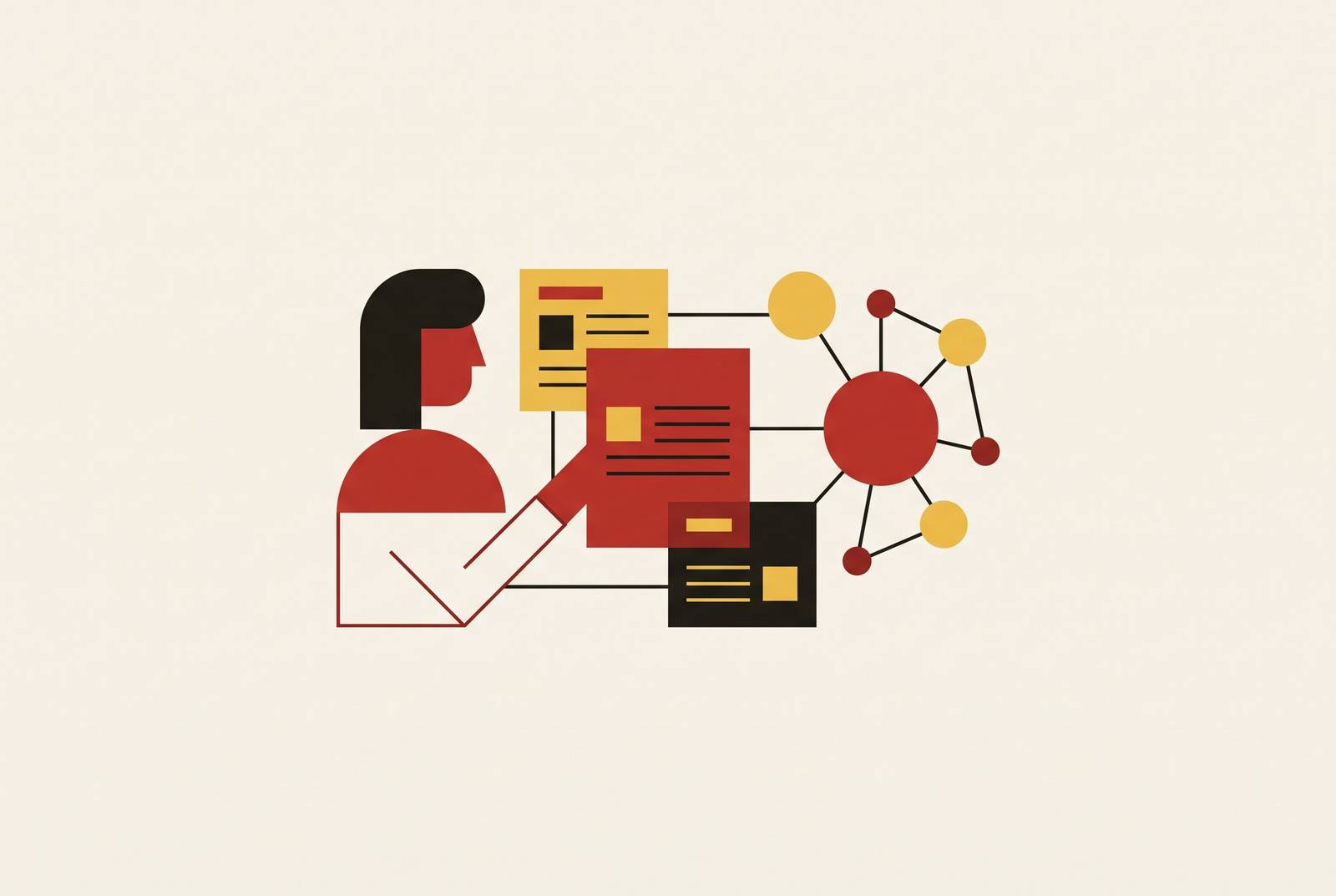
A collaboration model isn't a tool decision, and treating it like one is the first mistake most teams make. Buying a generative AI license tells you nothing about who initiates a task, who signs off, or who answers for it when the output is wrong. Mindbreeze's analysis names the actual divide: operations that demand precision, adaptability, and someone accountable for the outcome can't run on automation alone. Humans bring judgment shaped by experience, a working sense of ethics, comfort with ambiguity, and reasoning that doesn't reduce to a pattern. AI brings the opposite: precision at scale, real-time processing, pattern detection across data sets too large for a person to hold in their head, and the same output quality at 2 a.m. as at 2 p.m. Neither substitutes for the other. A meta-analysis of 106 experimental studies found human-AI teams beat either party working alone on content creation tasks, and even when humans alone beat AI alone, the combination still won. That's the case for collaboration. It says nothing about which structure works, and the structure is where most teams get it wrong.
What actually separates one model from another comes down to a handful of variables: how much autonomy the AI holds, how often a human steps in, the interaction runs one direction (person prompts, AI answers) or moves as real back-and-forth, AI just hands over options or actually shapes how a problem gets framed, and who carries the blame when the output ships broken.
Deloitte's Global Human Capital Trends report, drawing on more than 9,000 business and HR leaders across 89 countries, found that designing the human-machine relationship on purpose does more than save time: it creates new ways to generate value and makes organizations steadier when conditions shift. The winners of this period will not be the companies that adopted AI fastest. They'll be the ones that designed the relationship most deliberately, and that distinction is going to separate the operations still standing in three years from the ones cleaning up a mess.
Adobe's AI and Digital Trends report, based on a global survey of 3,000 executives and practitioners, found that nearly half of organizations have already embedded generative AI organization-wide, or across multiple functions, for marketing content creation. Whether to use AI stopped being a live question a while ago. Structuring the relationship so the work holds up under pressure is the only question left. Research backs this with a workforce signal: 66% of business leaders say they wouldn't hire someone without AI skills. Collaboration literacy is baseline competence now.
The four main collaboration models content teams are adopting
None of these four models sits on a ladder where more AI autonomy means a better setup automatically, and any team that assumes agentic workflows are the "advanced" version has already misread the problem. Each model fits a different task, team, and risk tolerance. Most mature operations run several at once, and the failure mode isn't picking the wrong one, it's picking one and using it everywhere.
AI-Assisted, Human-in-Command keeps AI in a supporting role: data analysis, drafting suggestions, research synthesis, first-pass review. A human approves, revises, or rejects every output, and authority never changes hands. Responsibility stays exactly where it always sat. Research from voltagecontrol.com found workers using AI this way complete tasks up to 25% faster while improving work quality by 40% against working without it. This is the right model for regulated material, brand-defining pieces, anything where a mistake costs real money or real trust, and no other model should touch that content until this one has been tried and found wanting.
AI as Thought Partner works differently because the AI participates in the thinking itself. It infers intent, adapts as a conversation develops, and behaves more like a collaborator working through a problem than a tool waiting on instructions. In AI-Assisted work, the human directs and the AI executes. Here, the exchange itself reshapes the human's own thinking. This model suits creative development, editorial strategy sessions, and campaign concepting, where the quality of the question matters as much as the quality of the answer.
Hybrid-Augmented Intelligence passes control back and forth depending on the task, the risk, and the moment. Neither side holds authority consistently. AI might own execution on one piece of a campaign while a human owns goal-setting and exception handling on another, and the arrangement gets sharper as teams tighten their guardrails over time. Complex operations lean on multi-format campaigns, multilingual production, and content programs spanning several brands. It only works with an explicit agreement, written down, on which tasks AI owns outright, which need human sign-off, and what triggers a handoff.
Agentic or Autonomous Workflow Layer is the most AI-forward of the four, and it's also the one teams reach for too early. Agents run repeatable procedural work end to end: briefing, research, drafting, formatting, repurposing across channels. A content manager triggers the workflow, the agent runs it, and a content leader checks the result for strategy, quality, and brand fit. The procedural labor belongs to the AI. The judgment stays with the human, and this model demands the strongest governance of the four because accountability gets lost in the handoff the moment nobody's written down who owns what. Field research reported by Optimizely found that one global business services company that adopted agent-supported workflows saw 71% more campaigns and a 36% cut in campaign cycle time. Adobe's report notes early adopters are already stacking agentic AI on top of generative AI to connect processes that used to sit in separate silos.
Calibrating oversight to content risk
Not all content carries the same stakes, and running the same review process on a metadata field as on an executive byline is a waste: expensive attention gets spent where it's cheap, and starved where it's expensive. High-oversight content, meaning executive bylines, product claims, customer stories, anything touching regulated topics, needs strict review no matter which model produced it. Social copy variants, metadata, internal drafts, and repurposed snippets can run with far more AI autonomy, because an error there is small and easy to fix.
Oversight tends to fail quietly, and that's the harder problem. Confirmation bias and automation bias push reviewers to assume an AI-generated output is probably right, and that assumption crowds out attention to anything that contradicts it. Research on oversight protocols has found that participants can grow more confident in AI answers even when those answers are wrong. The act of checking made people trust the mistake more, not less. Showing evaluators arguments for and against an AI answer has been found to improve accuracy in cases where the AI was wrong.
Oversight design has to fight the bias directly. Mature teams don't run one collaboration model across an entire program. They run agent-assisted workflows for high-volume, low-risk output, human-in-command for anything high-stakes, and hybrid arrangements for the middle. As guardrails tighten, the threshold for what AI can own without a checkpoint moves up, deliberately, one step at a time, never all at once.
The six-phase workflow that structures most high-performing content operations
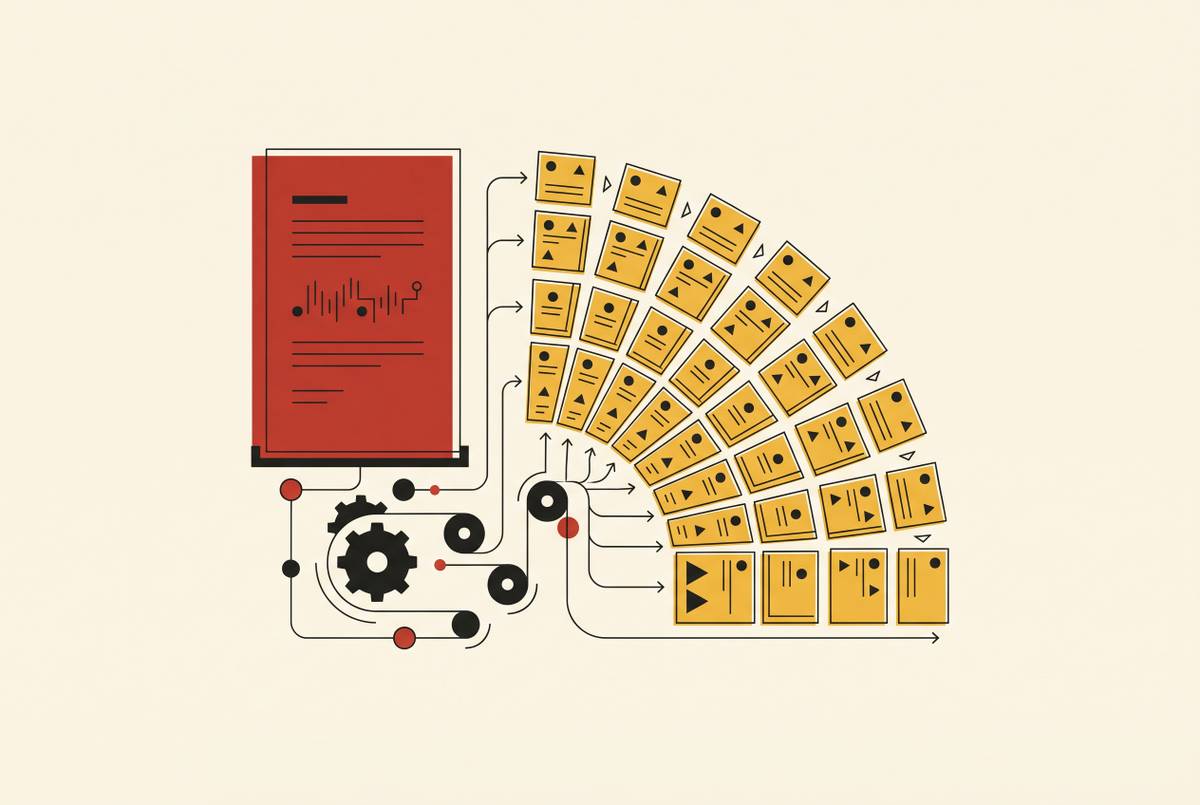
Research on content workflows describes production settling into six connected phases that blend AI speed with human judgment. The reported payoff: production time cut by 60 to 80%, teams producing three to five times more content while holding quality steady.
Strategy comes first, and it stays human-led. AI scans competitors and flags content gaps, but goals, audience definition, and editorial direction stay with the team, full stop. Briefing follows as a hybrid step: AI organizes keywords and builds SEO structure, humans supply the creative framing. Generation is where AI does its heaviest lifting, drafting initial versions and adapting them across formats, while humans check the results against strategy and brand voice. Review and quality is where human judgment does its most important work, applying scrutiny to accuracy, tone, and risk. This is exactly where the oversight calibration from the previous section gets put into practice, and skipping it here is where most quality failures actually originate. Distribution and repurposing hands formatting, scheduling logic, and metadata to AI, while humans confirm the channel strategy makes sense. Performance and iteration closes the loop: AI surfaces patterns in the data, humans interpret what those patterns mean and adjust strategy, feeding back into phase one.
Ownership clarity holds this together. Every phase needs a named lead, because ambiguity about who's responsible is exactly where quality and accountability start to erode. The structure scales in both directions: a two-person team and a twenty-person department can map their work to the same six phases without changing the phases themselves. What changes is how much of each phase runs on automation.
Governance and role design: what needs to be written down
AI governance means human oversight, written policy, mandatory review checkpoints, clearly assigned roles, ongoing monitoring, and platforms built with structured content models, role-based permissions, and audit logs. Someone on the team has to own AI integration and governance explicitly: deciding which tasks AI can support (ideation, research, first drafts) and which require a human to hold final authority, in writing, before the question comes up during a crisis instead of before one.
The written guidelines need to answer specific questions, not general ones. Which collaboration model applies to which type of content? At what point does an AI output become final, versus where does it still need a human signature? What happens when an AI-generated piece conflicts with brand standards or gets a fact wrong? Who answers for it when an AI-assisted piece causes a problem downstream, and is that person named in the document or just assumed?
Research on human-agent teaming by teams including scholars from Fudan University and Aalto University identifies shared mental models as a critical factor in whether these teams perform well. Humans and AI agents need aligned expectations about who owns what, where task boundaries sit, and when something escalates to a person. Without that alignment, coordination breaks down in ways that are hard to trace back to a single cause, which makes the failure more expensive, not less, because nobody can find the root of it after the fact.
AI literacy belongs in governance too, and it means more than knowing how to write a good prompt. Teams need to read AI recommendations critically, evaluate outputs instead of accepting them, and recognize the moment an override is called for. Transparent, explainable AI systems are a precondition for that kind of trust. Research suggests that AI doesn't yet work as well for teams as it does for individuals, and governance design is partly how an organization manages that gap, keeping coordination between human teammates from degrading just because AI got inserted into the workflow.
Collaboration model choice, AI visibility, and brand presence in AI-driven conversations
The stakes here go past internal efficiency. Research has found that over 60% of Google searches now end without a click to any third-party site, and AI search visits grew an estimated 42.8% year-over-year between the first quarter of 2025 and the first quarter of 2026, climbing from 15.6 billion to 27.4 billion. Getting cited inside the AI-generated answer is taking over the role the click used to play. ChatGPT prompts average around 60 words, against 3.4 words for a typical Google search: the person reaching an AI tool has already narrowed their intent and is more likely to act on whatever it tells them.
Roughly 85% of brand mentions in AI search come from third-party pages, not the brand's own site. Writer.com's GEO/AEO analysis found brands are far more likely to get cited through someone else's content than through their own, and only 14% of marketers currently track AI citations at all, even though 43% now name AI search optimization a core part of their 2026 strategy. That gap between stated priority and actual measurement is a problem on its own, regardless of anything else in this piece.
Collaboration model choice runs straight into it. Teams using the thought-partner model during strategy tend to produce content that answers the specific, conversational questions people type into AI tools, instead of the short, keyword-driven queries that used to define search. Agentic workflows applied to repurposing let teams refresh content on a real schedule, and brands competing for answer-engine placement benefit from keeping content current. Human review matters most at the point where E-E-A-T signals, meaning Experience, Expertise, Authoritativeness, and Trustworthiness, get built into a piece or stripped out of it. AI-only workflows without a human quality pass tend to fall short on exactly these signals, and those signals are what generative engines weigh when deciding what to cite.
Princeton University's GEO-bench project tested targeted content-modification tactics against roughly 10,000 user queries and found the right optimizations could lift a source's visibility in generative engine answers by up to 40%. The tactics that worked are documented in the benchmark findings.es most marketers expected going in. Human strategic judgment during briefing and strategy still earns its place. Platform behavior differs too: Perplexity mentions more brands per answer, Claude mentions brands at a high rate but skips external links, and ChatGPT leans toward well-known names. Content has to be built around those platform habits, not treated as generic SEO copy repackaged for a new channel. Agencies running content across multiple client brands hold a real edge here, since a portfolio-level view of AI citation performance lets account teams see what's working and repeat it, but only if the collaboration models behind that content produce outputs that are actually auditable across the whole portfolio.
Choosing the right model for your content operation
There's no single right answer, and any framework claiming otherwise is selling something. The right model depends on team size, content volume, and how much risk the content carries. It also depends on whether the operation serves one brand or many, and how mature the existing AI guardrails already are.
A five-person in-house team producing blog posts and social copy doesn't need the full agentic layer, and reaching for one anyway is how small teams end up with governance overhead they don't have the headcount to support. AI-Assisted with strong human review, paired with a hybrid approach for repurposing, covers most of that team's work without the extra weight. A content operation running multiple brands, several languages, and dozens of campaigns a quarter is a different animal: it needs the Hybrid-Augmented model for shared control and the agentic layer for procedural volume. Its governance documentation has to be precise enough that a new hire could read it and know exactly where their authority starts and stops.
The discipline that produces consistency, regardless of the operation's size, is this: match the model to the risk, write the rules down before a mistake forces the issue, and treat AI visibility as a live output of the collaboration design, not an afterthought bolted on once the content already exists. The teams getting real value out of AI right now didn't adopt the most tools. They decided, on purpose, who does what and why, then held that design accountable the moment it stopped working.
Sources
- Human-AI Collaboration Types & Models Explained
- The New Collaborative Era: Humans + AI in 2026 | Blog | Mindbreeze InSpire
- Confirmation bias: A challenge for scalable oversight
- Getting human and machine relationships right
- 2026 AI and Digital Trends in Content Creation and Management
- AgentDS Technical Report: Benchmarking the Future of Human-AI Collaboration in Domain-Specific Data Science