AI Answer Engine Visibility Measurement for B2B Brands
Track mentions, citations, accuracy and share of voice across engines.

AI answer engine visibility measurement gives B2B brands a way to understand whether they appear in buyers’ research before a website visit ever happens. The discipline needs more than referral counts. It needs separate measures of mentions, citations, accuracy and competitive presence, collected through repeatable tests and connected to commercial outcomes.
Why AI answer engines have become a measurable part of the B2B buyer journey
B2B buyers use AI answers to find vendors and build shortlists. That puts part of the research process outside the channels a brand can directly observe through its website, ads or sales team. A brand absent from those answers is absent from that part of the buyer’s consideration. The gap opens before a visit is possible. For a team responsible for demand, the question is therefore not just whether AI sends traffic, but whether it includes the brand when buyers explore the category.
Classic web analytics and SEO tools were built around a different set of events, including clicks, impressions and positions in link-based search results. Those events remain useful, but they do not reveal whether an answer named a brand, recommended a competitor or ignored the category. The answer itself is now a research surface. Measuring it requires observing what the buyer could read there, rather than relying only on what happens after the buyer leaves it.
Why referral traffic alone cannot measure AI visibility
An AI answer can name, describe or recommend a brand without sending anyone to its website. The buyer may get enough information to end that research session inside the answer. No visit follows, so no referral is recorded. Watching a web analytics tool for chatgpt.com or perplexity.ai referrals therefore captures only the exposure that produces a click. It cannot account for the brand’s presence in answers that buyers read without leaving the engine.
This is a boundary of analytics. GA4 measures what happens on the website, while the missing event happens elsewhere. A referral can show that an AI answer brought a visitor to a page, but it does not show how often the brand appeared across other answers. Nor does it reveal whether those answers described the brand accurately.
Even inspecting an answer once does not close the gap, because citations and recommendations vary between runs. A brand can appear today and disappear when the same question is asked again. Which answer represents its standing? Neither answer alone provides a stable measure. Referral data helps teams track what happens after a click, but they need to collect answers repeatedly to judge changes in visibility with confidence.
The four measurement primitives that actually capture AI answer visibility
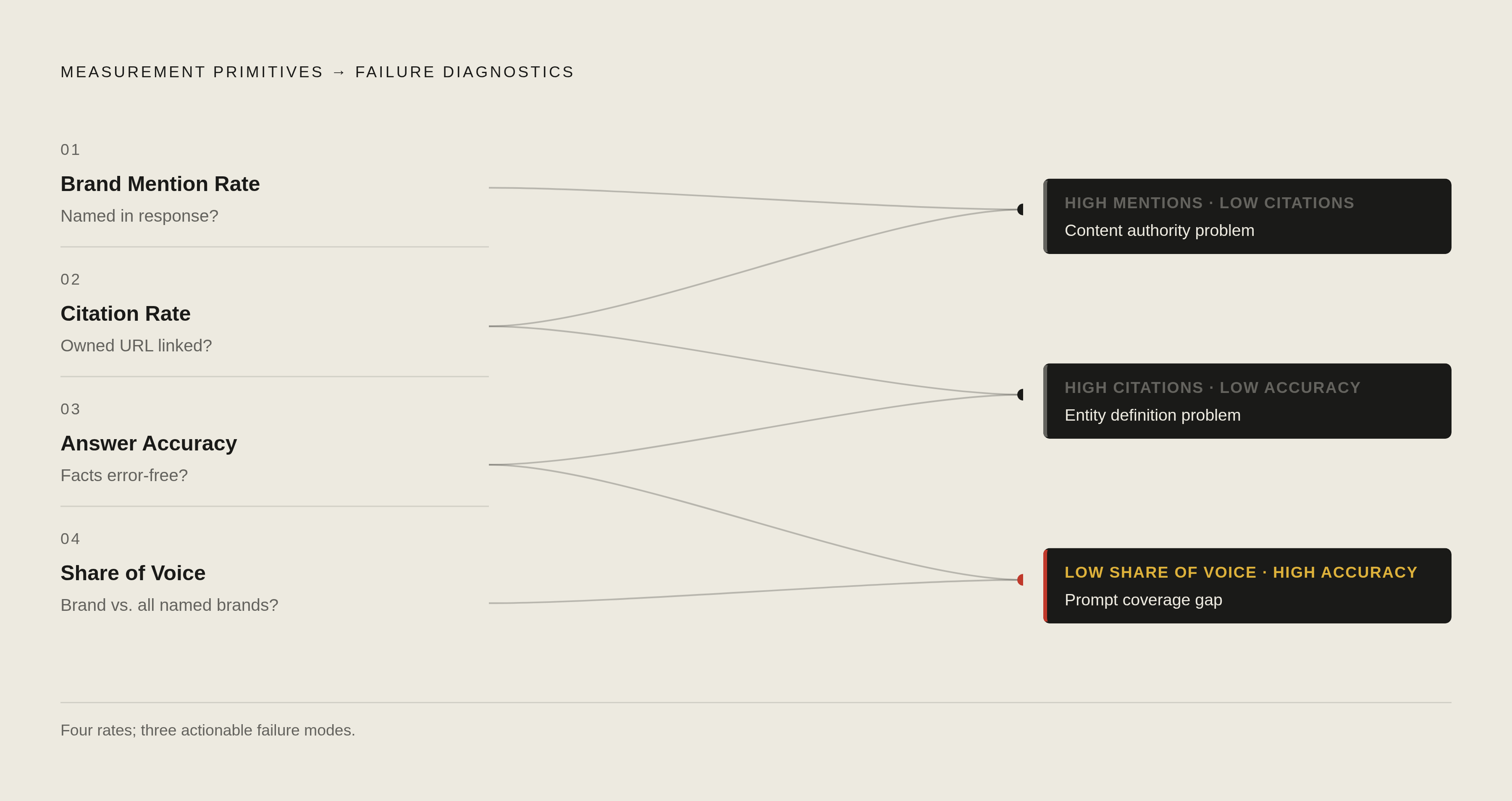
Brand mention rate is the share of runs on a fixed prompt panel in which the brand is named anywhere in the answer. This measures inclusion in the answer itself, with or without a link or click. It answers the simplest question about presence, but it says nothing on its own about whether the engine used the brand’s content as evidence.
Citation rate is the share of runs in which the response links to a supporting URL from the brand’s domain. This is distinct from a name appearing in prose. An answer can mention a brand while citing another source. Reporting citation rate separately shows when a brand has a high mention rate but its brand-owned sources are rarely used.
Answer accuracy is the proportion of brand mentions that contain no material factual error. Visibility that misrepresents a brand can actively harm the buyer’s understanding of the offer.
Mention and citation share of voice measures the brand’s mentions or citations against all named-brand mentions or citations across the same panel and period. Mention share and citation share are calculated separately. They provide the competitive context that the other measures lack. Together, the four signals point toward different problems. High mentions with low citations point to problems with content authority, high citations with low accuracy point to problems with entity definition, and low share of voice with high accuracy points to gaps in prompt coverage.
How to build the prompt panel that the measurement runs on
To put those measures into practice, a team should start with a fixed panel of questions that reflects how buyers research. Buyers do not only type category keywords. They describe problems, ask for comparisons and request recommendations. A panel built from keyword equivalents alone would leave much of that behavior untested, even if its results looked consistent.
The panel should cover discovery and category questions such as “what tools help with X”, comparisons and alternatives such as “X vs Y”, and problem-framing questions such as “how do I solve Z”. Implementation questions such as “how do I get started with X” add a different research stage. Risk questions such as “what are the downsides of X” test another. Coverage across them gives the resulting rates a clearer meaning than a collection of unrelated spot checks.
Once selected, the prompts need version control. Changing a question between periods changes the instrument, so the resulting figures are not a like-for-like trend. Each run should also record the engine, model or interface where known, account state, geography, language, device and collection date. These conditions can affect the answer. Documenting them helps separate a change in brand visibility from a change in how the test was run.
Repetition is a required part of the protocol. Each prompt should run at least five times per engine per period before results are aggregated. A single stochastic answer cannot show a trend. A standing measurement cadence gives those repeated runs a consistent place in the team’s work, while the versioned panel preserves comparability between periods.
Why each AI engine requires its own measurement approach
ChatGPT, Claude, Gemini and Perplexity draw on different indexes and produce citations through different mechanisms. Visibility on one therefore predicts little about visibility on another. The prompt panel provides a common instrument, but the engine remains a separate measurement dimension. Combining results too early can hide where the brand is present and where it is missing.
Perplexity’s citation-led design makes it fairly easy to see which sources it uses, because most answers show numbered, clickable links. Mode still changes the measurement conditions. Writing mode disables web retrieval and does not produce those citations, so the absence of a citation there cannot be read in the same way as its absence from a retrieval-enabled response. The interface belongs in the record for a reason.
Claude uses Brave Search, an alternative to Google or Bing, for its web search. That makes it important for pages to be easy to index across the web, beyond being in any single search index. Some engines may have less access to the same source than others. A program limited to one engine consequently measures one channel within the full AI research category that buyers may move through.
Timing differs as well. For retrieval-based surfaces such as Perplexity and Google AI Overviews, content changes can affect citation outcomes in days to weeks. Training-data-dependent surfaces operate over a much longer cycle. Teams should allow for those different timelines when judging the effect of publishing, since engines can respond outside the same reporting window.
What benchmark visibility rates actually look like for B2B brands
AI visibility varies widely with a brand’s size and its place in the category. A broad average can therefore be a poor reference point for an individual B2B brand. Industry, prompt type and engine also change the comparison. A benchmark is useful only to the extent that it resembles the conditions under which the team collected its own results.
Citation rates were lower than mention rates. That gives teams a useful orientation point, because appearing in an answer does not imply receiving a link to an owned source. It is not, however, a universal target or a promise of what any particular panel should produce.
The denominator deserves as much attention as the percentage. A citation rate across all runs answers a different question from competitive citation share, while accuracy uses brand mentions as its base. Comparing those figures as though they measured the same event would distort the benchmark.
Volatility further limits what a snapshot can establish. An appearance on one day does not guarantee an appearance on the next, even for the same question. Benchmarks collected at a single moment can overstate stability if reported without that qualification. Teams can set sounder expectations by comparing brands in the same segment and repeating their own measurements than by using a headline average without knowing how it was measured.
How the sources a brand controls — and the sources it influences — shape citation outcomes
Citation outcomes depend on both brand-owned material and independent sources. The notes behind this framework show that brand mention density across the broader web has a stronger correlation with citation probability than backlinks do. The work is not simply to accumulate links, but to understand where engines encounter the brand and which sources they use to support their answers.
Yext’s analysis of millions of AI citations found that first-party websites and managed listings account for the large majority of citations across ChatGPT, Gemini and Perplexity. Brands therefore control a meaningful share of the material engines can retrieve. The useful distinction is between sources the brand can edit directly and sources whose treatment of the brand it can only influence.
To make that distinction actionable, measurement should include an ongoing citation-source distribution report showing which owned and third-party pages receive citations. A rate shows how often an owned domain appears, while the source report reveals where the answer’s evidence is grounded.
Publishing cadence and structured, machine-legible content follow from the same principle, because the site must be retrievable to serve as a cited source. Letterstory is one option that combines this publishing approach with measurement of whether ChatGPT, Claude, Gemini and Perplexity name and cite a brand across a fixed prompt panel. Such measurement makes answer-level exposure repeatable and gives publishing work an observable result to test whether new pages earn citations.
How to connect AI visibility measurement to commercial outcomes
Assessing whether visibility contributes to qualified demand and revenue requires a measurement path connecting mention trends to commercial outcomes. That path starts with prompt coverage, moves through answer accuracy and mention and citation share, then looks at cited-source distribution. It continues through AI referrals and assisted conversions to attributed pipeline and revenue. Each stage measures something different and can fail independently.
An answer may get the facts about a brand right without an owned-source citation, or cite a source without sending a visit. That is why visibility and revenue cannot be treated as interchangeable measures. The earlier signals explain exposure and source use. The later signals show the commercial activity that can be connected to that exposure. Zero-click answers leave a limit on what referral-based attribution can establish.
For the observable part of the journey, teams should preserve AI referral UTMs, track original landing pages and map assisted journeys from AI-referred sessions to qualified opportunities and proposals. This instrumentation connects visits to outcomes beyond the initial session. It gives a budget discussion more substance than citation frequency alone. It also keeps the claim proportionate to the evidence, distinguishing measured commercial journeys from exposure that produced no recorded visit.
Enterprise governance makes that evidence defensible. Version control, records of how answers were collected and protocols teams can repeat help them judge changes without mistaking a new test setup for better performance. Controlled tests can then connect changes in content or coverage to changes in the measured signals, with engine-specific timing kept in view. AI visibility measurement is an engineering discipline. The task is to instrument it, test it under controlled conditions and change strategy on evidence.