AI Personalization for Lead Conversion in B2B Marketing
Most B2B buyers decide long before talking to sales, forcing personalization earlier in research.

Advertisement
By the time a B2B buyer fills out a contact form, 70 to 80 percent of the purchase decision is already made. Personalization that kicks in after a sales handoff is solving a problem that closed weeks ago. The real work now happens earlier, inside anonymous research behavior and inside AI tools that most marketing stacks can't see into.
The numbers back this up from more than one direction. Research from 6sense in 2025 found that 83% of buyers fully define their requirements before ever speaking to a sales rep, and roughly 70% of the buying journey happens in what the industry calls the Dark Funnel, leaving no trace in a CRM or marketing automation platform. Separately, 61% of B2B buyers say they'd prefer a buying experience with no rep involved. That's a stated preference, not a service failure to fix, and it changes what personalization is supposed to do. It's a stated preference, and it changes what personalization is supposed to do.
What AI personalization means in a B2B context, and what it doesn't
Segmentation, customization, and personalization get used interchangeably, and they shouldn't be. Segmentation puts people into buckets based on shared traits, like industry or company size. Customization hands the buyer the controls and lets them build their own experience, the way someone configures a software dashboard. Personalization is different from both: it predicts what a specific person needs before they ask for it, and delivers that thing without waiting for a request.
AI-driven personalization takes that a step further. It stacks predictive models, live behavioral signals, and real-time adjustment on top of the basic idea, at a volume no team of humans could match by hand, no matter how good the team is.
Four distinct modes get flattened into one term constantly:
Predictive personalization looks at historical patterns, across a whole customer base, to guess what a given buyer will want next. Behavioral personalization reacts to what a visitor is doing in the moment, which pages they're on, what content they just opened. Intent-driven personalization reads research activity, like which comparison pages or pricing pages someone is hitting, to infer where they sit in the decision process. Real-time personalization pulls all three together and acts on them instantly, across email, web, and ad channels at once.
None of that is a first name merged into an email subject line. That's a mail-merge trick from two decades ago wearing a new label. Actual personalization means the message and the content itself shift based on what the behavioral data says right now, not based on a static field pulled from a database.
How AI reads buying signals before a buyer announces themselves
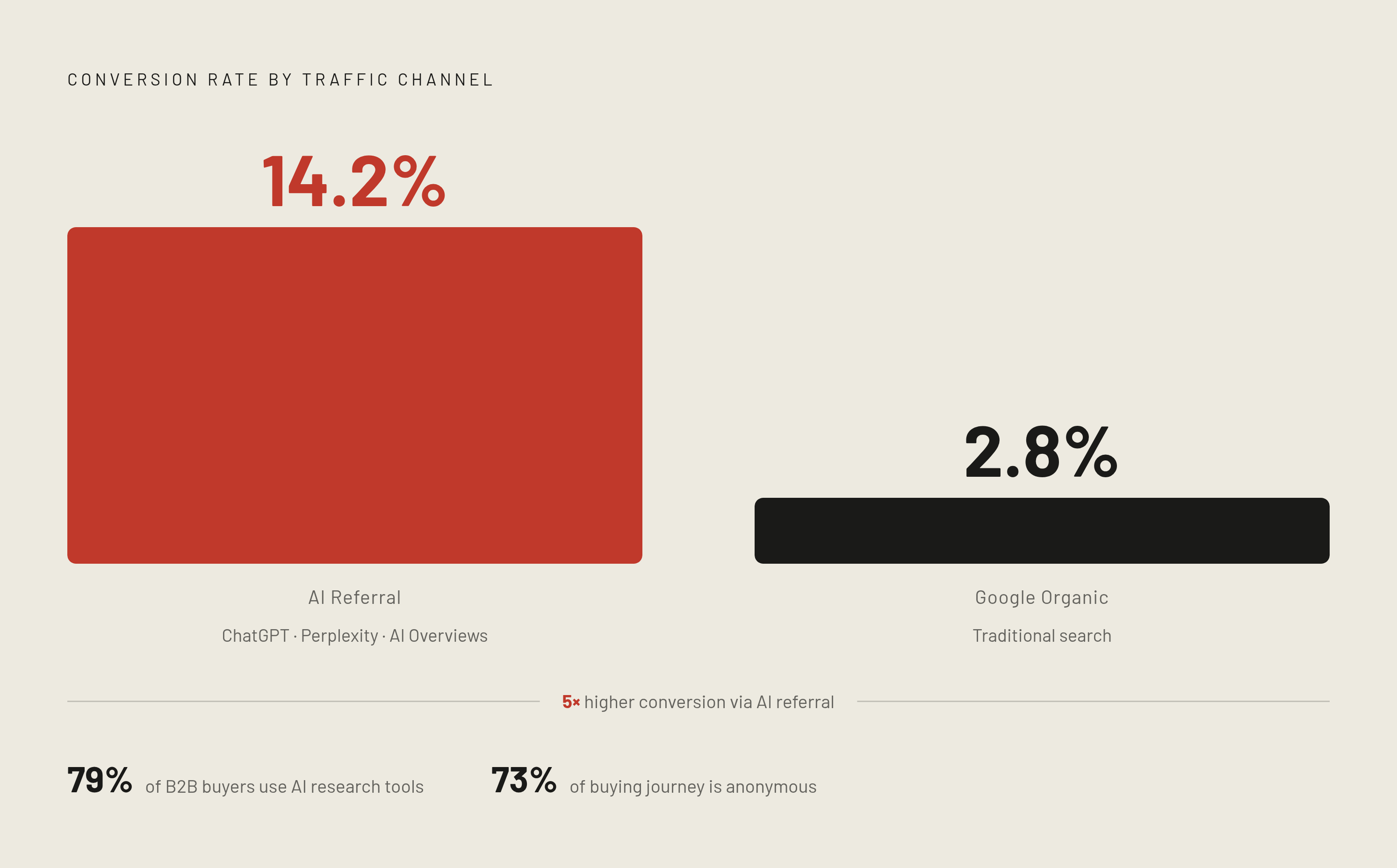
73% of the buying journey is anonymous. Standard tracking stacks, the ones built around form fills and known contacts, simply don't register it. That forces the signal-reading work up a level, into the content itself and into the AI surfaces where research happens, rather than sitting inside a CRM waiting for a lead to convert.
This is where AI-driven lead scoring earns its keep. Instead of a static point system built by a sales ops team years ago, dynamic models now weigh behavioral signals, intent data, and engagement velocity together, continuously. Companies that have adopted AI-driven scoring have reported a 51% increase in lead-to-deal conversion rates, a gap wide enough that it changes what gets prioritized on a sales team's daily call list.
The models themselves are pulling in a wide range of signal types at once: company fit against an ideal customer profile, behavioral engagement across web visits and email opens, intent signals drawn from active research behavior, timing indicators such as where a company sits in its budget cycle, and identification of who inside the buying committee is acting as the internal champion. Intent data platforms are built specifically to catch companies actively researching a category of solution before they ever raise a hand to sales, which turns outreach from a cold guess into a well-timed conversation.
Where buyers are now doing their research
The anonymous 70 to 80 percent of the journey happens inside AI tools. It's happening inside AI tools. 79% of global B2B buyers now use AI-driven research tools like ChatGPT, Perplexity, and Google AI Overviews to evaluate solutions, and 71% of B2B software buyers specifically say they rely on AI chatbots when researching software purchases.
Scale matters here. As of March 2026, ChatGPT had crossed 900 million weekly active users, and Google AI Overviews were appearing in more than 25% of all searches. That's not a niche behavior anymore; it's the default starting point for a large share of buyer research.
The conversion data is where this gets strategically urgent, not just interesting. Traffic arriving from AI referrals converts at 14.2%, against 2.8% for traditional Google organic search, a difference of roughly five times. Buyers who land on a site after an AI tool sent them there have already filtered themselves. They've asked the questions, compared the answers, and arrived with real intent, which means the handful of visitors coming through that channel are worth disproportionate attention.
Why most B2B brands are invisible at the moment buyers are forming their shortlists
The 2026 2X AI Visibility Index found that only 4.3% of B2B companies maintain what it calls a healthy discovery funnel, showing up in early-stage buyer questions asked before a buyer knows which vendors exist. The other 95.7% appear mainly in queries where the buyer already typed the company's name in. In plain terms, they're only visible to people who already knew to look for them.
That distinction matters more than it sounds like it should. An AI assistant that a buyer consults before contacting anyone is effectively building a shortlist in real time, and for the overwhelming majority of B2B brands, that shortlist gets built without them ever entering the conversation.
SEO, AEO, GEO, and related terms get used loosely and often wrongly as synonyms. SEO is the practice of helping pages rank on traditional search engines. AEO, or Answer Engine Optimization, is about getting specific answers extracted into featured snippets and direct-answer boxes. GEO, Generative Engine Optimization, is about getting a brand pulled into AI-generated responses that synthesize information across many sources at once. AI Visibility sits above all three: it's the broader question of whether a brand exists at all inside a model's parameters and retrieval indexes, regardless of any single query.
Slots are scarce, too. AI platforms typically cite only three or four brands per response, and the top 20 domains across the category capture 66% of all AI citations. There isn't much room on that list, and most brands aren't on it.
How AI systems decide which brands to cite
GEO is mostly won or lost on pages a brand doesn't control. A large majority of brand mentions inside AI search responses come from third-party pages rather than brand-owned domains, and brands are substantially more likely to be cited through third-party sources than through their own blog or resource center.
In B2B SaaS specifically, about half of AI citations trace back to review sites and forums, places like G2, Capterra, TrustRadius, and Reddit. Brand-owned content tops out at around 15% of an LLM's citations for a given topic, even for brands that publish constantly and well.
The practical consequence is blunt: a company can write a genuinely sharp, detailed piece of analysis on its own blog and still be invisible in AI search, if nobody is discussing that company on the independent platforms the models actually pull from. Owning the best answer on your own site doesn't help if the model never goes there to find it.
Ranking position in classic search doesn't transfer over cleanly, either. An Ahrefs study, covering 863,000 keywords and 4 million AI Overview URLs, found that about 62% of cited URLs fall outside the organic top 10 results. Ranking first on Google says less about AI citation odds than most content teams assume.
Connecting AI visibility to the personalization stack (how being cited shapes what buyers experience)
Follow the chain through to its conclusion. If a buyer's shortlist gets built inside an AI assistant, and a brand isn't cited there, none of the downstream personalization work, the email sequences, the tailored website experience, the retargeting ads, ever gets a chance to run. The buyer simply never appears. All that infrastructure sits idle, waiting for a visitor who went somewhere else.
When a brand does get cited, the visitor who clicks through arrives already shaped by that context. The 14.2% versus 2.8% conversion gap between AI referral traffic and organic search traffic points to buyers who've already done a meaningful amount of filtering before they land, which means the personalization stack meeting them on-site has a much higher-intent visitor to work with from the first page view.
AI also increasingly functions as the layer coordinating the whole journey. It maps where a buyer sits and adjusts in real time, lining up marketing and sales activity so the buyer experiences one connected path instead of a string of disconnected campaigns that don't seem to know about each other.
By 2026, topical AI assistants had moved past answering basic FAQs. They guide prospects through genuinely complex buying decisions, recommend content based on what a buyer has already engaged with, and qualify leads, all without a human touching the process.
What the personalization and AI visibility stack looks like in practice
Nearly half of organizations have now embedded generative AI across the whole company, or at least across multiple functions, for producing and activating marketing content. That's a real shift in capacity. But producing content that's personalized at scale, discoverable by AI systems, and consistent with a brand's voice across every channel at once takes more than a single team running a generative AI pilot on the side.
Multi-agent systems are what make managing that across a whole portfolio of brands actually workable. Research, drafting, optimization, and distribution get split across different agents, each following a shared set of rules, and multi-tenant setups let a small team run programmatic content across several brands at once without the standards drifting from one brand to the next.
Agentic AI makes this a standing operation rather than a one-off campaign. Autonomous agents hold long-term context, work toward defined goals, and carry out multi-step workflows on their own, managing a content lifecycle from the first idea through publishing, personalization, and ongoing optimization, without someone re-prompting the system at every step.
There's already a working example of this at scale. Monks runs a managed service called Monks.Flow that deploys agents across a brand's entire marketing operation. For Headspace, it produced 460 custom assets across 20 use cases for a single campaign, delivering meaningfully higher conversion rates and lower cost-per-signup. That's not a hypothetical about what agentic systems might someday do for a marketing team. It's a documented outcome, and it's the shape of what running personalization and AI visibility together at real scale actually looks like.