Signal-Driven Content Publishing With CI/CD Integration
Automated triggers let teams publish content fast enough to earn AI citations before competitors do.

Signal-driven content publishing applies CI/CD’s trigger, build, test, deploy logic to content operations. Its purpose is to turn real-world signals into reviewed releases, then measure whether those releases solved the problem that prompted them. Automation supplies the speed, human gates preserve judgment, and monitoring connects publication to an outcome.
Why content operations needs the logic CI/CD already solved
A competitor earns an AI citation on Tuesday for a topic the brand should own. The editorial calendar is already full for weeks, so the response enters a backlog and ships, if it ships at all, the following month. By then, the competitor’s page has already been cited. The team had an idea and a reason to act, but neither could move through the publishing process quickly enough.
The delay is architectural. There is no defined trigger, automated build, quality gate, or measurable release connecting the discovery to publication. DevContentOps addresses this gap between content work and development operations. Many CMS architectures are difficult to integrate with DevOps processes and do not support close collaboration between developers and content creators. The resulting code and content freezes, including “double publishing,” leave teams coordinating work manually where a connected process should exist.
Software delivery once had the same structural problem, with code waiting in queues, integration happening in batches, and failures discovered late. CI/CD replaced those batches with a continuous pipeline that runs when an event starts it. Content has different risks, but a similar coordination problem. A useful response cannot establish a brand’s position in an AI-generated answer while it is still waiting for a slot in the calendar.
What CI/CD actually does, stated precisely enough to map onto content
Continuous Integration means merging changes into a shared trunk continuously. The content equivalent is bringing each new signal into work on the production content set. The signal enters a defined process with a route toward a tested artifact.
Continuous Delivery keeps that artifact ready to ship, with a clear decision still to be made about when to release it. For content, a reviewed draft is one approval away from publication. Continuous Deployment goes further by releasing automatically once tests pass, although its content equivalent must still respect human-review gates. Readiness and permission are different conditions. Keeping them separate makes it possible to automate preparation without treating editorial approval as a technical formality.
The working vocabulary is therefore trigger, build, test, and deploy, with a scoreboard to judge the result. JetBrains’ AI in DevOps research shows that trust and measurable outcomes shape AI adoption inside pipelines more than model capability. A capable drafting system is not enough. The surrounding process must show that it can produce dependable work and reveal when it does not.
DORA supplies that measurement discipline by pairing throughput with stability. Deployment frequency maps to publishing cadence, while lead time for changes maps to elapsed time from signal to publication. Change failure rate becomes the rate of material corrections or retractions, and mean time to restore initially maps to time spent correcting a published error. Publishing more often is not progress if the additional output also demands more repair.
The signals that should trigger a content pipeline
An AI citation gap is the content equivalent of a production alert. A monitoring check finds that ChatGPT, Claude, Gemini, or Perplexity is not naming the brand on a query it should own. The team should act on that absence before taking on another calendar assignment. It represents a visibility gap in the answer itself, and the notes behind this approach identify recently updated material as a strong feature of cited content. Without a refresh loop, absence can compound week after week.
What does a monitoring check actually do? A watcher queries each engine on a defined schedule, records whether the brand is named and in what position, and writes the result to a shared store that the pipeline reads. The engines need separate attention because citation rates differ meaningfully by platform. A gap in one engine is not evidence of an identical gap in all of them. The response therefore needs to reflect where visibility is missing.
The Bing AI Performance Dashboard has been live since February 10, 2026, and shows first-party citation and grounding data. Microsoft notes that it shows only a sample of actual citation activity, so it is not a complete census. Grounding data nonetheless connects the signal to pages and queries. Practitioners have used it to identify specific pages receiving high grounding query volume, giving the pipeline a more precise starting point than a broad instruction to improve visibility.
Competitive moves and breaking developments supply the other triggers. The same monitoring layer can flag a competitor publishing on an owned topic or earning a citation the brand lacks. A regulatory change, platform update, or industry event can also expose stale content or create a new gap. In each case, the event supplies the reason to act. The calendar no longer has to be the only mechanism that starts work.
How signals map to pipeline stages: trigger, build, test, deploy
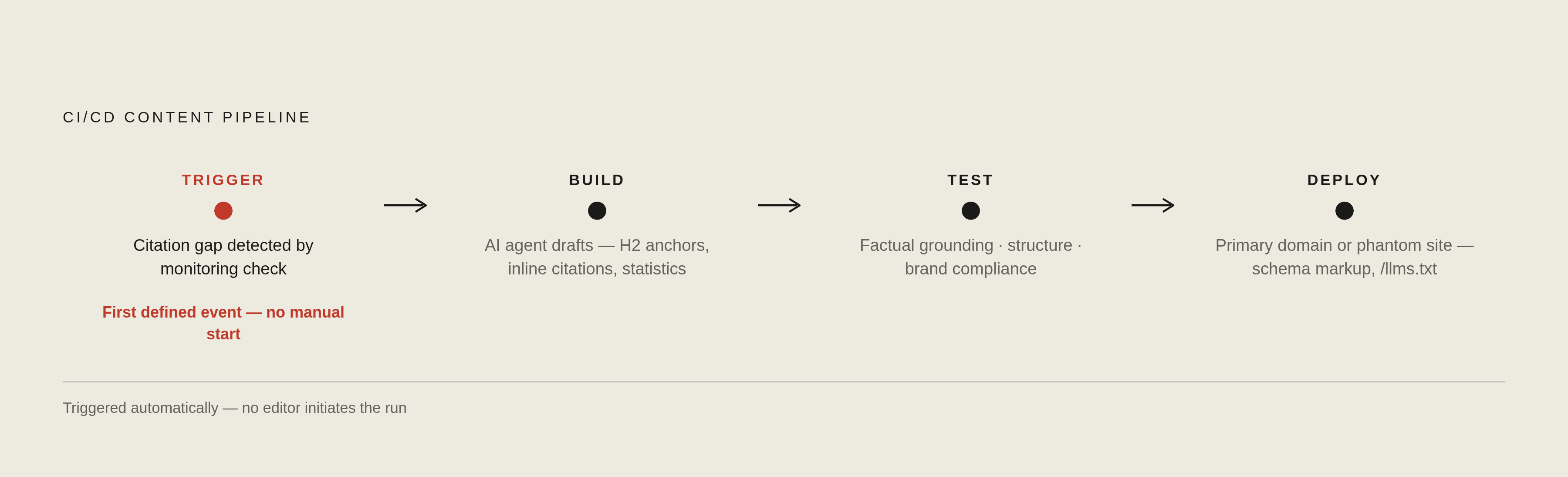
The trigger is the equivalent of a commit. A monitoring check returns a citation gap, a watcher flags a competitive move, or a scheduled audit finds stale content, and the pipeline starts. This is the decisive change from manual publishing. Without a defined event that initiates work, automation merely makes individual tasks faster while leaving the handoff between discovery and action unresolved.
Build turns the signal into a content artifact. An AI drafting agent uses it as the brief for a new post, an updated section, or an /llms.txt regeneration. The build includes a clean heading hierarchy, with H2 headings as thematic anchors and short, single-idea paragraphs, creating chunks that AI systems can extract and cite.
Aggarwal et al.’s GEO-bench research, associated with Princeton/IIT/Georgia Tech, found that inline citations, statistics, quotations from credible sources, and readability improvements measurably increase the share of AI-generated answers a source occupies. The build must use those findings, so editors cannot choose to leave them out. The draft needs support as well as readable prose. Its structure and evidence should serve the citation gap that initiated the work.
Test checks the artifact before people begin their review. A factual-grounding check asks whether every claim traces to a source the pipeline can retrieve. A structural check looks at heading hierarchy, /llms.txt syntax, and whether internal links resolve, and a brand and compliance check uses an approved-claims list to flag claims. These checks catch different kinds of failure. The agent-driven model can also select checks relevant to the trigger, giving a citation-gap artifact a GEO structure check and a breaking-news artifact a factual-currency check.
Deploy releases the approved artifact to the primary domain, a phantom site, or a partner property with the correct metadata, links, and schema markup. Staging keeps review separate from public release. Feature-flag logic allows a draft to appear at a staging URL before the production URL goes live, providing a content counterpart to a canary release. After deployment, monitoring starts checking whether citation rates improve, so the workflow continues with a test of what the published work achieves.
Where human review fits as a mandatory gate, not an optional step
Doesn’t automation remove editorial judgment? It can, if approval is treated as an optional final glance. The CI/CD model instead puts gates owned by people at set points, with closer review when the artifact carries more risk. Automated tests prepare the work for judgment. They do not decide whether the brand should stand behind it.
The factual gate requires every claim to be verified, labeled, or removed before the artifact advances. Source retrieval alone cannot settle that judgment because the system cannot know what it does not know. The editorial gate then assesses voice, structure, clarity, and audience fit against the brief. A person decides whether the piece is worth publishing.
The risk and compliance gate covers legal, regulatory, and brand-policy constraints, and financial, medical, or legal content cannot skip it. The publication gate addresses a different failure. It confirms that the deployed artifact is the reviewed version, with the correct metadata, links, and destination. Otherwise, a sound approval process can still release the wrong thing.
Risk-tiered automation changes the division of labor while preserving the need for accountability. For routine product updates and resource lists, teams can use 80% automation with a light review by people. For thought leadership, people must set the strategy while AI does the work, and experts must review everything on sensitive topics before it is published. These are three distinct review patterns. They prevent a routine update and a sensitive claim from receiving the same treatment merely because both are text.
The EU AI Act adds a specific regulatory reason to formalize review. Its transparency rules applicable from 2 August 2026 exempt AI-assisted public-interest text where it has undergone human review or editorial control and a natural or legal person holds editorial responsibility for publication. For pipelines relying on that exemption when publishing to European audiences, editorial control is more than a quality preference. Every AI-generated suggestion should remain reviewable and reversible before release. A gate that disappears under deadline pressure is not a gate.
The ground-site and phantom-site layer that gives the pipeline something to publish to
The destination can still become the bottleneck. A pipeline cannot route around a slow editorial process if a single domain is its only publishing surface. The grounding strategy therefore uses multiple authoritative surfaces to provide convergent evidence about the brand as an entity. One domain gives the brand one place to be cited, and independent surfaces give it more.
The ground site is the primary domain and the pipeline’s highest-trust deploy target. It is organized for chunk extraction through clean heading hierarchy, short single-idea paragraphs, and inline citations. Its deploy configuration includes schema markup and /llms.txt regeneration on every content release. Tying that work to deployment keeps the publishing surface in step with the artifact being shipped.
A phantom site is a purpose-built citation surface. It is an independent property focused on a defined subject cluster, receiving content on a cadence and building topical authority. Its role differs from the primary domain. It gives the brand more ways to appear in AI answer pools, so its chances of being cited can draw on more than one domain’s authority.
Each surface therefore functions as a deploy environment with its own configuration. The primary domain gets its schema and /llms.txt updates, while phantom sites get structures built around the topics in their target query clusters. Deployment alone proves little about citation performance. After a release to either surface, the monitoring layer checks citation rates on the relevant queries, just as a post-deploy health check tests whether a service responds correctly.
Measuring the pipeline with content-native DORA equivalents
Publishing frequency counts how often a signal-triggered workflow reaches production. Signal-to-publish lead time then measures the interval between a detected gap and the reviewed artifact going live. Together, they describe throughput. A system that drafts a lot of content may still be slow to release it.
Correction rate supplies the stability counterweight by measuring the share of published artifacts that require a material correction or retraction. Citation recovery time runs from when a citation gap is found until it closes after deployment. A published page is therefore not automatically a recovered citation. The monitoring loop must establish the outcome.
All four measures need to be read together. High publishing frequency with a high correction rate shows that delivery is unstable, while a low correction rate with lead times measured in weeks shows that the team is slow to respond. Checking engines on a schedule and recording the results lets the team track citation recovery after a triggered release. Without that instrumentation, the team may count publications but cannot tell reliably whether its responses closed the gaps that prompted them.
Click-through rates from AI citation sources are typically very low, so GEO is better understood as brand presence in the answer than as a traffic channel. The practical shift is toward citation rate and citation recovery time as primary KPIs. That changes what stakeholders should expect the pipeline to prove. Instead of asking only how much traffic a page brought back, they can ask whether a detected absence was corrected, how long recovery took, and whether the response stayed accurate. Content operations becomes an engineering discipline when the team uses those answers, along with how much it publishes, to decide what to change next.