Content Maturity Model for Scaling B2B Marketing Operations
Mature B2B content operations must optimize for AI discovery, not just production volume.

A content maturity model for scaling B2B marketing operations must distinguish production capacity from a system that builds authority over time. Today, its highest stage must also account for AI discovery. A mature operation does not merely publish good content efficiently. It makes that content retrievable and attributable by AI answer engines, measures whether it earns citations, and uses that evidence to improve.
Why volume became a false proxy for content maturity
For a decade, “more content = more mature” felt right. A full calendar suggested repeatable work, enough staff, and a reliable production process. AI broke that shortcut by making it easier to increase output without improving the decisions behind it. Producing more cost less, but people still had to make the decisions. A team could publish more while remaining unclear about whose questions it should answer or what success meant.
The benchmark itself never endorsed the shortcut. The CMI/MarketingProfs model defines “sophisticated” through accurate business measurement and the ability to scale across the organization. Walker Sands’ 2026 B2B Growth Maturity Assessment found that 95% of B2B leaders believe they still need to change how they do marketing a great deal to compete with the most advanced B2B and B2C brands. Years of investment have not settled the problem. The gap is between producing work and knowing whether the operation is effective.
What the established maturity frameworks actually measure — and what they miss
Robert Rose at CMI describes four content-led stages, which are campaign-led, content factory, content orchestration, and integrated media operation. The progression explains why a capable production team can still struggle. Its hardest transition is from factory to orchestration because that introduces governance where none existed. Who decides which story gets told, to whom, and by which brand? A workflow can move an article through production without answering those questions.
CMI’s healthcare technology case makes the distinction concrete. A multi-brand company was losing market share despite a talented, tooled-up content team of five. Three brands were telling the same story to the same buyer, creating “collision zones” that made all of them invisible. Capacity was not the missing ingredient here. The fix was a content orchestration council with cross-functional decision rights.
The EngagePulse 2026 Marketing Operations Maturity Model extends the operational view through Reactive, Operational, Structured, Integrated, and Strategic stages. At its highest stage, AI agents execute defined campaign classes with human review, while formal governance sets permissions and review requirements. These are substantial capabilities. But neither framework accounts for AI retrievability, entity recognition, or citation tracking across ChatGPT, Claude, Gemini, and Perplexity. They still measure pipeline, leads, and revenue attribution, so an updated content model must also cover how content gets found.
How AI answer engines changed the demand signal content teams are optimizing for
Similarweb’s 2026 Generative AI Brand Visibility Index shows that AI search is ahead of traditional search when U.S. consumers discover products. That is consumer evidence. It nevertheless shows the scale of the shift toward answers assembled by AI. For B2B teams, the important question is whether their content appears when buyers ask those engines about products and categories.
Traffic alone cannot answer that question anymore. A piece can lose Google clicks while gaining LLM citations, and a page that never ranked in Google can still appear regularly in ChatGPT answers. Reach and visits have become distinct signals. A reporting system built only around site traffic can therefore miss visibility on a surface where the buyer receives an answer without visiting the source.
Retrieval and training data shape that visibility. Retrieval concerns what the system fetches in real time, with crawl access, freshness, and structured formatting influencing what is available. Training data helps with entity recognition through signals such as a presence on Wikidata and coverage in seed-domain publications. These mechanisms demand more than polished prose. Content can go stale when editorial work runs on quarterly cycles, and standard blog formats may lack the structural signals that retrieval systems prefer.
Stages one through three: where most B2B programs actually sit today
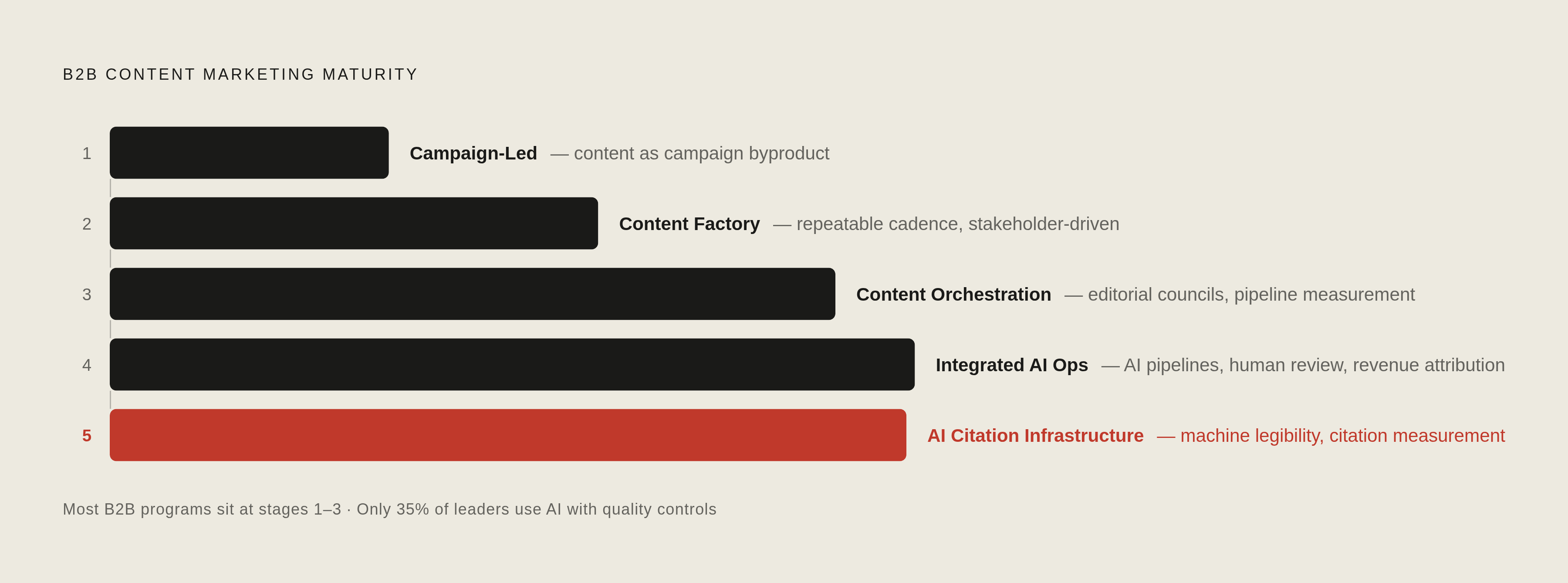
Stage one is campaign-led and reactive. Content exists as a campaign byproduct, with no documented editorial process or governance and little measurement beyond campaign results. The campaign supplies both the reason to publish and the reporting boundary. There is no broader operating system connecting the work.
Stage two is the content factory, or operational stage. Documented workflows and a regular cadence make production repeatable, but the loudest stakeholder or brand still determines priorities. The calendar is full. Alignment remains weak. The healthcare company occupied this territory before its council gave the brands a shared way to decide what good content meant.
Stage three brings content orchestration and structure to the operation. Editorial councils, defined decision rights, and quality standards shift planning from internal demand toward audience need. The team measures pipeline contribution as well as vanity metrics. This is the governance foundation for integrated work. It does not, by itself, mean that AI use has formal permissions and review gates.
The Walker Sands assessment found that only 35% of leaders say their marketing teams actively use AI to improve efficiency while maintaining quality and relevance. That finding does not assign every organization a maturity stage, but it shows how far adoption is from disciplined operation. Adding AI to a stage-two factory can accelerate undifferentiated content without resolving who sets priorities or judges its value.
Stage four: integrated operations with AI pipelines and human review
Stage four has multi-stage AI pipelines with a set process for human review. The operation specifies which classes of work AI may execute, where people intervene, and who owns each decision. That makes scale a property of the process.
The Starr Conspiracy formalizes this approach through its Content Pipeline Triage Framework and a human review quality gate. The latter has strategic gates that editorial leadership owns, craft gates that senior writers and editors own, and compliance gates that people in governance roles own. Each gate has a different purpose. Human attention goes toward thesis development, source judgment, opinion calibration, and narrative architecture, while AI handles research synthesis, first drafts, and reformatting.
The EngagePulse model’s highest stage describes a related operational capability, including partially automated lead lifecycle decisions with explainable scoring. Its stage numbers cover marketing operations more broadly, so they do not line up directly with the stages in this content-specific ladder. Here, integrated AI execution is stage four because another capability remains unaddressed. A program can govern quality, improve production efficiency, and attribute revenue without knowing whether AI answer engines cite its content.
Stage five: content infrastructure engineered for AI citation and measured there
Stage five adds three connected capabilities, which are machine legibility, entity grounding, and citation measurement. They extend the operation beyond how content gets made to how an answer engine can find it, identify its source, and use it. A useful page that cannot be retrieved or confidently attributed leaves the discovery job unfinished.
Machine legibility begins with access and structure. The program accounts for the major AI crawlers and controls named in this model, including GPTBot, ClaudeBot, PerplexityBot, Google-Extended, Applebot-Extended, and OAI-SearchBot. It also uses structured formatting and freshness cadences suited to retrieval. These are publishing requirements. They make machine access part of the content lifecycle rather than something considered after an article has shipped.
Entity grounding addresses a different question about identity. Can the model recognize the brand as the source of a claim? A Wikidata entry with proper properties and mentions on authoritative seed-domain publications help establish that machine-readable identity. The distinction is between relevance and attribution. Content can cover the right topic without making clear which organization is the source.
Proprietary “data nodes” give attribution a concrete basis. Instead of another generic article, the content owns a specific claim or dataset that a buyer’s question calls for. The aim is to make the brand the necessary source for that answer, though citation still has to be observed. This also explains two-surface publishing. Commercial category pages and high-intent comparisons can serve Google organic discovery, while definitional content, entity relationship pages, and brand authority signals serve LLM citation, with each surface measured separately.
An Australian SaaS reseller put that approach into practice through GEO-structured “X vs Y” comparison content and updated off-site profiles on G2 and Clutch. AI tools cited its comparison pages for commercial investigation queries, with a material increase in branded search impressions from AI-related sources over six months. The example connects publishing choices to discovery outcomes. At stage five, however, the final test is recurring measurement of whether ChatGPT, Claude, Gemini, and Perplexity actually name and cite the brand from session to session. Rankings and traffic cannot stand in for that evidence.
How to audit which stage your content operation is actually at
To apply the model, look at governance, the AI review pipeline, and citation measurement instead of counting the assets the team has published. The quickest diagnostic is to look for the boundary of the current system. What does it control reliably, and what does it merely assume? The following signals distinguish the stages without requiring a full capability inventory.
Stage one is visible when campaigns remain the unit of planning and there is no documented editorial process. Stage two has a dependable cadence and documented workflows, but stakeholder demand still sets priorities. Neither stage has the cross-functional authority needed to settle competing demands.
Stage three has an editorial council or the same decision rights, a written quality standard, and a way to measure pipeline contribution. Its plans follow what the audience needs. AI may be present without formal governance. Stage four adds a multi-stage pipeline with clear human review gates, production efficiency that the team can measure, and pipeline and revenue attribution, but evidence of AI citation is still missing or based on anecdotes.
Stage five has machine access and brand grounding, along with content built on purpose as data nodes or entity pages. It also documents a two-surface strategy and measures citations across the major engines on a standing cadence. A crawler setting alone is not enough. The EngagePulse model’s warning against skipping stages applies here because technical infrastructure cannot substitute for the governance that protects quality and authority.
What moving to the next stage actually requires — and where most programs stall
Teams need to address the missing operating capability before investing in the next layer. For stage one to two, that means designated marketing operations ownership and a first documented workflow. A new tool cannot assign accountability by itself. The immediate task is making the work repeatable, with someone responsible for how it moves through the process.
From stage two to three, the blocker is alignment. The healthcare case shows why teams need cross-functional decision rights before they add the means to produce more content. The same five people, toolset, and budget could operate differently once a council governed their choices. Teams at this boundary should establish that authority before asking AI to increase throughput.
To move from stage three to four, teams need to design the pipeline. Strategic, craft, and compliance gates need clear owners before the operation produces more AI-generated work. Otherwise, review becomes a backlog. The goal is to place judgment where it improves the work.
To move from stage four to five, teams must measure more. Citation tracking needs to become a standing practice so the team has evidence about the discovery surface it is trying to serve. Letterstory is one option for adding that layer through standing watchers and citation measurement across ChatGPT, Claude, Gemini, and Perplexity, with API-accessible components that fit an existing stack. The practical sequence is to instrument citation, measure it repeatedly, and change the publishing system on evidence.