What the 6 Percent of Companies Winning at AI Scale Do Differently
How the few companies earning AI returns link content, citations and measurement.
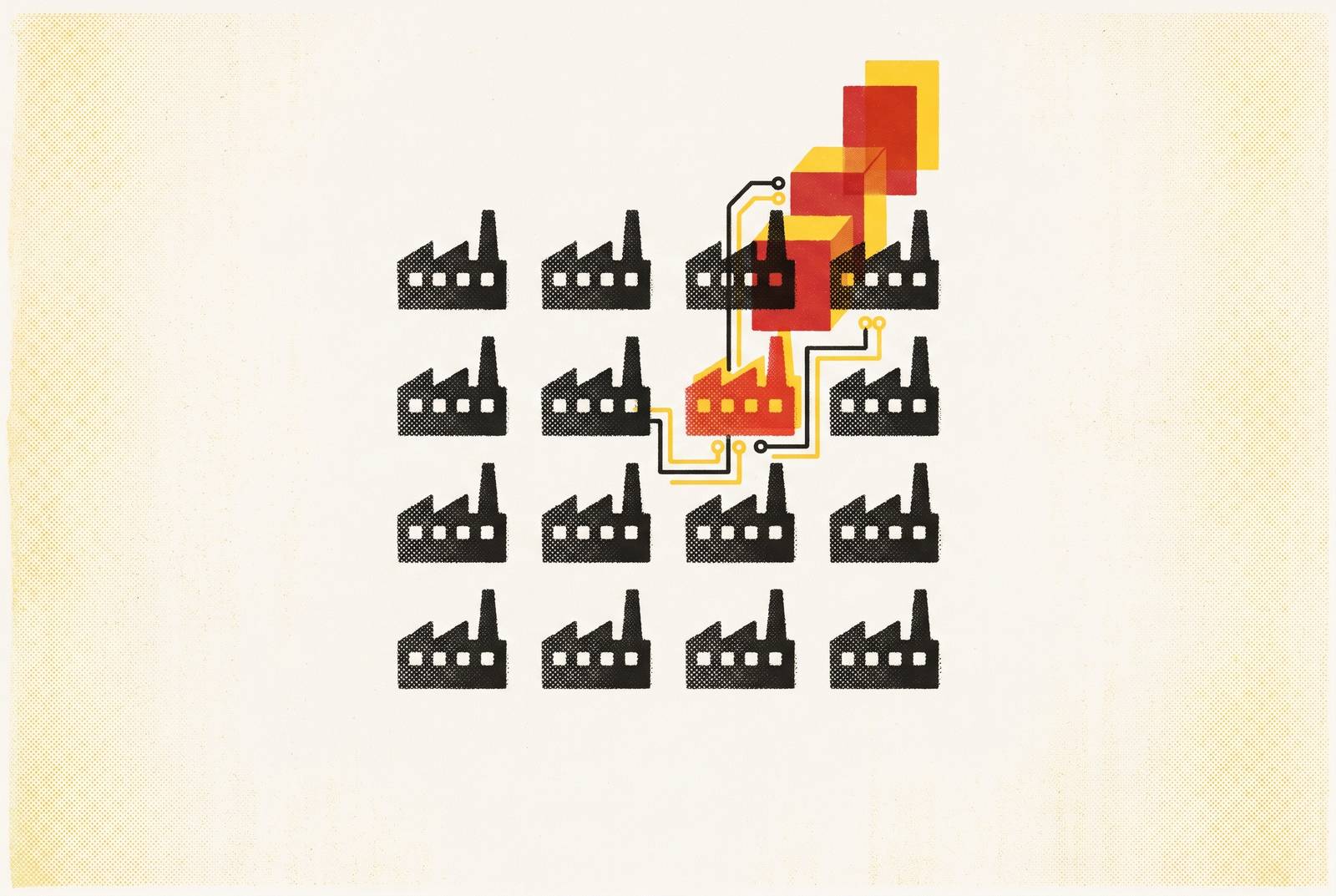
The companies capturing strong returns treat AI as a measured, multi-layer system. That difference becomes especially clear in content and buyer discovery, where publishing, outside corroboration, human review and visibility measurement must work together before gains can compound.
Why only a small fraction of companies are capturing real AI returns
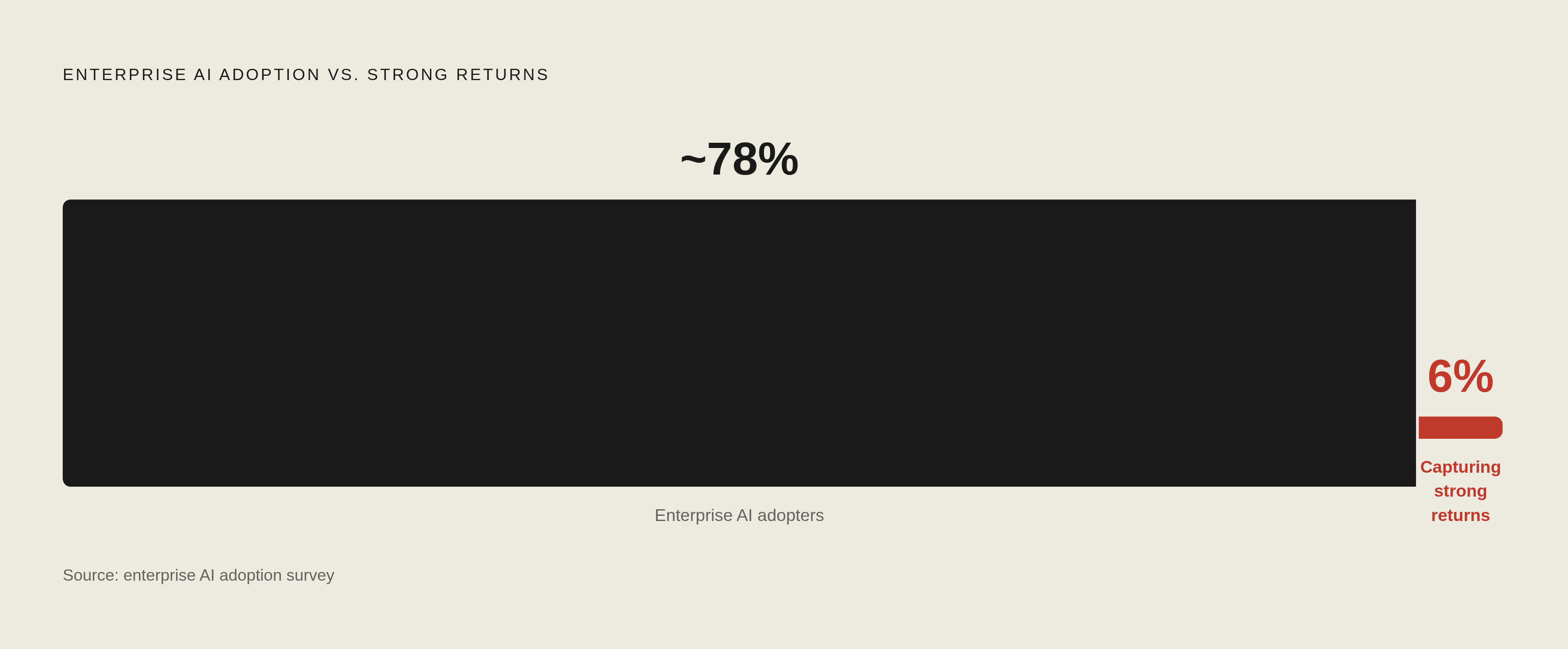
AI pilots often remain separate experiments, with tools that never connect and results that never improve the next round of work. A team can adopt a writing assistant or automate a task without changing how it judges success. Adoption is not the same as return. One widely cited industry benchmark puts the share of enterprise AI adopters capturing strong returns at only 6%, while the overwhelming majority are not capturing meaningful value.
The 2026 AI Index Report establishes that organizational AI adoption has reached a large majority of surveyed organizations. That makes the gap harder to explain as a simple lack of access. The infrastructure layer has a different position because hyperscalers building and selling AI compute capture returns regardless of what customers accomplish with it. Enterprise buyers still have to use that capacity to do work that pays off for the business.
What, then, separates a useful experiment from a business system? Companies getting real returns link the layers of work, decide where human judgment is needed and measure whether the work meets a business goal. A faster draft is an intermediate output. Its value depends on whether the content is accurate, reaches a buyer and earns a place in the sources that shape a decision.
Content and AI visibility offer a concrete way to examine this operating model. They connect internal production to an external outcome that the company does not fully control. A brand can choose what to publish, but it cannot simply instruct an answer engine to cite it. That constraint makes the discipline visible. Success requires both useful evidence and a way to learn whether the evidence is being used.
How AI answer engines are reshaping the front door to discovery — and why most brands are missing it
Buyer discovery is shifting from finding pages to receiving answers. In search, a reader sees results and chooses which sources to open. An AI answer engine selects evidence on the reader’s behalf and folds it into a response. A brand is competing for a place in the model’s evidence set.
That changes when a brand gets its chance. A buyer can ask for a comparison, receive a shortlist and move on without visiting any of the companies discussed. If a brand is absent from the evidence used, its website may never get an opportunity to persuade. The shortlist can close before a click happens. This is a demand-side change driven by buyer behavior.
AI referral traffic is growing quickly enough to make absence from these answers a current visibility risk. But referrals reveal only the visits that follow an answer. What happens when the answer is enough? The brand’s exposure may begin and end in a place its usual traffic reports do not capture. That is why AI visibility cannot be treated simply as another source of website visits.
Most brands have little visibility into this presence just as buyer behavior is changing. Companies that actively track their appearance in answers can at least distinguish being included from being absent. Those that do not track it cannot make that distinction reliably. The operating model starts to diverge here. Winning companies treat AI visibility as a measurable business outcome rather than assuming traditional SEO will deliver it as a byproduct.
Why content built for search rankings does not automatically win AI citations
A place in the model’s evidence set requires content it can use to support an answer. Search rankings and AI citations are therefore different jobs, even when the same page can serve both. Brand mentions correlate more strongly with AI visibility than backlinks do. Links can still have value and causation remains unproven, while AI visibility requires evidence beyond a familiar search signal.
Longer pages with more substance get far more AI citations than thin pages because their depth gives the model more evidence to verify and cite. Extra words are not the goal here. A page becomes more useful when its detail supports the question being answered.
Freshness adds another requirement to that work. Recently updated content has a meaningful citation advantage, so a static archive can lose AI relevance even if it once ranked well. Publication is not the end of production. A team maintaining an evidence base has to consider whether its claims remain current. This is one reason a content pipeline needs a renewal process as well as a drafting process.
Ranked “best-of” listicles and original proprietary data, or “data nodes,” have disproportionate citation weight. A ranked comparison answers a question about what to choose, while original data gives the model facts that come from a source the brand owns. If an answer needs that finding, only the page where it first appeared can be its original source.
Adding statistics and verifiable claims is consequently among the most effective ways to improve AI visibility. Readability still helps the reader, but persuasion alone does not create machine-verifiable evidence. Content quality includes evidence density as well as clear writing. Yet even a strong on-site archive is only one layer of the system. Teams must also assess whether the wider web corroborates what the brand says about itself.
How winning brands build an off-site citation footprint that AI engines treat as ground truth
Publishing across authoritative sources can multiply AI citations compared with publishing only on the brand’s own site. This is a sharp shift for teams accustomed to treating outside coverage mainly as a way to earn backlinks. The outside mention can be valuable in itself. It gives an answer engine another source through which to recognize and corroborate the brand, whether or not that source sends a visitor to the brand’s website.
Major LLMs base their answers on core sets of domains they trust. Winning brands identify which publications in their vertical serve that role and prioritize securing mentions there. The target is a presence in the sources an engine uses for the questions relevant to the business.
The contrast with conventional link-building is especially clear when the mention is unlinked. An unlinked mention on a highly authoritative site can be more valuable for AI citation purposes than a do-follow link on a low-authority blog. The engine is reading for corroboration, not counting link equity. A link and a mention perform different jobs. Treating them as interchangeable can leave a team optimizing the wrong signal while believing its visibility work is complete.
This also explains the role of standing off-site properties that publish structured, verifiable material. They give engines more sources to cite, while the client brand can leave the upkeep of some properties to others. But the underlying requirement is still credible evidence. Distribution does not remove the need for substantive content, and the existence of several pages is not itself proof that their claims deserve trust.
Letterstory, an AI content and visibility platform, is one option for this approach, researching, drafting and publishing on a cadence across a brand’s blog and independently hosted phantom sites to build an off-site citation footprint. Its watchers can also draft a post when a relevant news item or competitor move appears, addressing the freshness problem of a static archive.
What separates AI content pipelines that compound from ones that stall at the pilot stage
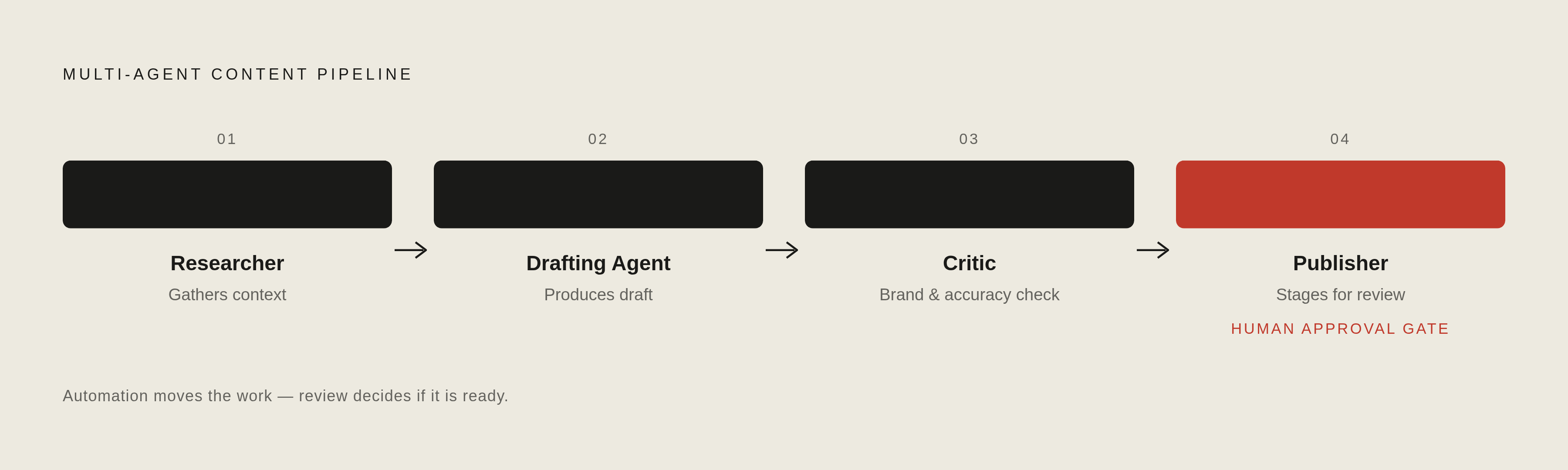
Keeping content fresh and full of evidence across several properties takes work. A one-shot writing tool can produce text, but it does not by itself provide a reliable publishing process. Winning companies instead build structured, multi-agent pipelines with human judgment at defined checkpoints. Each stage has a distinct job to do. That separation makes it possible to examine a weak stage without treating the entire system as a single opaque tool.
In a mature pipeline, a researcher gathers context and a drafting agent produces the draft. A critic then reviews it against brand and accuracy rules, while a publisher stages the result for human approval before it goes live. Each agent is specialized and replaceable. The design separates generating an answer from judging whether it is fit to publish. That distinction is essential when fluent writing can still contain unsupported claims.
The AI Index documents a substantial leap in agent task success rates, supporting the case for production use. As agents can do more, however, review becomes more important and is still needed. More work can move through the system. If the approval structure is weak, faster generation does not resolve the weakness. The possibility of hallucination is a practical reason to check claims within the pipeline.
Human review is still the main way teams running agents in production judge their work. Nuanced or high-stakes output needs a judgment layer that automated checks cannot replicate. The intensity of that review can vary. Internal summaries need few checks, marketing copy needs one reviewer, and customer-facing or compliance content needs sign-off at several stages with an audit trail.
This design also preserves the ability to say no. A draft can move quickly through stages that each have their own job while still needing approval before it is published. A well-designed pipeline uses automation to move the work and review to decide whether the work is ready.
Why most companies have no idea whether AI engines are citing them — and what measuring it actually requires
Showing whether an answer engine is using what a strong pipeline publishes requires a separate measurement layer, because website traffic captures only some of the places where a buyer encounters a brand. The exposure may never become a visit. With 93% of AI Mode sessions ending without a click, the answer itself may be the brand’s only impression.
The overlap between domains cited by ChatGPT and those cited by Perplexity is small, so visibility on one does not establish visibility on the other. Each has to be observed in its own right. A combined view should preserve those differences.
Repeated observation is just as important as breadth. Only a minority of brands remain visible from one answer to the next on the same query, and even fewer persist across consecutive runs. A one-time audit records a moment. Continuous measurement is what allows a team to distinguish a recurring citation footprint from an isolated appearance.
Microsoft’s Bing Webmaster Tools added an AI Performance Report in public preview that shows data on actual citations. Its measures include Total Citations, Average Cited Pages, Grounding Queries and Page-Level Citation Activity. These provide a first-party view of citation activity. Third-party monitoring can extend the picture across ChatGPT, Claude, Perplexity and AI Overviews, including sentiment monitoring. The two approaches address different parts of the measurement problem rather than making one another unnecessary.
What does that make possible for the operating model? Teams can check visibility across engines rather than take it for granted that publishing more gets them seen more. They can also judge their content and distribution work by whether engines cite it, while keeping citation visibility separate from proof that the business gets a return. Measurement closes the gap between producing work and learning from it. The few are winning because they have built the discipline to treat AI as a measured, multi-layer system.