Maintaining Brand Voice in AI-Generated Content
Build systems, not adjectives, to keep AI content recognizably yours.
Most companies solving brand voice for AI reach for better adjectives: friendlier, punchier, more authentic. That's the wrong layer to work in. The businesses that stay recognizable at scale build an operating standard: documentation, structured prompts, quality checks, and a feedback loop that constrains AI output before a sentence ever reaches a customer. Adjectives don't survive contact with a language model. Systems do, and the companies still arguing about tone words instead of building that system are the ones whose AI content already reads like everyone else's.
What brand voice is, and why it resists informal definition
Brand voice is the personality a business carries through everything it writes: word choice, sentence rhythm, level of formality, the attitude a piece of content projects. A product page, a support email, and a thirty-word caption should all read as the same brand with no logo attached. Tone moves with context. An apology email doesn't sound like a launch announcement. Voice stays put underneath that movement; a voice document has to capture both the stable core and the range of variation the brand still allows inside it.
Informal definitions fall apart the moment a model gets involved. Tell it to sound "friendly" or "professional" and you've handed it almost nothing, because it has ingested millions of friendly voices and will average them into something forgettable. Growth Rocket's guidance on voice documentation names the fix: behavioral specificity. Not "conversational," but "uses contractions naturally, asks rhetorical questions, uses industry terms without stopping to explain them." Negative examples do more work than most teams expect. Telling a model what a brand does not sound like, no hedging, no jargon, no exclamation points, often narrows output faster than any positive description manages.
Skipping this step raises the numbers directly. Adoption without precise definition doesn't buy distinctiveness. It buys uniformity, and uniformity is invisible to the exact audience a brand is trying to win. Once voice gets pinned down at this level of detail, it can be written down and reused, and that's where the real construction work starts.
Building the brand voice document that constrains AI output
Growth Rocket's voice architecture framework lays out three components, and dropping any one of them undermines the other two. Voice characteristics documentation comes first: behavioral rules rather than adjectives, covering sentence construction, in-or-out vocabulary, punctuation habits, and a running list of banned phrases. Contextual usage examples come second, showing how the same voice bends across a whitepaper, a social caption, and an email subject line while staying recognizably one brand. Negative examples finish the set: counter-samples that show a model what to avoid, most useful for brands defined partly by what they refuse to sound like.
Channel-specific guidance matters just as much, and most teams cut this corner. The Pedowitz Group's brand voice playbook lays out a voice kit with worked examples by channel: headlines, emails, ads, landing pages, product messaging, customer stories. A rule that holds up in a landing page headline can fall apart in a push notification, and the document needs to say so outright rather than leaving a model to guess.
Vocabulary rules need to be spelled out, not implied: preferred terms, forbidden phrases, sentence-length guidance, punctuation preferences. All of it removes ambiguity a generic prompt can't resolve on its own. None of this gets filed away after a rebrand and forgotten either. AirOps research found that pages left unrefreshed for a full quarter are three times more likely to lose AI citations than pages updated recently. Voice drift and document staleness are the same failure wearing two names. Treat the voice kit as a living file, written for human editors and AI systems at once, or it stops working for either one within a quarter.
How structured prompts translate voice rules into consistent AI output
Most voice loss doesn't happen inside the model. It happens in the prompt. A generic prompt produces generic output no matter how detailed the voice document sitting next to it is, because a constraint that never makes it into the prompt is a constraint the model has no way to apply.
The Pedowitz Group's playbook lays out what a structured prompt needs to carry: audience specification, intent and objective, channel and reading level, the desired voice traits pulled straight from the voice document, must-include and must-avoid items, and specific proof points or brand facts the output should reference. Five distinct load-bearing pieces, bolted onto a single request.
The template, not the individual prompt someone writes on a Tuesday afternoon, is the unit that scales. AirOps research found that teams who replaced one-off prompting with shared, reusable templates saw voice drift drop across the board, because the constraint stopped depending on whoever happened to be at the keyboard that day. Ask the model to produce multiple versions and explain how each one maps to named voice traits. Asking the model to produce multiple versions and explain how each one maps to named voice traits surfaces misalignment before a human editor ever opens the draft.
Fine-tuning sits a rung above templates, and it's the harder one to copy. Growth Rocket's research describes curating a dataset of a brand's best-performing, on-brand content and fine-tuning a model on that corpus specifically, which builds a constraint competitors can't replicate since they don't have access to the underlying data. Quality beats volume here: a small set of precisely on-brand samples will beat a large, inconsistent one every time. The more advanced version splits fine-tuned models by content type, one for technical writing, one for social, one for email, routed through a master system. Contentstack's Knowledge Vaults and Voice Profiles are one named implementation running in production, training a model on a brand's specific tone, terminology, and messaging rules before generation ever starts.
The quality control layer: what happens between AI output and publication
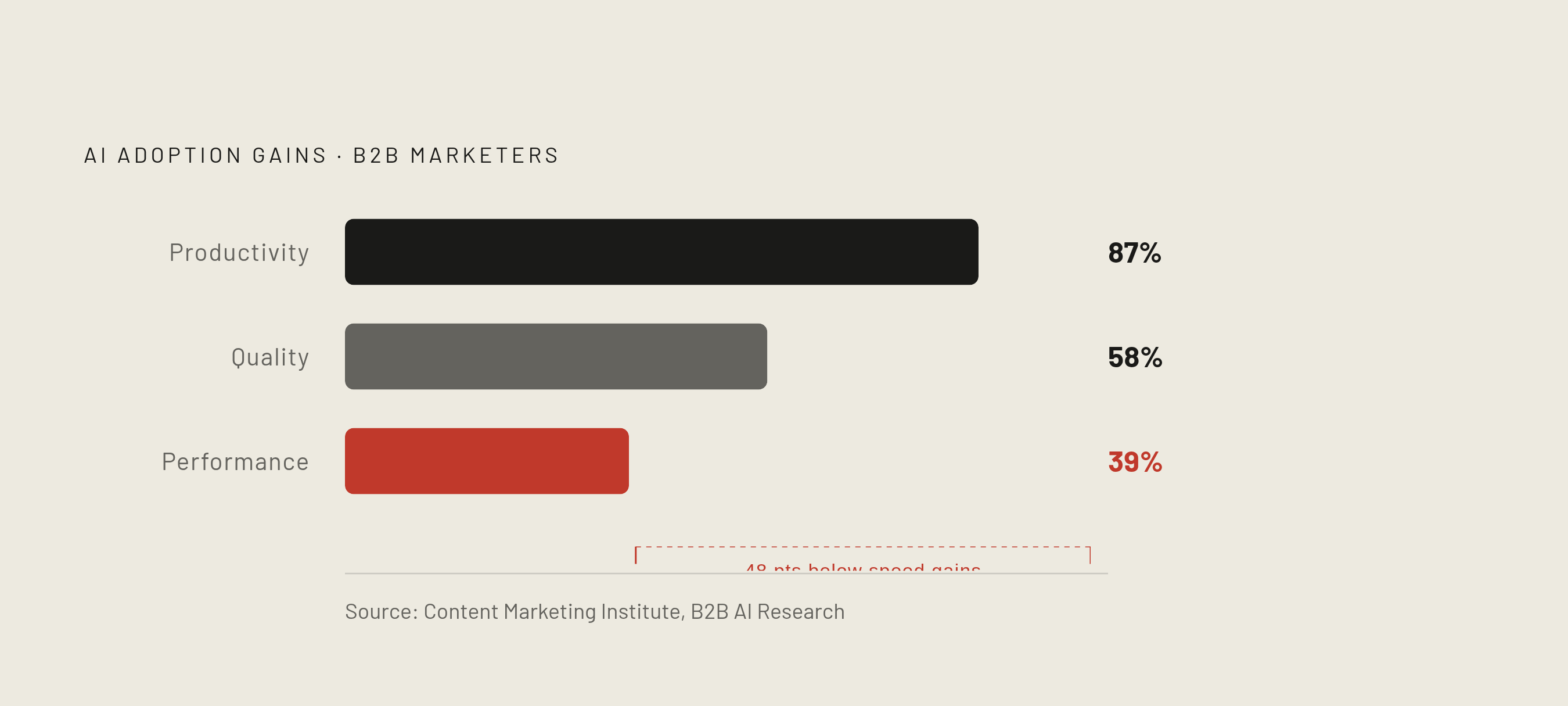
A gap sits between how fast AI writes and how well the result actually performs, and that gap is where review earns its keep. The Content Marketing Institute found that 87% of B2B marketers using AI report better productivity, but only 58% say quality improved, and just 39% say performance did. Speed went up. Results mostly didn't. Call that a governance failure, not an AI failure.
Not every piece of content needs the same scrutiny, and treating them all equally burns review capacity on things that don't need it. Homepage copy, campaign hero assets, and executive communications get full human review before anything ships. Lower-stakes content, internal memos, comment replies, community macros, passes through lighter, automated checks instead. Define the tiers ahead of time. Ambiguity about which bucket a piece of content falls into is exactly where governance quietly breaks down.
A quality control framework treats automated voice scoring as a first-line filter: algorithms that check output against documented voice traits, sentiment, tone, complexity, keyword usage, and flag drift before a human ever sees it. Human review doesn't disappear for customer-facing or regulated content, though. Human review doesn't disappear for customer-facing or regulated content, because some judgment calls resist automation.
Reported cases like Coca-Cola and McDonald's Netherlands make the failure mode concrete. Both drew public backlash over AI-generated holiday content that lacked editorial judgment. In neither case did the AI fail on its own terms: nobody stopped the content before it went out the door, which is a process gap, not a model limitation. For complex campaigns, governance now has to work at the block level. For complex campaigns, a single effort can involve governing many modular pieces separately, headlines, body copy, CTAs, disclaimers, email subjects, push notifications, social captions, each carrying its own voice parameters and compliance rules. None of it holds without an approval trail: it requires knowing who signs off on which content type, keeping a log of every change, maintaining version history, and producing an audit record. That workflow is the institutional memory the whole system runs on.
Voice consistency is now also an AI visibility problem, not just a brand problem
Voice consistency used to sit squarely inside branding. It now sits inside discoverability too, because audiences find brands differently than they did even two years ago. Similarweb's Generative AI Brand Visibility Index found that 35% of US consumers now use AI at the product discovery stage, against just 13.6% who start with a search engine.
AI systems recognize brands through pattern matching, the same mechanism they use to recognize anything else. Consistent descriptions across channels help a model correctly categorize and cite a brand. Inconsistent voice across owned content, third-party coverage, and press mentions sends conflicting signals, and a model becomes less likely to treat that brand as a stable, citable entity. Most of what shapes that signal sits outside a brand's direct control anyway: AirOps' analysis found that roughly 85% of brand mentions inside AI search answers come from third-party pages, not the brand's own site. A brand is far more likely to get cited through someone else's domain than its own, so voice discipline has to extend past owned content into press coverage, partner sites, and trade publications, places a brand never writes directly but absolutely gets described in.
None of this is a set-it-and-forget-it exercise. AirOps research shows only 30% of brands stay visible from one AI-generated answer to the next. The ones with staying power carry real topical authority, frequently refreshed content, and a footprint spread across platforms rather than parked on one channel. Brands running homogenous, undifferentiated messaging are the ones most likely to get treated as interchangeable when a model decides who to cite, and interchangeable is the one thing a brand voice project is supposed to prevent.
Managing brand voice across multiple brands or clients at scale
Everything above gets harder once an agency or holding company runs several brand voices at once. The risk that matters most here is cross-contamination between brands. It's cross-contamination between brands, where one client's voice quietly bleeds into another's because a team shares tools, templates, and shortcuts across accounts without meaning to.
Multi-agent systems are the operational answer that's emerged. Multi-agent architectures split the work across research, drafting, optimization, and distribution, all following shared rules, with individual agents configured for distinct brands, customer journeys, or use cases inside one platform. That setup lets a small central team coordinate strategy without hand-writing every asset that goes out the door. Multi-tenant programmatic deployment backs the same idea at the infrastructure level: separate brand manifestos, separate keyword strategies, separate voice profiles per domain or subdomain, so a lean team runs many brands without merging their identities by accident.
Monks.Flow's work with Headspace shows what this looks like at real volume: a single campaign generated 460 custom assets across 20 use cases and produced a 62% higher conversion rate. High-volume, multi-brand AI production can still deliver measurably differentiated results, provided voice constraints get applied at the individual asset level rather than averaged across the whole batch.
Agencies carry an added burden: accountability to clients paying to see proof, not promises. That means per-client voice documentation, per-client QA workflows, and reporting that actually demonstrates voice consistency is being held, not assumed. Here, platform infrastructure with per-client controls, analytics, and structured reporting becomes load-bearing because clients are paying to see proof, not promises. None of it matters if the account team can't speak credibly to a client about AI visibility and voice consistency. Training the people delivering the service belongs inside the system, not tacked on at the end.
The feedback loop that keeps the voice system calibrated over time
A voice system that doesn't update itself drifts out of step with the brand it represents, quietly at first, then all at once. AirOps' finding on quarterly refreshes applies directly here: pages left untouched for a quarter are three times more likely to lose AI citations than pages kept current. Content freshness and voice maintenance turn out to be the same motion wearing two different names, not two separate tasks fighting for the same hour on someone's calendar.
The feedback loop has a few distinct moving parts, and they don't all run on the same clock. Performance data flows back into the examples library: whatever content performs best, by engagement, by conversion, by AI citation rate, gets added to the voice kit as a new gold-standard sample, so the system learns from what actually works rather than only from what an editor signed off on at launch. Editor corrections flow into the prompt templates themselves; if editors keep correcting the same AI habit week after week, that pattern belongs in the prompt constraints, not in a shared doc of complaints. Quarterly audits of the voice kit matter too, checking vocabulary rules and channel examples against wherever the brand's positioning has moved since the last review, because a static voice kit ends up constraining a version of the brand that no longer exists.
AI citation tracking deserves a place in this loop as well. Watching how AI systems describe a brand in generated answers shows whether the brand's own signals are actually landing. A gap between how a brand describes itself and how AI systems characterize it is an early warning sign of voice or authority drift, and it is visible long before it costs any traffic. Automated tone scoring, complexity checks, and keyword pattern detection should run continuously in the background, not just at launch, so deviations get caught while they're still small and cheap to fix.
Governance frameworks for voice at scale describe a recognizable maturity curve, moving from ad hoc prompting and manual review toward reusable templates, automated checks, and eventually distributed teams running standardized workflows under centralized governance. The brands that stay recognizable at that final stage aren't the ones with access to the best AI tools. They're the ones that built, and kept rebuilding, the system that keeps those tools in line. The system is the moat, not the model.