Automatically Converting Technical Events Into Published Content
Build a credible published record from every technical event your brand produces.

Automatically converting technical events into published content is a pipeline design problem. Releases, launches, and webinars already have the raw material. A reliable pipeline turns that material into structured records that AI answer engines can retrieve and cite, while keeping a named person responsible for publication. The goal is not a busier blog, but a credible published record of what the brand actually does.
Why technical events are an underused content asset
A release has a version, a date, and a list of changes. A webinar has a transcript, claims, and a named speaker. These details can go into a published record, yet the event often ends without a lasting account of what happened or what people gained from it. The bottleneck is conversion. When someone has to find time afterward to repurpose the material, the post can be late and say less than the source material supports.
That gap now extends beyond the people who missed the event. ChatGPT, Gemini, Perplexity, and Claude can use live or indexed web content in addition to training data when their web-search capabilities are enabled or invoked. A webinar with no published transcript or structured summary offers no such record of its claims. This is where answer engine optimization and generative engine optimization enter the picture, because both depend on turning an internal or passing signal into accessible content.
What a content pipeline actually does to a raw technical event
A content pipeline is a fixed sequence that converts raw input into a published, structured asset. Its six stages are ingestion, processing, generation, validation, publishing, and monitoring. Consider a product release webinar as the input. At ingestion, the recording comes in through a file upload, API webhook, scheduled fetch, or file-system event. A source-agnostic ingestion layer lets other event types enter later without requiring the rest of the pipeline to be rebuilt.
For that recording, transcription is the first critical conversion. Processing then cleans the material, extracts metadata, removes duplicates, and enriches it with information from the organization’s own knowledge base. That preparation gives generation a firmer foundation than an unfiltered transcript would. The drafting prompt uses the processed input and approved organizational material, rather than relying on the model’s memory for product facts.
Validation tests the resulting draft against the publication’s requirements. Those checks cover format, length, brand safety, and duplication against recently published content. Passing them does not itself authorize publication. Publishing remains conditional on human approval, records what went live and where, and is idempotent so that repeating the operation does not create duplicate publications. Monitoring logs the input received, model used, validation result, publishing result, and total duration for every run.
The distinction from an ordinary content workflow is continuity. A workflow produces an asset when someone requests it. A pipeline runs in the background, responds when a new event appears, and builds a searchable content database across successive runs. The webinar is therefore not a one-off automation project, but one input to a repeatable conversion system. Editors still decide what the system should do, while approved material from an event starts the mechanical work.
Where the human approval gate sits and why it cannot be automated away
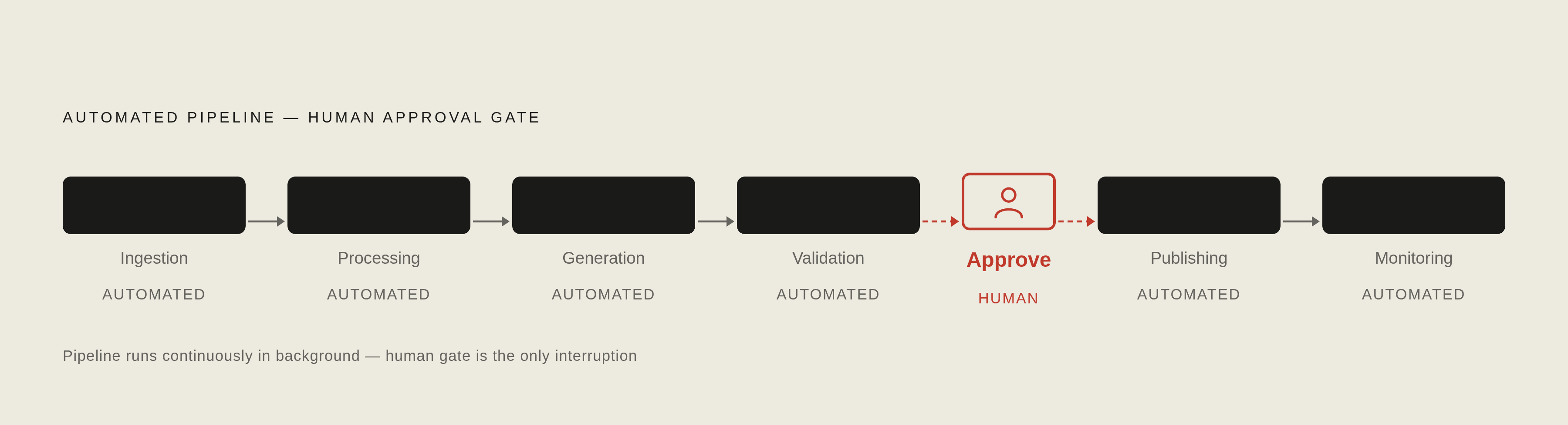
The approval gate comes after the draft passes validation and before it is published. It must have a named owner. NIST’s Generative AI Profile identifies confabulation, or confidently stated but erroneous content, as a core risk of generative AI. Fluency cannot serve as proof of accuracy. The pipeline should therefore put the article and its quality-check report in front of a person who resolves flagged issues and authorizes release.
In a well-designed pipeline, the reviewer touches the content at two defined points, while the mechanical work proceeds between them. The first review checks the outline, adds context the AI could not know, and approves drafting. The second verifies every statistic and claim against the brief’s sources, adjusts the voice, and approves publication.
Grounding the draft reduces the editor’s burden without removing it. A brief that names approved sources restricts what the drafting agent may claim, while retrieval brings the relevant organizational material into the generation step. Neither makes the resulting text automatically trustworthy. Google’s guidance says a person should factcheck and review AI-generated content to make sure it is accurate and trustworthy before it is published. The pipeline’s design should make that review fast and informed.
What, then, does automatic publication mean here? It means that formatting, scheduling, and delivery can proceed automatically after approval. Without that distinction, automation can publish errors faster than an editor can catch them. The human gate protects credibility and brand safety at the point where a draft becomes a public source that an answer engine might cite.
Why AI answer engines cite structured, published records rather than raw event signals
An answer engine cites a published, retrievable record such as a transcript, summary, or product page. That need for a record links answer engine optimization, or AEO, with generative engine optimization, or GEO. AEO targets a featured snippet or direct answer. GEO aims to get the brand named and cited in a generative response, and both need a document that clearly states the information the engine needs.
A usable document needs more than a recognizable title. Passage-level extractability means that a specific answer can be found in a discrete passage. Semantic entity coverage means that the brand, product, and topic are named consistently. Statistics also need their primary sources attached. These properties help distinguish a grounded record from a page that merely mentions the right subject.
Consistency must extend beyond the individual page. The brand’s name, description, founding year, and product details should match across its site, LinkedIn, industry directories, and structured data. When descriptions disagree, they can cause hallucination or lead the engine to cite neither source. JSON-LD schema markup provides a machine-readable entity network separate from the page’s visual presentation. For that reason, structured data should be a required production output for every asset.
Gemini can be grounded with Google’s live index, though that capability is not always invoked. Perplexity retrieves live web sources and includes inline citations in nearly every answer. ChatGPT can answer from training data or use real-time search, while Claude’s web search is opt-in. These differences mean that the pipeline needs multiple structured publishing surfaces rather than one blog post expected to reach every platform in the same way.
How to structure event-derived content so AI engines can extract and cite it
A single webinar should produce a family of assets with different retrieval uses. A full structured transcript preserves passages and speaker attribution, while a summary article draws out the key claims with primary-source citations. A FAQ maps those claims to the questions they answer. Entity pages with schema markup link the brand, speaker, product, and date.
The FAQ is useful because its unit is already an answer. A discrete question-and-answer pair closely matches the way a generative engine responds to a query. The transcript serves a different purpose by preserving who said what, while the summary gives the claims a coherent explanation. These should not become competing versions of the event. Each asset should use consistent entity descriptions and JSON-LD that links its content entity back to the brand.
The content brief is the main control over what those assets say. It should specify the event’s exact name, date, and speaker, the claims that may be stated, and the primary sources supporting them. It also supplies the outline, voice guidelines, internal link targets, and reviewer notes. This is the handoff from research to drafting. Retrieval-augmented generation then gets facts from the organization’s approved material named in the brief, so the model has those sources to fill gaps in its memory.
Internal links make the resulting assets a connected record. A product page can link to the launch post, which links to the webinar summary and then to the FAQ, with consistent descriptions throughout. That network is stronger conceptually than a set of isolated posts because the relationships remain explicit. An editorial calendar planned four weeks ahead tells the pipeline which events to cover. Editors should make those choices, even when an AI comes up with the topics.
Distributing event content across the surfaces AI engines actually draw on
Publishing only on the brand’s blog leaves independent corroboration absent. AI citation probability depends partly on whether other sources support the brand’s claims, so distribution needs to reach earned-media and third-party channels. Sharing content through earned-media channels can give the brand much more AI search visibility than publishing only on its own site. That makes distribution part of the citation system itself.
Product details and brand descriptions should remain consistent across the surfaces on which they appear. Otherwise, sharing the content more widely also creates more places where the information can disagree. Independent sources provide support that another page on the brand’s own domain cannot supply in the same way.
A citation also does not necessarily expose the brand’s name. Some answers contain “ghost references,” where the content appears as a source but the brand is absent from the answer itself. A report that treats every citation as a brand mention overstates exposure. Perplexity is the major platform where citations most reliably become trackable referral traffic, though ChatGPT, Gemini, Claude, and Copilot also produce trackable referrals.
Measuring whether the pipeline's published content is producing AI citations
The measurement loop starts with two separate records. A mention means the model names the brand in its answer, while a citation means the answer links to the domain as evidence. Both should be logged for each prompt and each model. Referral traffic also shows what happens after a citation appears.
Platform-level reporting is necessary because citation volumes can differ by orders of magnitude for the same brand. An aggregate total can hide those differences. The measurement cadence should also track traditional search rankings, since their relationship with AI citations varies by platform. Gemini is more closely coupled to conventional search results than ChatGPT is. Consequently, a change that improves one platform’s visibility cannot simply be assumed to have improved the others.
Those results should guide research into what to cover next. Future coverage can then reflect what produces visibility and traffic. This closes the loop between an event entering the system and evidence of its published record being used. Without that feedback, publishing more says little about how well the content works. With it, the pipeline can improve the direction of later work instead of merely repeating the same production routine.
The event-to-content pipeline turns technical activity into AI citation assets only when ingestion, grounded generation, review, structured publication, distribution, and measurement function as one complete system.