Winning Content Frameworks in Competitive Search Markets
Documented content frameworks now double success odds as AI Overviews rewrite search.

Content Marketing Institute's 2025 research found 97% of B2B marketers have a content strategy this year. Only 29% call it extremely or very effective. That gap is not a knowledge problem. It's a structure problem, and this piece is about the frameworks that close it at the exact moment AI Overviews are rewriting what "ranking" even means.
Start with the part that should worry every content team and somehow doesn't: having a strategy and having a documented framework are not the same thing. A strategy is a slide deck that says "we will create helpful content for our audience." A framework is the operating system underneath it: how a topic gets chosen, how it gets structured, how it connects to a pipeline number, and how someone checks in ninety days later to see if any of it worked. Organizations with documented strategies are twice as likely to report success, per the same Content Marketing Institute data. Not twice as likely because they tried harder. Twice as likely because they wrote it down and then actually followed the document, which turns out to be the harder part.
The pressure to get this right isn't theoretical. Search competition keeps climbing, and 81% of B2B marketers now use generative AI tools to produce content, up from 72% in 2023. So every results page is flooded with competent, keyword-matched, AI-assisted content that reads fine and ranks nowhere. The floor has risen. Mediocre stopped being a viable strategy the moment it became the default output of a tool that costs twenty dollars a month.
What follows isn't a list of tactics. It's a connected system, running from the technical shift in search itself down to the spreadsheet that tells a team whether any of this is paying off.
How AI Overviews have rewritten the economics of organic search
Start with scale, not anxiety. AI Overviews now appear on 48% of tracked Google search results, up from roughly 6 to 7% at the start of 2025, according to BrightEdge's February 2026 tracking data. That's not a feature rollout. That's a rewrite of the results page for nearly half of all queries in well under a year.
The click-through numbers that follow are blunt. Ahrefs studied 300,000 keywords and found AI Overview presence correlates with a 58% lower average click-through rate for the page that ranks first. Position two loses 50.8%, position three loses 46.4%, and even position ten, usually an afterthought, loses 19.4%. Pew Research looked at 68,879 real searches in July 2025 and found people clicked a traditional organic result only 8% of the time when an AI Overview showed up, compared to 15% when it didn't. That's a drop measured against what people actually do with their mouse, not what a model predicts they'll do.
A widely cited case study in the industry involves a major B2B content operation whose SEO traffic declined 70 to 80% on the query patterns AI Overviews target most. Worth sitting with why: it ran one of the most well-optimized content operations in B2B marketing, tuned precisely for the pre-AI search era. That precision is exactly why it got hit hardest. AI Overviews are extremely good at summarizing how-to content, which was the operation's bread and butter. The better a brand had gotten at answering questions directly and efficiently, the easier it became for an AI Overview to lift that answer and hand it to the searcher without a click.
And this isn't confined to "how do I fix a leaky faucet" queries anymore. Commercial intent, the queries closest to a purchase decision, is no longer exempt either.
Here's what most teams still get backwards: they keep optimizing to rank above the fold and collect the click, when the click isn't the prize anymore. The prize is presence inside the AI answer itself. Every framework below should get read through that lens, because a framework built to win the old game will lose the new one quietly, without anyone noticing until the traffic graph does the noticing for them.
The citation reversal: why being inside the AI answer beats ranking above it
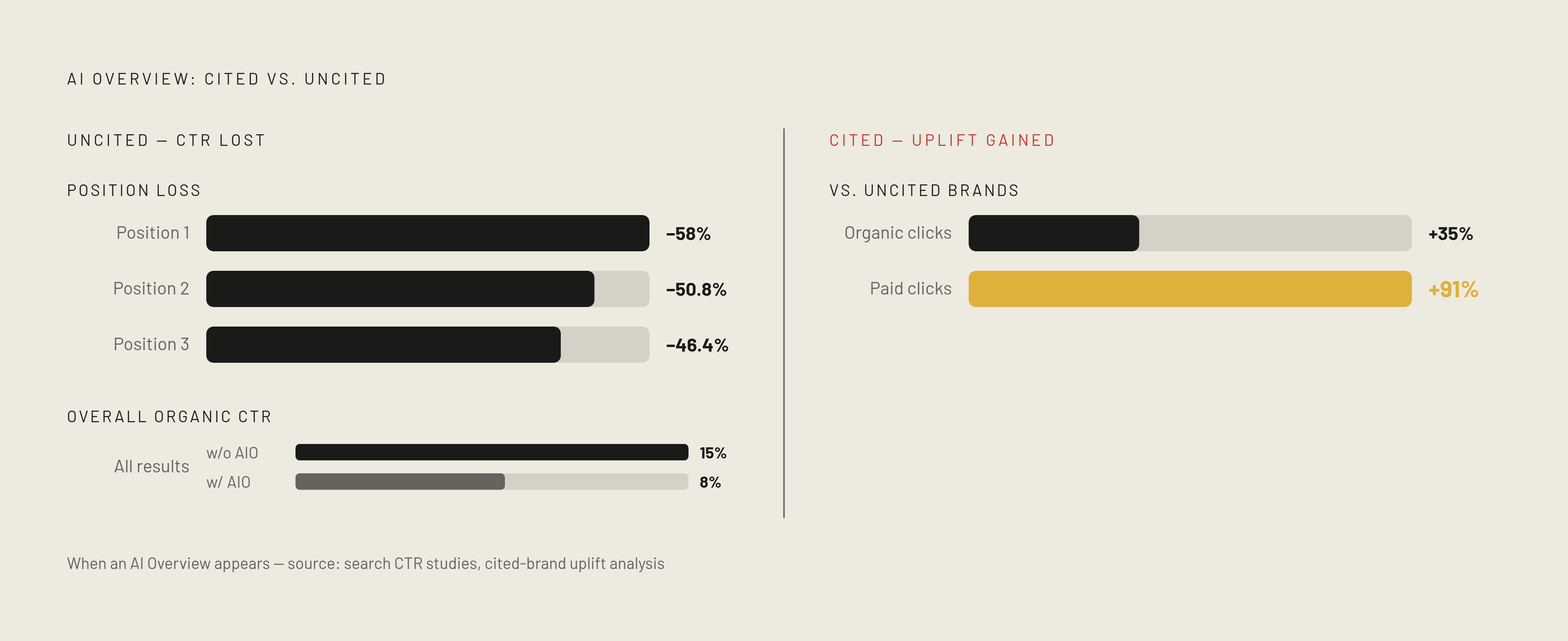
Here's the finding that flips the anxiety in the previous section into something closer to opportunity. Per Seer Interactive, a brand cited inside an AI Overview gets 35% more organic clicks and 91% more paid clicks compared to a brand that isn't cited at all for that same query. Being the summarized answer doesn't just avoid the click loss, it actively pulls in more of it, likely because citation functions as a trust signal that plain ranking never carried with the same weight.
The conversion data backs this up in a way that should reorder budget conversations. Research on high-value topics has found visitors arriving from AI search convert at a meaningfully higher rate than traditional organic visitors do. Fewer visitors, sure, but the ones who show up have effectively already been pre-qualified by an AI system that decided the brand was worth naming.
So the operative question changes shape entirely. It stops being "how do I rank for this keyword" and becomes "how does this piece of content become the source an AI system trusts enough to cite by name." Those aren't the same question, and a team optimizing for the first one while assuming it answers the second is going to watch a competitor's citation count climb while its own rankings stay perfectly healthy and perfectly irrelevant. That's the uncomfortable part: a team can do everything the old playbook said to do and still lose, because the playbook was written for a game that changed the rules mid-season.
Two kinds of brands are showing up in competitive results right now. One loses clicks every time an AI Overview appears. The other gets amplified by it. The difference isn't budget, and it isn't talent. It's whether a structured framework exists to earn the citation in the first place, which is the subject of the three-layer model below.
Worth flagging: this shift moves faster than old-school SEO timelines. Adding specific statistics and clearly structured answers to a page can shift AI citation visibility within 30 to 45 days. Traditional ranking improvements typically operate on much longer timelines. That asymmetry alone should change how a content team prioritizes its next sprint.
The three-layer visibility model that replaces rank-and-click thinking
Rank-and-click was a single-lane road. Competitive search in 2026 runs three lanes at once, and a brand that only drives in one of them gets passed by the other two.
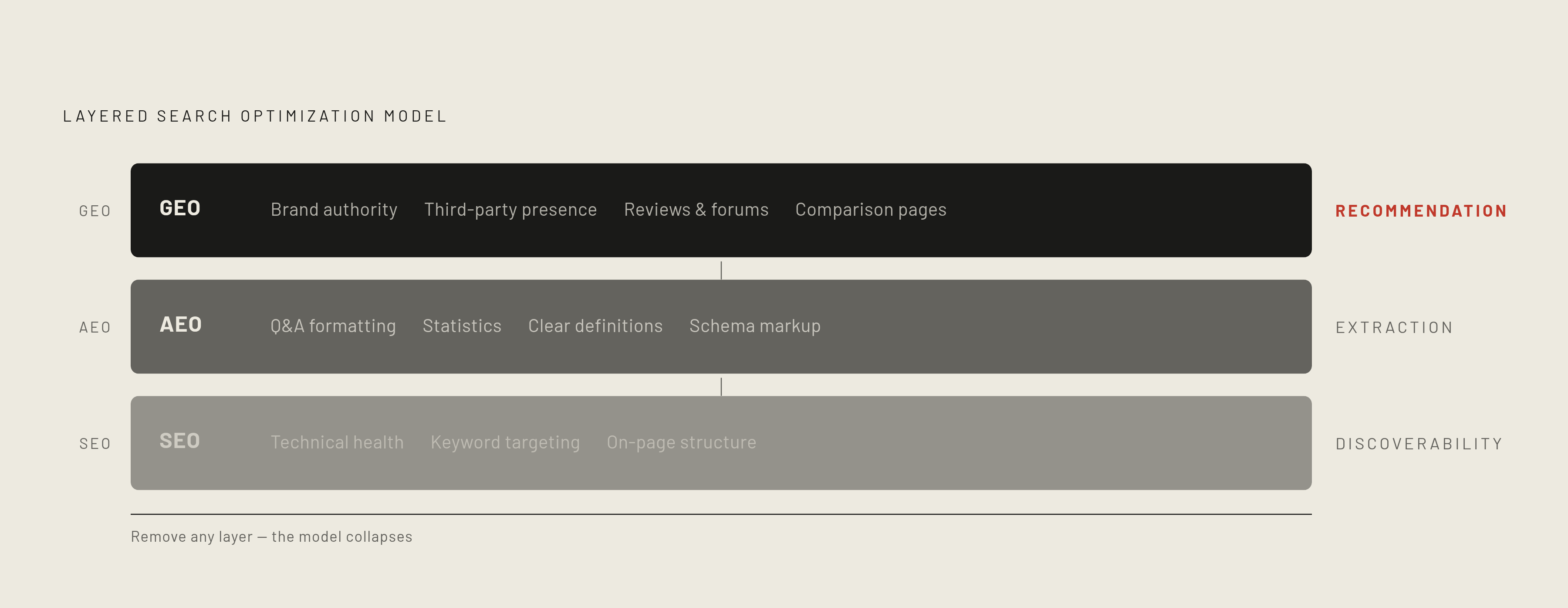
Layer one is SEO, and it hasn't gone anywhere. Technical health, keyword targeting, on-page structure: these remain the foundation everything else stands on. Google still holds close to 90% of global search engine market share as of early 2025, so traditional search isn't dying, it's redistributing where the value lands. SEO on its own now produces diminishing returns in informational categories, the ones AI Overviews summarize most easily. But AEO and GEO without an SEO foundation underneath them have nothing to draw authority from either. Neither layer replaces the other. They lean on each other.
Layer two is AEO, Answer Engine Optimization, the discipline of structuring content so a machine can pull it out cleanly and cite it. The goal is showing up as the cited source in featured snippets, knowledge panels, and AI Overviews themselves. The mechanics are concrete: specific statistics instead of vague claims, direct question-and-answer formatting, clear definitions stated plainly, and schema markup that tells a crawler exactly what kind of content it's looking at. This is content built to be pulled apart and extracted, not just read start to finish by a human with time on their hands. ChatGPT processes 2.5 billion prompts a day, and 65% of those qualify as search behavior. AEO stopped being a bet on the future somewhere around the time those numbers became current.
Layer three is GEO, Generative Engine Optimization, and it's the least intuitive of the three because it's mostly not about the page at all. Recent analysis from mid-2026 found GEO runs predominantly strategic and only marginally technical: positioning, ecosystem presence, and earned brand authority do more work here than any on-page trick. AI engines routinely pull from comparison pages, review sites, community forums, documentation, and third-party mentions that have nothing to do with a brand's own domain. So presence across the web that a brand doesn't control can matter as much as the content sitting on the web that it does. Quick honesty check here: GEO and AEO get used almost interchangeably by practitioners in the field, and no settled academic definition separates them cleanly as of early 2026. That's a live terminology mess, not a hidden nuance being glossed over.
If someone tells a team to pick one of the three and go deep, that's bad advice, full stop. SEO builds discoverability, AEO earns extraction, GEO earns recommendation, and a brand needs all three running at once to compete in a search environment where AI Overviews now touch close to half of all queries.
Topical authority and content clusters: the framework AI retrieves at scale
Topical authority is the perceived expertise a site holds over a specific subject area, and Google's systems reward comprehensive coverage of that subject over isolated keyword-matching every time. This is the governing principle behind cluster architecture, and it's the most underused lever in competitive content strategy today, full stop.
The mechanics aren't complicated. A pillar page covers a broad topic with real authority. Cluster pages branch off it, each going deep on one specific sub-topic. Internal links run in both directions between pillar and cluster, which spreads authority across the group, signals semantic depth to a crawler, cuts down on pages competing against each other for the same keyword, and surfaces the entity relationships machine systems use to understand what a site actually knows.
Here's the finding that should reorder how competitive markets think about content investment. Observed patterns suggest sites with a larger number of interconnected pages on a topic get cited in Google AI Overviews even when their specific cluster page ranks well outside the top positions in traditional organic search. The AI system was evaluating the cluster as one authoritative unit, not judging each page in isolation. A well-built cluster sitting at position 10 can out-cite a standalone page sitting at position 3. Sit with that for a second, because it inverts the logic ranking teams have operated under for two decades. The individual page is no longer the unit of competition. The cluster is, and most content calendars are still built page-by-page like it's 2015.
Research has found content organized into clusters drives meaningfully more organic traffic than standalone pieces, and holds its rankings for meaningfully longer. On sites that have already built topical authority, brand-new cluster pages can start picking up Search Console impressions relatively quickly after publishing, often before a single backlink has arrived. On sites without that established authority, the identical piece of content, same word count, same research, same author, can sit invisible for months. That gap is topical authority showing up directly in the data, not a theory about it.
A practical build sequence: pin down the core topic first, map how wide the pillar page needs to be, audit whatever content already exists for cluster fit, find the coverage gaps, and build the internal link architecture before publishing a single new page rather than bolting links on afterward as an afterthought. Worth connecting this back to the AEO layer directly: a cluster functions as an answer ecosystem in its own right. Each page targets a specific sub-intent, which makes the whole group machine-readable and citation-ready across several query types at once, rather than betting everything on one page answering one question perfectly.
Search intent mapping as the connective tissue between content and conversion
Most competitive search results are packed with content that nails the keyword and completely misses why the person typed it in. That mismatch was always expensive. AI Overviews make it more expensive, because misaligned content simply never gets cited. The AI has no reason to summarize an answer to a question the searcher wasn't asking.
Four categories cover most of the working model here: informational, navigational, commercial investigation, and transactional. Each calls for different depth, different structure, and a different call to action at the bottom of the page. Confusing them isn't a minor styling error. It's a mismatch between what the page offers and what the reader came in wanting.
Why does this matter more now specifically? AI Overviews summarize informational content with real efficiency, which means brands whose content library skews entirely toward how-to guides and explainers are the most exposed to the click collapse described earlier, the same pattern described in the case study above. Commercial investigation and transactional content is a tougher nut for AI to fully synthesize on its own, because it requires comparing named brands, citing specific pricing, and carrying trust signals a language model can't generate credibly out of thin air. So the strategic move here isn't subtle: shift more content investment toward commercial and decision-stage material, because that content requires comparing named brands and carrying trust signals that make it harder for AI to fully synthesize on its own.
One might argue most B2B teams already know this and just haven't acted on it. Maybe. But the data suggests a structural reason beyond inertia. Only about 5% of B2B buyers are in an active buying window at any given moment, according to Ehrenberg-Bass Institute research cited in Whitehat's 2026 analysis. A documented intent map keeps the other 95% fed with content built to stay mentally available for whenever they do enter the market, while the 5% who are ready right now run into content actually built to close.
The mapping process itself isn't exotic. Look at what's currently ranking for a target keyword, because the content types Google already surfaces there tell you what intent it has confirmed for that query, whether anyone agrees with that classification or not. Assign every planned piece to a specific intent stage before it gets briefed, not after a draft comes back and someone tries to retrofit a purpose onto it. And flag the informational queries where AI Overview prevalence already runs high, then ask honestly whether that piece should get restructured to earn a citation instead of chasing a click that mostly isn't coming anymore.
None of this works detached from a revenue number either. SMART goal-setting, per Content Marketing Institute's research, only functions when the goals tie to specific intent stages. "Generate pipeline" as a goal requires commercial-intent content sitting inside the framework somewhere, not a content calendar stacked entirely with awareness-stage blog posts and a hope that volume eventually converts.
Competitive content analysis as an ongoing input, not a one-time audit
Competitive content analysis, done properly, is a systematic look at what competitors are covering, how they're formatting it, what SEO tactics they're running, and how they're distributing it. Not so a team can copy the homework, but so it can see where the market is saturated and where it's wide open.
Three outputs matter here, and they should feed directly into framework decisions rather than sitting in a slide deck nobody opens again. Coverage gaps show topics competitors have skipped or covered thinly, where original and genuinely authoritative content has room to claim a cluster position outright. Format signals show what kind of content actually earns links, citations, and engagement in a specific vertical, which should shape production decisions instead of defaulting to whatever format is easiest to produce. AI citation patterns show which competitors already show up inside AI Overviews for shared target queries, and what their cited content has in common structurally, whether that's depth, entity coverage, or a strong third-party citation trail.
Here's the discipline piece most teams skip, and it's the one that actually matters: competitive analysis done once, at the moment a strategy gets written, decays within months in any market that's actually moving. It has to run as a quarterly review, not a one-time project filed away and forgotten.
Finding the real competitive set takes some cross-referencing too, because it's often not the obvious brand list. Keyword research shows who consistently ranks for the target queries. Industry publication mentions show who gets cited as a thought leader by people outside the company. Social platform presence shows who's actually part of the conversation happening in real time. Layer all three together and the real competitive set that emerges is frequently different, sometimes wildly so, from the list of "known competitors" sitting in a sales deck.
The AI citation angle deserves its own look, separate from the general competitive scan. When a competitor turns up inside an AI Overview for a shared query, that's a data point worth reverse-engineering: examine the structure of what got cited, how deep it goes, how it covers related entities, and what third-party sources back it up. What is the AI actually rewarding there? Answer that specifically enough, and the gaps competitors left open stop looking like ordinary ranking opportunities. They start looking like citation vacuums, spots where a well-built cluster page has a real shot at becoming the AI's default answer simply because nobody's built the thing that deserves to be cited yet.
The measurement system that keeps a framework honest
None of the preceding sections mean much without a way to check whether they're working, and this is where most content operations quietly fall apart. Per Content Marketing Institute research cited by Whitehat, 58% of B2B marketers say content helped generate sales and revenue over the past year. And 58% also say they still struggle to attribute ROI to content efforts. Same number, opposite direction: the work is producing results, but the measurement infrastructure underneath it can't prove that on paper, which makes it nearly impossible to defend a budget in the next planning cycle.
A framework needs two tiers of metrics running side by side, because leading indicators and lagging indicators answer different questions and neither substitutes for the other. Leading indicators catch framework health early: Search Console impressions tracked by cluster rather than by individual page, AI Overview citation frequency for target queries, topical coverage depth measured against competitors, and time-to-first-impression for any new cluster page that goes live. Lagging indicators catch the business outcome at the end of the chain: marketing-attributed pipeline, MQL-to-SQL conversion rate broken out by content type, cost per lead by content category, and average sales cycle length specifically for deals that touched content somewhere along the way.
Stop treating raw organic traffic as the scoreboard. That's the single biggest mistake sitting inside most reporting dashboards right now, and it's worth saying plainly instead of hedging around it. A page can lose the majority of its clicks to an AI Overview and still be the single most valuable asset in the entire content library, if it's the thing getting cited by name every time that query gets asked. Traffic without citation context is a number missing its unit, and building a framework in 2026 that still leads with it is a bit like measuring a marathon in steps instead of miles. Technically a number. Just not the one that tells anyone whether the race went well.