Audience Segmentation for Content Personalization at Scale
Layered segmentation prevents personalization from collapsing at scale.
Audience segmentation for content personalization works only when it's built as a layered system rather than a one-time carve-up of a customer list. Get the layering wrong, or skip straight to demographic buckets and call it done, and personalization collapses back into generic noise the moment an audience doubles in size.
That's the scaling paradox worth sitting with for a second: the bigger an audience gets, the more tempting it is to default to one-size-fits-all content, and that's precisely the moment relevance starts to erode. It's a bit like a restaurant that nails a ten-table dining room, then opens a 400-seat banquet hall and starts microwaving everything. Research on customer expectations puts a number on the stakes: 71% of customers expect personalized experiences, and 76% say they get frustrated when they don't receive one, according to a Contentful research synthesis. Twilio's 2024 research goes further and puts a price tag on that frustration: 64% of consumers say they'd stop using a brand entirely if the experience felt impersonal. That's a retention floor collapsing under a company's feet.
There's a perception problem tangled up in all this, too. A large majority of companies believe they personalize well, but far fewer of their customers agree, per the same Contentful synthesis. That 25-point gap is the whole article in miniature: companies confuse having segments with using them well. A spreadsheet full of tidy buckets does the job of a filing cabinet, sitting there rather than steering anything.
What segmentation actually means when personalization is the goal
Segmentation, at its most basic, means dividing a broad audience into subgroups based on shared characteristics. That's it. It's the precondition for personalization at scale, which is the payoff: adapting content dynamically to each user's behavior so interactions stay relevant even as volume climbs into the hundreds of thousands or millions.
The distinction matters more than it sounds like it should. Segmentation is structural, the scaffolding. Personalization is operational, what actually happens on that scaffolding. Plenty of programs stall out because a team builds the scaffolding, admires it, and never gets around to building anything on top.
Practitioners widely recognize multiple types of segmentation: demographic, behavioral, psychographic, technographic, transactional, contextual, lifecycle, and predictive. Most teams start with demographic, because it's the easiest data to collect and the cheapest to buy. It's also, inconveniently, the least predictive of what content someone actually wants to read next. The more powerful layers, behavioral, predictive, contextual, take real infrastructure and real intent to build. Nobody backs into a predictive model by accident.
Scale, in this context, means segments that hold their accuracy without someone manually rebuilding them every quarter, rather than a simple pile-up of more segments. The goal is a system where audience understanding compounds as data piles up, not one that needs to be re-carved from scratch every time the subscriber count doubles.
The segmentation layer that most teams stop at — and why it isn't enough
Demographic segmentation sorts people by age, gender, income, education, job title, the census-form stuff. In B2B, its cousin is firmographic segmentation: company size, industry, revenue band, seniority. Both are useful for establishing fit. Neither tells a content team a thing about timing.
This is the layer that powers ad platforms like LinkedIn Matched Audiences or Facebook Custom Audiences, and for paid media targeting, it's table stakes. Nobody's arguing it's useless. But table stakes for an ad buy is a different thing than a foundation for content personalization, and treating it that way is where a lot of programs quietly go wrong.
Here's the honest limitation: demographic data tells a marketer who might be interested. It says nothing about whether that person is ready to act, what problem they're wrestling with this week, or whether they'd rather read a 2,000-word guide or watch a four-minute video. Take a B2B example: a firmographic segment defined as "mid-market SaaS companies, 500 to 2,000 employees, fintech vertical" describes a shape of company. It says nothing about where that account sits in a buying cycle, or what they've already read on the site three times this month.
And demographic segments are static by design. They don't twitch when someone's behavior shifts, when a prospect who was casually browsing suddenly starts comparing pricing tiers at 11 p.m. on a Tuesday. Forrester research summarized by Adobe found that only 18% of B2C consumers believe retailers actually meet their experience needs, a fairly damning sign that demographic-only personalization reads as generic static to the people on the receiving end.
Demographic data still earns its keep as floor one of a building. The fix is addition, layering the rest of the structure on top rather than discarding what's already poured.
Behavioral and psychographic signals as the engine of content relevance
Behavioral segmentation groups people by what they actually do: purchase history, content engagement, feature usage inside a product, which pages they keep returning to, how recently and how often. It beats demographic cuts for one simple reason: it reflects real intent instead of assumed interest.
Picture a B2B account that's visited a pricing page three separate times inside 30 days. That's a signal, not idle curiosity, and it should trigger a different content sequence than the one served to a first-time blog reader who bounced after ninety seconds. In e-commerce, the same logic applies to browse history and purchase patterns, which is what makes product recommendations and win-back emails feel well-timed instead of randomly generated.
Psychographic segmentation digs a layer deeper, into motivation: values, lifestyle, the beliefs steering a purchase decision. Consider the organic food aisle. One shopper buys organic for health reasons. Another buys it because of environmental concerns. A third buys it to support a local farm down the road. Same product, same checkout line, same demographic profile on paper, three completely different reasons to say yes, and three completely different messages that would land.
Getting at psychographic data takes more work than pulling behavioral logs. It usually means surveys, community listening, preference centers where someone volunteers zero-party data because a brand asked a good question at the right moment. It's especially valuable higher up the funnel, where brand storytelling depends on emotional resonance rather than a feature comparison chart.
Put the two together and something useful happens: behavioral data says what someone is doing, psychographic data explains why. Combined, they narrow the field of content options from "plausible" to "likely to convert." The catch is that behavioral data is abundant but noisy, while psychographic data is rich but expensive to collect at any real volume. Neither shows up automatically just because a team bought an analytics dashboard. Both require someone to design the data architecture on purpose.
Where technographic and intent data change the B2B content equation
Technographic segmentation groups prospects by the tools already sitting in their stack, CRM platform, marketing software, dev frameworks, infrastructure choices. It sounds like a minor detail until it isn't: a prospect running one major CRM needs different integration content than a prospect running a competitor's platform. The product pitch might be identical underneath, but it can't be delivered identically on top.
This layer keeps getting more relevant for SaaS, e-commerce, and digital service businesses, where tool affinity turns out to predict both fit and how receptive someone will be to a given message.
Intent-based segmentation sits on top of that, drawing on third-party and behavioral signals that show active research happening inside a category right now. It's arguably the highest-signal input available for timing content delivery. Consider manufacturing companies actively evaluating a specific software category, identified through technographic research. Those accounts need a comparison page, a case study, something bottom-of-funnel, rather than an awareness-stage blog post explaining what the category even is. Intent data is what collapses the "right message, wrong time" failure that quietly wrecks a lot of volume-first content programs, the ones that publish constantly and still can't explain why conversion stays flat.
Lifecycle segmentation rounds this out: knowing whether someone's a prospect, a brand-new customer, an at-risk account, or a loyal long-timer adds context that intent signals alone can miss. A loyal customer researching a new use case for a product they already own needs expansion content, aimed at a very different goal than the acquisition pitch directed at total strangers. Lifecycle stage is what stops the wrong content from landing at technically the right moment.
Stack all four together, firmographic fit, behavioral engagement, technographic context, intent signal, and the result is a segment precise enough to justify building bespoke content for it rather than just hoping the general blog covers it.
How predictive segmentation shifts the model from reactive to anticipatory
Here's the limitation that runs through every segmentation type covered so far: they all describe what already happened. None of them, on their own, say what a user is about to do next.
Predictive segmentation is the attempt to fix that. Machine learning models chew through behavioral signals, attributes, and historical patterns to forecast churn likelihood, next purchase, preferred content format, readiness to convert. Segments update continuously as fresh data comes in, no quarterly refresh meeting required, no analyst manually rewriting rules in a spreadsheet. High-value customers who haven't raised their hand yet start surfacing before they ever fill out a form. Churn risk becomes visible before it turns into an actual cancellation, which opens a window for content to intervene while there's still something to save.
What changes day-to-day for a content team is the question they're asking. Instead of "what did this segment do last month," the question becomes "what is this segment about to need." The editorial calendar stops being a rearview mirror and starts pointing forward.
None of this works without a solid data layer underneath it, a point worth flagging now and returning to shortly. Research finds only a small minority of marketing executives are actually using AI or machine learning extensively, even though most say they believe in its potential. That gap between intention and execution is largely a data-readiness problem, and no amount of new software fixes a data foundation that was never built to support it.
The data infrastructure that makes dynamic segmentation possible
Most organizations aren't short on data. They're short on access to the data they already have. Customer signals sit scattered across a CRM here, an email platform there, an ad system somewhere else, a product analytics tool nobody in marketing has the login for. Fragmentation across platforms is widely cited as what actually makes it hard to adapt personalization strategy.
Customer Data Platforms exist to solve exactly this, stitching fragmented first-party data into one profile that segmentation tools and AI models can actually work with. CDP adoption has grown substantially among marketers worldwide, used alongside their other tools rather than replacing them. Skip this step and predictive models end up running on incomplete inputs, which produces generic segments regardless of how sophisticated the model is.
Modern CDPs are also shifting in what they're asked to do, moving from "collect and unify" toward "decide and act," ingesting streaming data in real time and feeding it straight into models that make next-best-action calls on the fly. Adobe's Real-Time CDP is the benchmark worth knowing: it processes 17 trillion segment evaluations a day, according to Adobe. That's not a number most companies need to hit. It's a useful marker for what true real-time personalization looks like when it's running at full enterprise scale.
For teams nowhere near that scale, the principle still holds even if the raw numbers don't apply. Segment freshness matters regardless of company size, and any architecture that depends on a human manually refreshing segments is an architecture that's already accumulating lag, and lag is relevance decaying in slow motion.
There's a second bottleneck worth naming honestly: even flawless segmentation infrastructure runs into a wall if the content team can't produce enough variants to actually fill the segments that infrastructure defines. Building forty precise micro-segments and then serving all forty the same three blog posts defeats the entire point. The data system and the content production system have to scale at the same pace, or the whole exercise turns into an expensive way to prove a point nobody acts on.
First-party data and privacy constraints reshaping how segments get built
The ongoing deprecation of third-party cookies has knocked out a data source that behavioral and predictive segmentation leaned on for years. Publishers are bracing for real ad revenue declines without a solid replacement in place, and research consistently finds that much of the industry admits it isn't ready for a cookieless environment. That's a substantial share of the industry admitting it isn't ready.
Regulation adds a second layer of pressure that isn't going away. Regulation adds compounding pressure, with GDPR enforcement producing significant cumulative fines across the industry, andve €7.1 billion, with €1.2 billion of that levied in 2025 alone, according to DLA Piper's GDPR Fines Survey. Contentful's research found 50% of companies say privacy rules have made personalization genuinely harder to pull off. Fair enough. Pretending otherwise doesn't make the compliance work disappear.
So the pivot, and it's less a clever workaround than a forced one, runs toward zero-party and first-party data. Zero-party data is what a customer volunteers directly: preferences typed into a survey, answers on a quiz, choices made in a preference center, information traded for a piece of gated content. First-party data is what a brand collects on its own turf: site behavior, email opens and clicks, product usage logs. Neither depends on a third-party cookie that a browser vendor can switch off overnight.
There's a silver lining tucked in here that's easy to miss. Twilio's research found 86% of consumers say personalized experiences make them more loyal to a brand, which means the privacy-respecting approach and the trust-building approach are, for once, pointing the same direction. On the technical side, Secure Privacy research found 67% of B2B companies now use server-side tracking, with data quality improvements averaging 41%, a workable path to behavioral signal collection that doesn't route through a third-party cookie at all. Contextual targeting fills in another gap: AI reading the content of a webpage itself, tone, sentiment, structure, rather than tracking the individual browsing it. It's privacy-compliant by design and getting sharper by the year.
Net effect: segmentation built on first-party data and contextual signals turns out to be sturdier than segmentation built on borrowed third-party data ever was. The friction everyone's complaining about is, somewhat annoyingly, pushing the whole industry toward a better data foundation than it had before.
Building a segmentation system that stays accurate as the audience scales
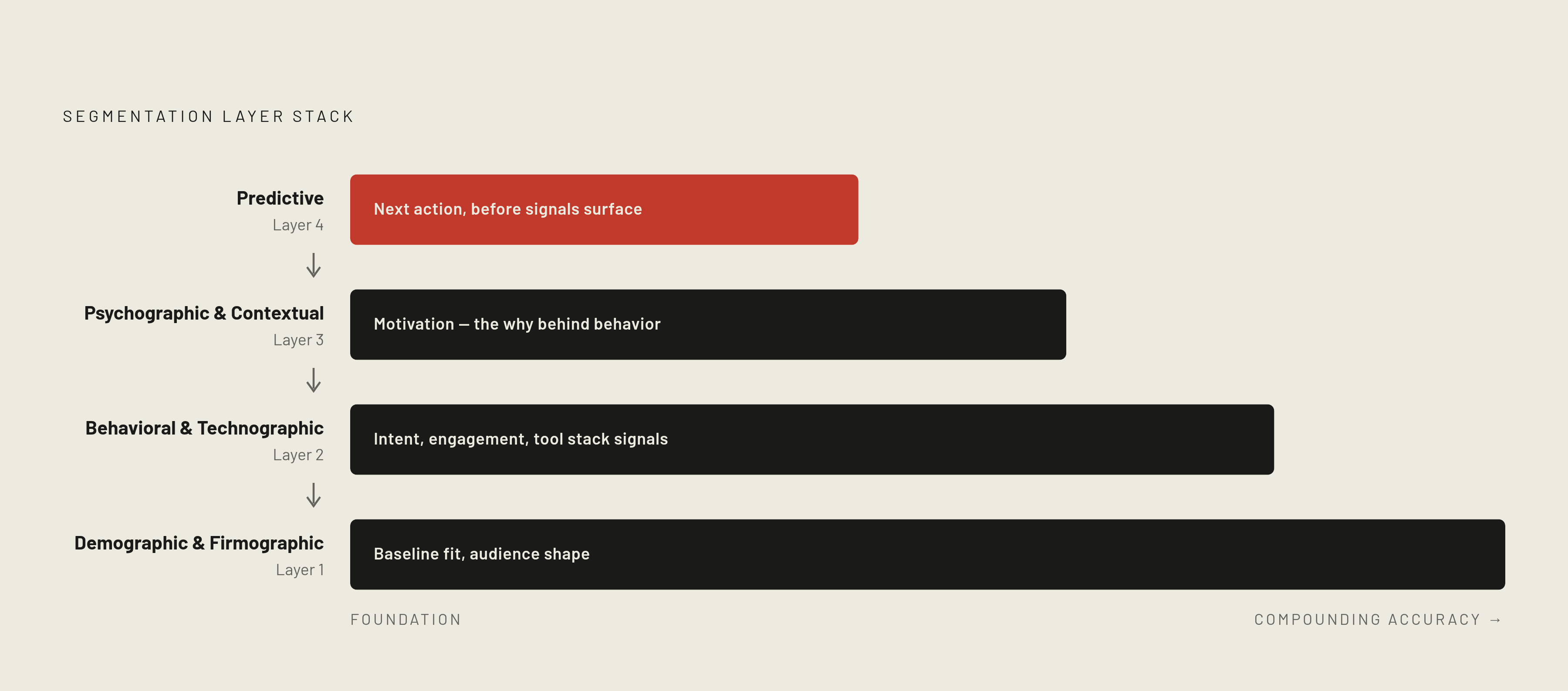
Everything above stacks. Treat it as a stack, not a pile of separate initiatives competing for the same quarterly budget.
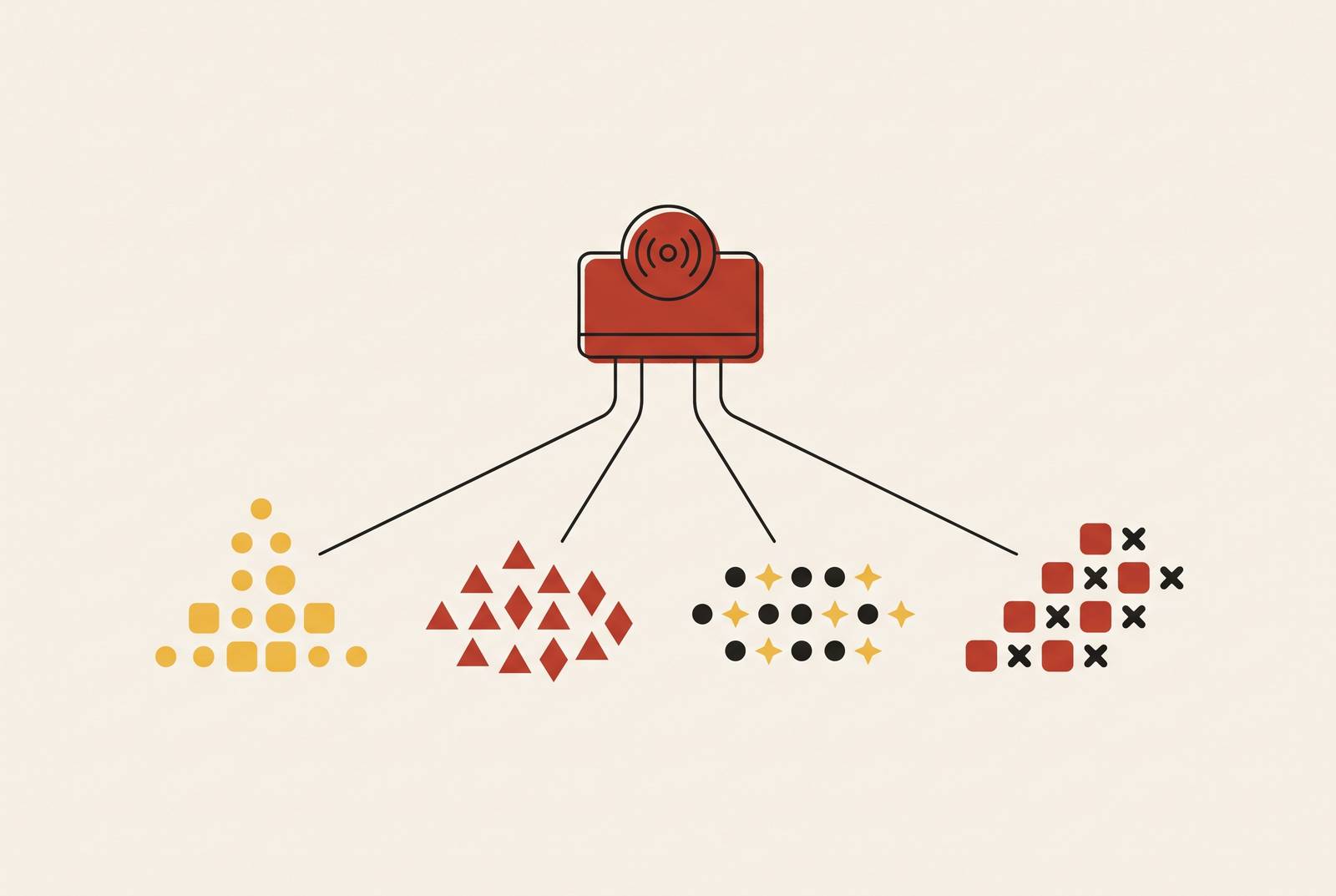
Layer one is demographic and firmographic: it establishes fit and sketches the baseline shape of the audience. Layer two is behavioral: it surfaces real-time intent and engagement patterns as they happen, not as they're reported a month later. Layer three is psychographic and contextual: it adds the motivational depth that explains why the behavior is happening in the first place. Layer four is predictive: it forecasts what comes next and surfaces valuable segments before those people ever raise a hand. Each layer feeds the one above it. The system gets more accurate in combination than any single layer ever manages alone.
None of that holds up without some unglamorous organizational plumbing. Data governance has to mean marketing, sales, and product agreeing on what a segment actually is, because inconsistent definitions across teams send conflicting signals into the content engine and nobody notices until the numbers stop making sense. Segment ownership has to mean an actual person accountable for watching segment health over time, not a one-time project that ships and gets forgotten. And content-to-segment mapping has to mean a clear, written answer, for every segment that exists, to the question: what does this person receive, and when do they receive it?
Skip that last part and the whole exercise, the CDP, the predictive models, the first-party data strategy, becomes an expensive, well-organized list that nobody's actually using. Which loops back to that 85-versus-60 perception gap from the opening: companies that believe they personalize well but customers don't feel it. That gap doesn't close with more segments. It closes when every layer of the stack actually reaches the content someone reads.