AI Adoption Challenges for Marketing Organizations
Most marketers use AI for speed, not revenue—and they're measured on revenue impact.
Advertisement
AI adoption has reached near-universal levels across marketing organizations. Almost none of them have anything to show for it. That finding sits underneath a stack of 2026 industry surveys because it's the defining operational problem for marketing leaders this year: not whether to bring AI in, but why bringing it in hasn't moved the numbers that matter.
Why near-universal adoption has produced so little value
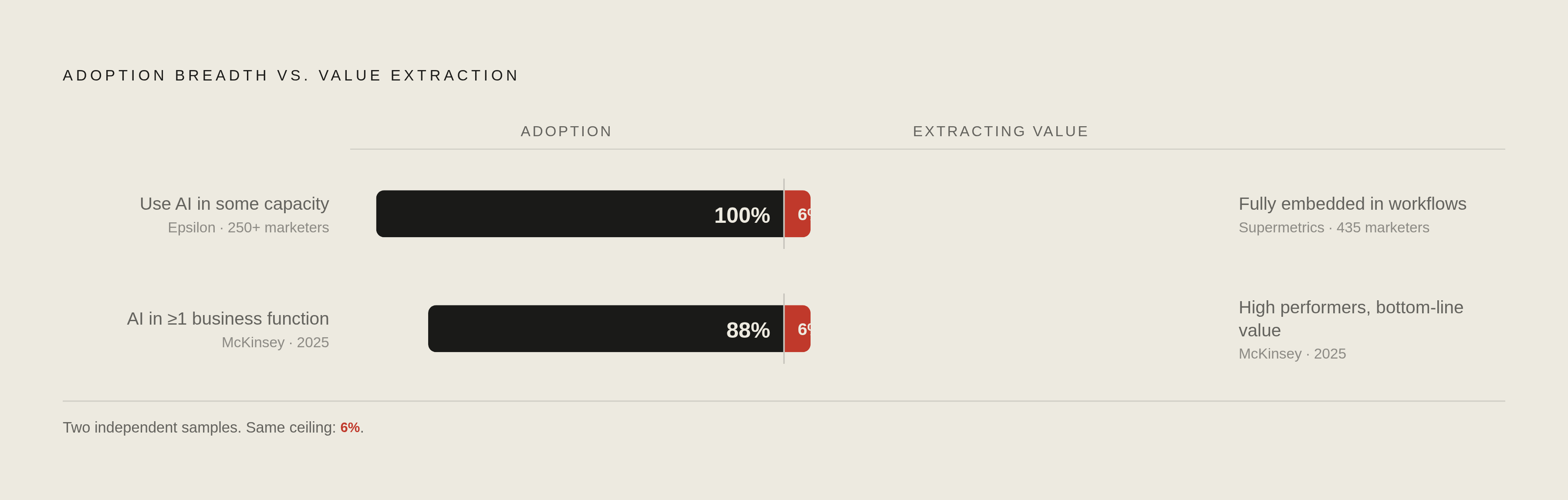
Epsilon's benchmark study, drawing on more than 250 marketing decision-makers, found that 100% of respondents now use AI in some part of their work. Supermetrics' Marketing Data Report, surveying 435 marketers globally, found that only 6% have fully embedded AI into their workflows. Those two numbers sitting next to each other are the whole story.
McKinsey's 2025 global survey landed on the same figure from a different angle: 88% of organizations use AI in at least one business function, yet only 6% qualify as high performers actually extracting bottom-line value from it. Two separate studies, two different sample sets, the same 6%. That's not noise.
The CMO Survey out of Duke and Deloitte adds velocity to the picture. AI now powers 24.2% of marketing activities, up from 13.1% in 2024, nearly doubling in a single year. Adoption is accelerating. Value is not keeping pace, and the gap between the two is widening rather than closing, which makes this a 2026 problem in a way it simply wasn't in 2023, when the conversation was still about marketers trying the tools.
Where the pressure to adopt is coming from
Marketers aren't choosing AI so much as they're being told to use it. Supermetrics found that 80% of marketers feel pressure to adopt AI, and the overwhelming majority of those say the pressure originates from senior leadership or the board. That's a mandate, not a strategy.
And 37% report that leadership has given them no clear AI strategy to execute against. So the order comes down, but the plan doesn't come with it. Marketers are told to move, then left to figure out where.
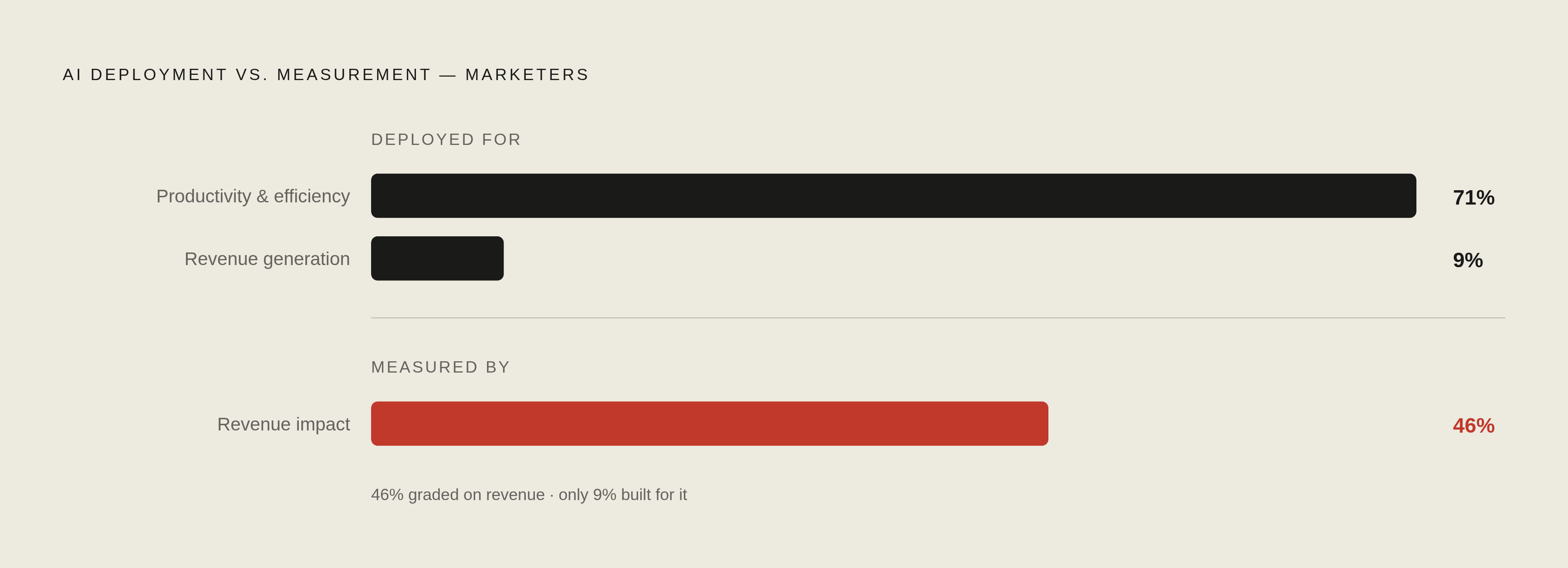
Epsilon's data shows what fills that vacuum. 91% of marketers said AI is "extremely" or "very" valuable to their organization, which sounds like alignment until you look at what they're actually doing with it: 71% use AI primarily for productivity and efficiency gains, while only 9% use it for revenue generation. Yet 46% say they measure AI's performance by revenue impact. Marketers are being graded on a metric that the majority of their AI use was never built to move. Leadership is asking AI to prove things that the majority of teams' AI use was never built to move, a structural mismatch between what's asked and what's deployed.
The data ownership problem that stalls AI before it starts
AI models are only as good as the data feeding them, and in most marketing organizations, marketing doesn't control that data. Supermetrics found that 52% of marketers say data strategy and measurement decisions sit with external teams, and only 31% of CMOs are meaningfully involved in those conversations.
When IT owns the data pipeline, it optimizes for what's easy to collect and easy to govern, not for what a campaign manager actually needs to make a real-time call. That mismatch breaks the feedback loop AI is supposed to create. According to Supermetrics, half of marketers report waiting one to three business days for data team support, and real-time support remains rare. A three-day wait for a data pull defeats the entire premise of automated optimization, which depends on iteration speed measured in minutes, not business days.
IBM's research on this points to a deeper structural cause: many organizations are running on data environments that have been fragmented and siloed for decades, long before generative AI ever entered the conversation. Layering a model on top of that doesn't fix the fragmentation, it just exposes it faster. Poor data quality weakens model performance directly, so the AI tool is underperforming because it was handed a bad diet. It's underperforming because it was handed a bad diet.
The governance gap widens as AI gets more capable
Governance is improving, just not quickly enough to match what AI systems can now do on their own. IBM found that AI-specific governance roles grew 17% in 2025, and the share of businesses with no responsible-AI policy at all fell from 24% to 11%. Real progress, but a gap that size, at this stage of deployment, is still a live risk rather than a solved problem.
Agentic AI systems can now complete tasks across multiple applications, make decisions, and touch sensitive data with limited human oversight, and most organizations still don't have policies for monitoring what those systems do, reviewing the decisions they make, or assigning accountability when something goes wrong. A model that recommends a headline is one kind of risk. A model that autonomously adjusts a media budget across five platforms overnight is another kind entirely, and the governance infrastructure for the second scenario mostly doesn't exist yet.
Compounding that, many organizations can't fully explain how their own AI systems prioritize actions or arrive at conclusions. Scaling an autonomous system you can't explain is a governance liability, and regulators are starting to treat it that way. GDPR compliance, audit trails, and documented responsible-AI practices are turning into baseline expectations rather than aspirational ones, particularly across financial services and healthcare, where the cost of an unexplainable decision is measured in more than lost revenue.
The skills gap and the meaning of "comprehensive training"
Skills gaps rank among marketers' top AI challenges, and only a small minority say they've received comprehensive, job-specific training. Those two figures explain a lot of what's happening (or not happening) inside the vast majority who haven't reached embedded use.
There's a real difference between having used a generative AI tool and having been trained to embed one inside a specific job function's actual decision loop. Most marketers have done the former. Almost none have done the latter, which is why so much AI use inside marketing teams still looks like a faster way to do the same old task rather than a genuinely different way of working.
The target keeps moving, too. The CMO Survey projects AI will power 55.9% of marketing activities within three years, more than double where it stands now. Closing a skills gap against a number that's rising that fast requires a training investment that most organizations haven't budgeted for, and the divide is visible in company size. Whitehat's research found that close to half of companies with revenue over $5 billion have reached AI scaling stage, compared with 29% of companies under $100 million in revenue. Large enterprises can fund structured, ongoing training programs. Smaller marketing teams generally can't, and that gap compounds every quarter it goes unaddressed.
What the 6% who are extracting value do differently
Supermetrics frames the gap as not a tooling problem. It's a strategy problem, a data-readiness problem, and a governance problem, and the organizations in that 6% closed all three before they scaled anything.
Aprimo's research points to the same distinction from a different angle. The highest-performing companies treat AI as a reason to redesign how work happens rather than as a feature bolted onto a process that was already broken. Workflow redesign comes first. Tool deployment comes after, and reversing that order is a large part of why so many organizations bought AI tools and got nothing back.
The scaling numbers tell the same story from the agentic side. 62% of organizations are experimenting with agentic AI, but only about a third report having scaled agents across the organization. The bottleneck sitting between those two numbers is operational architecture, since everyone has access to capable technology now. The organization needs to have built the workflow, the data pipes, and the review checkpoints an agent actually needs to operate inside.
A pattern is emerging among the organizations that have made it work, structured as a six-stage pipeline: strategy, briefing, generation, review, activation, measurement. AI carries the volume and the structure at each stage. Humans hold the goals, the judgment calls, and the quality gates. That division of labor, not the sophistication of any single tool, appears to be what separates the 6% from everyone else.
Agentic AI and the stakes for organisations still in the gap
The shift from generative AI to agentic AI changes what's at risk for organizations still stuck in the adoption-value gap, and it's happening fast. IBM describes agentic systems as ones that make decisions, coordinate tasks, and complete multi-step workflows with limited human involvement, a meaningful step beyond a chatbot drafting copy. Gartner projects that 33% of enterprise software applications will include agentic AI by 2028, up from under 1% in 2024.
The nearer-term numbers are just as steep. Gartner expects AI agents embedded in 40% of business applications by the end of 2026. The global AI agent market has already reached $12 billion in 2026 and is projected to hit $52.6 billion by 2030, a 46.3% compound annual growth rate. This isn't a slow-rolling trend anyone can afford to wait out.
Traditional marketing automation runs on rigid if-then logic: a lead does X, the system triggers Y. Agentic AI evaluates several factors at once, learns from what happened last time, and adjusts its own behavior without waiting for a human to approve each step. That's a different category of capability, and it comes with a different category of risk.
For an organization with fragmented data and no governance framework, in other words, most organizations, agentic AI doesn't fix the underlying problem. It amplifies it, because a flawed decision made by a human happens once, while a flawed decision embedded in an autonomous agent's logic can repeat at scale before anyone notices. IBM's warning about agents making flawed decisions at scale isn't a hypothetical for the future. It applies to the exact conditions most marketing organizations are operating under right now.
Why most marketing teams are missing AI answer visibility
While marketing teams have been sorting out internal workflow problems, the ground underneath their content strategy has shifted. Google AI Overviews reduce organic click-through rates by as much as 61% for informational queries, and zero-click searches, searches where the user gets an answer and never clicks through to a website, now account for somewhere between 58% and 69% of all searches. The traffic model most content strategies were built on is disappearing while they're still optimizing for it.
Ranking on Google and getting cited inside an AI-generated answer are two different jobs, and content built for the first doesn't automatically win the second. That distinction matters enormously for any team whose entire content operation was built around traditional SEO, because the skills, structures, and formats that earned rankings don't reliably earn citations from ChatGPT, Perplexity, Gemini, or Claude.
Citation sources are also far more concentrated than most marketers assume. Across the major AI answer engines, verified, structured, and widely distributed data accounts for the majority of distinct citation sources cited in response to a query. Being a well-known brand isn't sufficient anymore. Being well-structured and well-distributed is what actually earns the citation, and that's a genuinely different exercise from building domain authority the old way.
The clearest evidence of that difference: brand mentions appear to drive AI citation probability more than backlinks do. Backlinks were the foundational authority signal for a decade of SEO practice. For generative engine optimization, they matter significantly less, and teams still building their measurement dashboards around backlink counts are tracking a signal that's losing relevance in the exact system they're trying to influence.
This is also where the adoption-value gap becomes a measurement problem as much as a strategy problem. Most marketing teams can report on efficiency gains from automated tools, hours saved, drafts produced, campaigns launched faster, but very few can say whether that machine-generated content is actually being surfaced and cited by the systems their own customers are now querying instead of Google. Platforms built specifically to track that, like Letterstory, measure whether ChatGPT, Claude, Gemini, and Perplexity actually name and cite a brand's content, which surfaces a question most dashboards never answer: is the content strategy landing in AI-generated answers, or is it disappearing into the general web with everything else. Without that visibility layer, a team can hit every internal efficiency metric and still have no idea whether the work is reaching anyone.
The content and publishing infrastructure that earns AI citations
Owning a domain and publishing consistently on it is necessary, but it isn't close to sufficient. A brand's own website accounts for only a small minority of the sources AI search tools reference when they answer a question, and the large majority of AI citations come from earned media rather than owned content.
An AirOps analysis of more than a billion citations found that brands get cited through third-party sources at a rate many times higher than through their own domains. The implication is direct: a publishing strategy that lives entirely on a brand's own site leaves most of the available citation opportunity untouched, no matter how much content that site produces.
What earns citations on owned properties, where they do count, tends to share a structural trait: topical cluster architecture that covers a subject's full semantic range, rather than isolated posts chasing individual keywords one at a time. AI answer engines are synthesizing across sources to build a complete answer, and a site organized around comprehensive topic coverage gives them more surface area to draw from and more reason to cite it as an authority on the subject, rather than one voice among many saying the same narrow thing.
Sources
- The Biggest AI Adoption Challenges for 2026 | IBM
- Why AI adoption in marketing is stalling at 6% what to fix first (According to the 2026 Marketing Data Report)
- AI-Driven Marketing Strategies to Implement in 2026
- AI in Marketing 2026 | Whitehat
- 2026 benchmark study: Marketing's AI inflection point
- The Biggest AI Adoption Challenges for 2026 | IBM