Competitive Content Gap Analysis Methodology
Find what your competitors rank for that you don't—and understand why it actually matters.

Competitive content gap analysis is a process, not a tool export, and treating it like one is the fastest way to burn a quarter chasing keywords that were never the real problem. Done right, it means inventorying what a site already has, mapping what competitors rank for, sorting the difference by topic and funnel stage, and turning that into a roadmap with actual priorities attached. Keyword gap analysis is one piece of that, not a stand-in for it: it tells you which search terms competitors rank for that a site doesn't, which is a narrower question than "what content is actually missing." Confuse the two and the deliverable is a spreadsheet, not a strategy, and spreadsheets don't rank for anything.
A single content gap, say a missing buyer's guide for a product category, can contain thirty or forty individual keyword gaps stacked inside it. Treat keyword research as the whole job and the roadmap collapses into a list of terms with no plan attached. Teams that stop at the export tend to build content that covers ground already crowded with competitors, because nobody checked whether the topic itself was the problem or just the specific queries circling it.
Most content that goes live never earns a single visitor from organic search. That's not bad luck spread evenly across the internet. It's what happens when a topic gets written because someone thought it sounded relevant, not because a competitor was already eating that specific lunch, which is the problem Letterstory's automated topic curation was built to catch before a word gets drafted. What follows is the seven-step process that actually catches the gaps worth filling, starting with the four kinds of holes a complete audit has to account for.
The four types of gaps a complete analysis must catch
Keyword gaps get the most attention because they're the easiest to see: a competitor ranks for a query, the site doesn't, done. That visibility is exactly why most teams stop there, and stopping there is the mistake. A keyword gap is often just the visible tip of something bigger.
Topic gaps sit a level up: an entire subject, not a keyword cluster, that a competitor covers and a site hasn't touched at all. It's the difference between missing one recipe and never having opened the cookbook.
Quality gaps hide behind existing content that looks fine at a glance. The topic's covered, technically, but the page is three years stale, or it skims where competitors go deep, or it reads like it was written to hit a word count and nothing else. That's a coverage problem wearing a coverage win as a disguise.
Originality gaps deserve their own category, and treating them separately from quality gaps is warranted for good reason. Content can be current, well-researched, and still say nothing that isn't already sitting in the first five results. Thorough and forgettable at the same time, which is its own particular flavor of failure.
Each of these needs a different fix, and that's the whole reason the taxonomy matters instead of being an academic exercise. A keyword gap wants new content. A quality gap wants a refresh. An originality gap needs something to actually say that isn't being said already, and more words won't fix that. More words just make the sameness longer.
Google's patent on "Contextual Estimation of Link Information Gain," filed in 2018 and granted in 2022, formalized the idea that content repeating consensus carries a weaker signal than content adding something new. Originality gaps aren't just a strategy problem anymore. They're an algorithmic one too, worth sitting with before anyone assigns a writer to "cover the same topic, but better."
Format gaps thread through all four categories rather than standing alone as a fifth. A competitor's comparison page, calculator, or buyer's guide might close a topic gap, a quality gap, and an originality gap all at once, just by existing in a format the site never built. That gets its full treatment in Step 5, once funnel stage enters the picture.
Step 1: Scoping the analysis before any tool is opened
Before touching Ahrefs or Semrush or anything else, decide what the analysis is actually supposed to answer. A full-domain audit is a different animal from a single product category, and both differ from checking why one cluster lost traffic after an algorithm update. Skip this decision and every later step inherits the confusion, no exceptions.
Tie the scope to something the business actually wants: pipeline from a specific product line, topical authority in a niche, recovery after a ranking drop. Whatever the goal, it determines which gaps deserve attention later. A pipeline goal makes a high-volume informational gap low priority even if it looks like an easy win on paper, and that's worth saying twice because it's the exact spot where teams talk themselves into the wrong roadmap.
Scope also decides the competitor list, and that list won't look the same for every project. A company chasing enterprise buyers in one category and self-serve signups in another shouldn't run both against the same five competitors, because the SERP that matters to one buyer is barely visible to the other.
The mistake that wrecks this step almost every time is trying to analyze everything at once. That produces a gap list with hundreds of rows and no way to act on any of them. A scoped analysis produces something closer to a roadmap instead, because the boundaries force prioritization rather than leaving it for later, when there's no time left to do it properly.
The output here is small on purpose: a paragraph, maybe two, stating what's in scope, what's out, and what counts as success. Write it before opening a single tool. It reads like busywork. It's actually the thing keeping the whole project from sprawling into a spreadsheet nobody finishes.
Step 2: Auditing existing content to build an honest baseline
Pull every indexed URL before looking at a single competitor. Screaming Frog, Ahrefs Site Audit, and Google Search Console's Pages report all do this job, and most teams already have access to at least one of them sitting unused in a browser tab somewhere.
Tag each URL on four dimensions: topic cluster, the keyword or query it's actually targeting, funnel stage (top, middle, bottom), and date last updated. That last one matters more than it sounds, since a two-year-old post nobody's touched is a decay candidate whether or not a competitor has shown up to make it obvious.
This audit surfaces problems before any competitor data enters the picture at all. Topics with zero coverage show up. So do outdated posts that need a rewrite rather than a brand-new article sitting next to them, duplicating the effort nobody asked for. Funnel imbalance shows up too, almost every time: most sites are stacked with awareness-stage content and have close to nothing in the middle. Redundant URLs, three different posts all circling the same topic without ranking for any of it, show up as consolidation opportunities rather than gaps at all.
This inventory becomes the comparison layer for everything downstream. A competitor ranking for something is only a gap if the site doesn't already have a page for it buried somewhere in this spreadsheet. Skip this step and there's a real risk of "discovering" a gap that's actually an old, poorly optimized post nobody remembered existed, sitting on page four of a sitemap gathering dust.
The deliverable: one spreadsheet, one row per URL, tagged across all four dimensions. Ugly, but it's the working document for the rest of the process, and it should stay ugly. Prettying it up wastes time better spent on Step 3.
Step 3: Identifying the real SERP competitors, not just business rivals
Most analyses go sideways right here, before they've even started: the competitor list a sales team worries about is rarely the competitor list that actually shows up in search results. SERP competitors are whoever holds the ranking positions for the topics in scope, full stop, regardless of whether they sell anything comparable to what the business sells.
By 2026, that list looks different than it did a few years back. Aggregators and review sites, G2, Capterra, industry-specific directories, dominate high-intent commercial keywords in B2B categories especially. "Best of" roundups and affiliate blogs frequently outrank the actual brand sites on comparison queries, which is a strange thing to sit with if the brand in question is the one making the product being compared. Discussion forums, Reddit and Quora chief among them, have picked up meaningful visibility for question-intent queries most brands never bother optimizing for directly, and YouTube shows up first for a lot of how-to searches, which is as much a format problem as a content one.
The practical move here is simple: search each in-scope topic and write down who's actually sitting in the top positions. That's the competitor list for this analysis. Not the CRM list. Not the list from last quarter's board deck.
Skip this step and the whole downstream analysis rests on a flawed premise. Analyzing only direct business rivals means missing the aggregators and forums pulling the highest-intent traffic away entirely, and a roadmap built on that incomplete picture underperforms no matter how well the rest of the process runs.
Step 4: Extracting and filtering competitor keyword data
Most SEO platforms surface three flavors of data worth pulling here. Keyword Gap shows terms every identified competitor ranks for that the primary site doesn't touch at all. Keywords in Common shows overlap, both site and competitors rank for the same query, useful less for finding new gaps and more for spotting quality or originality problems hiding inside existing content. A third category flags terms where competitors rank and the site ranks too, just badly, which is its own quiet kind of embarrassment.
Raw exports are noisy, so filter hard. Prioritize terms where three or more competitors rank at once, since a gap only one rival occupies is a weaker signal, possibly just luck or a quirk of their internal linking rather than a real opportunity. Set a minimum threshold (100 monthly searches is a reasonable floor) and require some direct relevance to the product or audience, because volume without relevance is a distraction dressed up as an opportunity. Filter by intent too: if the underlying goal is pipeline, purely informational queries with no commercial angle should drop down the list even when the volume looks tempting on the surface.
What this export won't tell anyone is whether a given gap is a topic gap, a quality gap, or an originality gap. That distinction needs eyes on the actual content, which is exactly what Step 6 covers.
The output at this stage is a filtered list, annotated with competitor count per term. Not a roadmap yet. Just the raw material Step 5 turns into one.
Step 5: Mapping gaps to the buyer's journey and spotting funnel blind spots
Three stages to sort the gap list against: awareness, where the audience is discovering the problem exists at all; consideration, where they're comparing options; and decision, where they need proof before signing anything.
The pattern that shows up in nearly every B2B content audit is almost boringly consistent: heavy investment at the top of the funnel, a near-empty middle, and a thin bottom. That usually mirrors exactly what the Step 2 inventory already showed, a good sign the two steps are measuring the same underlying problem from different angles rather than surfacing two unrelated issues.
Leaving the middle of the funnel empty is the expensive mistake, and it's the one most teams make without ever noticing they've made it. Research on B2B buying behavior has consistently found that a substantial majority of buyers engage with a salesperson only after they've already made their decision. Consideration-stage content is doing the actual selling in a room where no salesperson stands. If that content doesn't exist, nobody's advocating for the product at the exact moment the buyer is choosing between it and something else.
Format gaps live here too, and mapping them against funnel stage sharpens the pattern considerably. Comparison pages, ROI calculators, and buyer's guides sit mostly in the middle of the funnel and carry outsized leverage, and they're the pieces most often missing entirely. Case studies and integration guides sit at the bottom and are frequently absent in B2B specifically. Interactive tools and video might be missing at any stage, not because nobody thought of them but because they cost more production effort than a blog post ever asks for.
As a planning benchmark, A commonly referenced content gap planning benchmark suggests something close to a 40/30/30 split across awareness, consideration, and decision content. It's a rough target, not a law, but it's a useful gut check against a site running something closer to 80/15/5, which describes more sites than anyone in content strategy likes to admit out loud.
B2B and B2C diverge here in ways worth naming separately. B2B's longer sales cycles and multiple stakeholders mean consideration and decision gaps deserve more weight, and there's a real measurement problem tangled up in this: a persistent pattern in B2B content strategy shows that teams often describe their approach as sophisticated while rarely tracking pipeline contribution as an actual metric. The measurement gap and the content gap are, in a sense, the same gap wearing different clothes. B2C skews differently: volume and intent signals carry more weight, and "best X for Y" comparison content tends to dominate regardless of funnel stage.
The output of this step is the Step 4 keyword list, now tagged by funnel stage and format. The shape of the actual holes should be visible at this point, not just a list of terms but a picture of exactly where the site runs thin.
Step 6: Manual deep-dive to find what tools cannot surface
Keyword tools show where a competitor ranks. They don't show why, and they can't tell the difference between a topic gap and an originality gap sitting inside content that technically covers the subject already. This is the step teams skip most often, which is exactly backward, since it's the one no software can do for them.
Backlinko's guidance here is straightforward: read the top-ranking articles for each priority topic and pay attention to what they leave out. Comments sections and forum threads often surface the questions nobody answered in the main piece. Outdated statistics an article still leans on are worth flagging, since a page can rank well today on numbers pulled from three years back. Watch for missing practical depth, articles that state a principle confidently and never show it actually working, and look for perspectives the entire top-ten consensus seems to be ignoring, because that's often where the real opening sits.
AI tools speed some of this up without replacing the reading itself. Clearscope analyzes semantic term coverage at the single-page level. MarketMuse works across topic clusters and full site inventories. Frase pulls SERP subtopics directly into content briefs. None of them read the way a person does, but they flag patterns fast enough to earn the subscription cost. A quicker, cruder version: feed ChatGPT a competitor's H2 structure next to the site's own outline and ask what questions the competitor answers that the site doesn't. Blunt, but it surfaces structural gaps in about thirty seconds.
Entity coverage turns "add more depth" from a vague note into something countable. If the top-ranking content for a topic collectively mentions 60 distinct entities, and a site's cluster covers 35 of them, the other 25 are a specific, actionable list, not a feeling somebody had after reading five articles in a row.
Before committing to fill any gap, run it through one test: can the planned piece add something genuinely new, original data, a documented use case, a perspective nobody else has taken, or would it just restate what the top ten already say in different words? If it's the latter, the gap probably isn't worth the writing time, no matter how attractive the keyword volume looks on the surface.
That test carries more weight now than it used to. During the volatility of late 2025, content demonstrating first-hand experience saw meaningful visibility gains, while sites filling gaps with generic, mass-produced text saw visibility drops as steep as 71% in product review categories following the December 2025 Core Update. Originality isn't a nice-to-have layered on top of the gap analysis anymore. It's closer to a prerequisite for the content surviving contact with the algorithm at all.
Step 7: Extending the gap audit to AI search citation gaps
Ranking well in Google no longer guarantees a site shows up in the AI-generated answers where a growing share of research now starts. That's a different kind of gap entirely, one that needs its own audit rather than an afterthought bolted onto Step 4.
The scale involved isn't small, and it's not slowing down either. ChatGPT reached 900 million weekly active users as of February 2026, up from 400 million a year earlier, per OpenAI's own reporting. AI Overviews now trigger on roughly 48% of tracked queries, a 58% jump year-over-year according to BrightEdge's analysis. None of that reads like a rounding error, and none of it gets caught by a rank tracker built for ten blue links.
Traditional rank tracking misses this shift because the two surfaces have started to pull apart from each other. Brandlight's research found the overlap between top Google links and the sources cited in AI answers has fallen from around 70% to below 20%. Ranking on page one used to be a decent proxy for AI citation. It isn't anymore, and treating it as one is a good way to lose an entire category of visibility without noticing until the traffic drop shows up in the quarterly numbers.
The audit itself is fairly mechanical: run the twenty most important in-scope queries through ChatGPT, Perplexity, and Google's AI Overviews, and record which pages get cited for each. Any query where a competitor shows up and the site doesn't is a gap, and it's one no keyword tool will ever flag on its own.
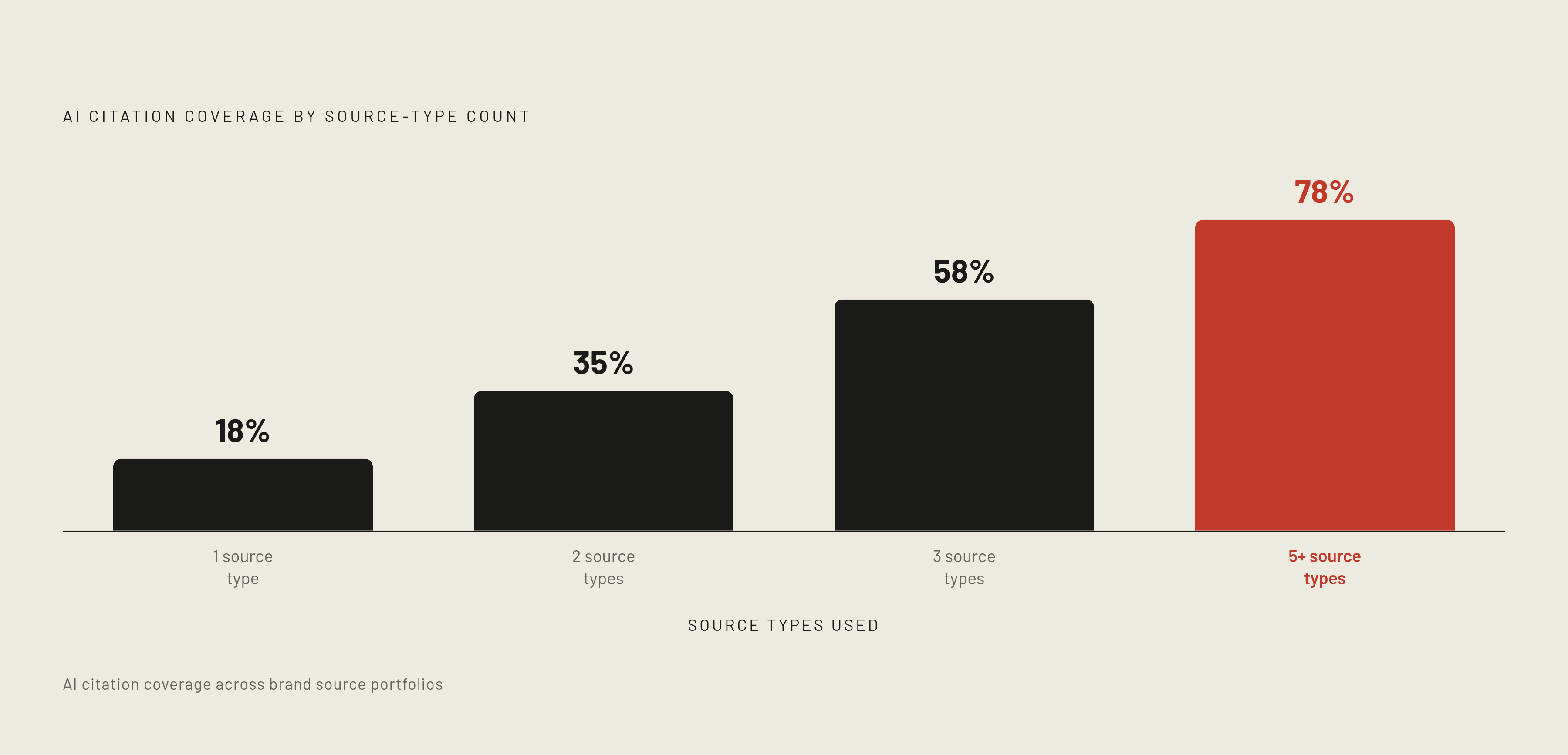
What actually earns a citation is worth knowing before building anything new to chase it. Comparison content leads every other format, accounting for 32.5% of AI citations according to research cited by the Digital Agency Network. More strikingly, 68% of AI citations pull from third-party sources; only 32% come from brand-owned content, which means optimizing a company's own site addresses less than a third of the surface that actually matters. Source diversity compounds this further: available data shows brands relying on a single source type average 18% AI coverage, two source types climb to 35%, three reach 58%, and five or more reach 78%. Showing up in more places, not just publishing more on the owned site, is what actually moves that number.
Tracking this is its own emerging category, worth naming the players in rather than gesturing vaguely at "tools exist." Platforms like AirOps run daily prompt tracking across ChatGPT, Gemini, Perplexity, and Google's AI Mode and Overviews, and AirOps' own research across more than 45,000 citations found that brands both cited and mentioned by name were 40% more likely to resurface in later answers than brands cited without a name attached. Profound, Semrush's AIO tools, Conductor, Passionfruit, Lumar, and Scrunch AI sit in the same general category, each tracking some version of where and how often a brand shows up inside AI-generated answers.
The gap between interest and action here is wide enough to be its own finding, and maybe the most telling number in this entire piece. 92% of marketers say they plan to optimize for AI search. Only 40.6% actually are, and that gap between intention and execution is really the same gap this whole methodology exists to close. Knowing where the holes are is the easy part. Building the roadmap that fills them, in the right order, for the right reasons, is the whole job, and it's the part that doesn't fit in a keyword export no matter how many columns get added to it.