Content Operations Manager vs Managing Editor vs Content Strategist
Three distinct roles shape content output: strategy, production, and operations.
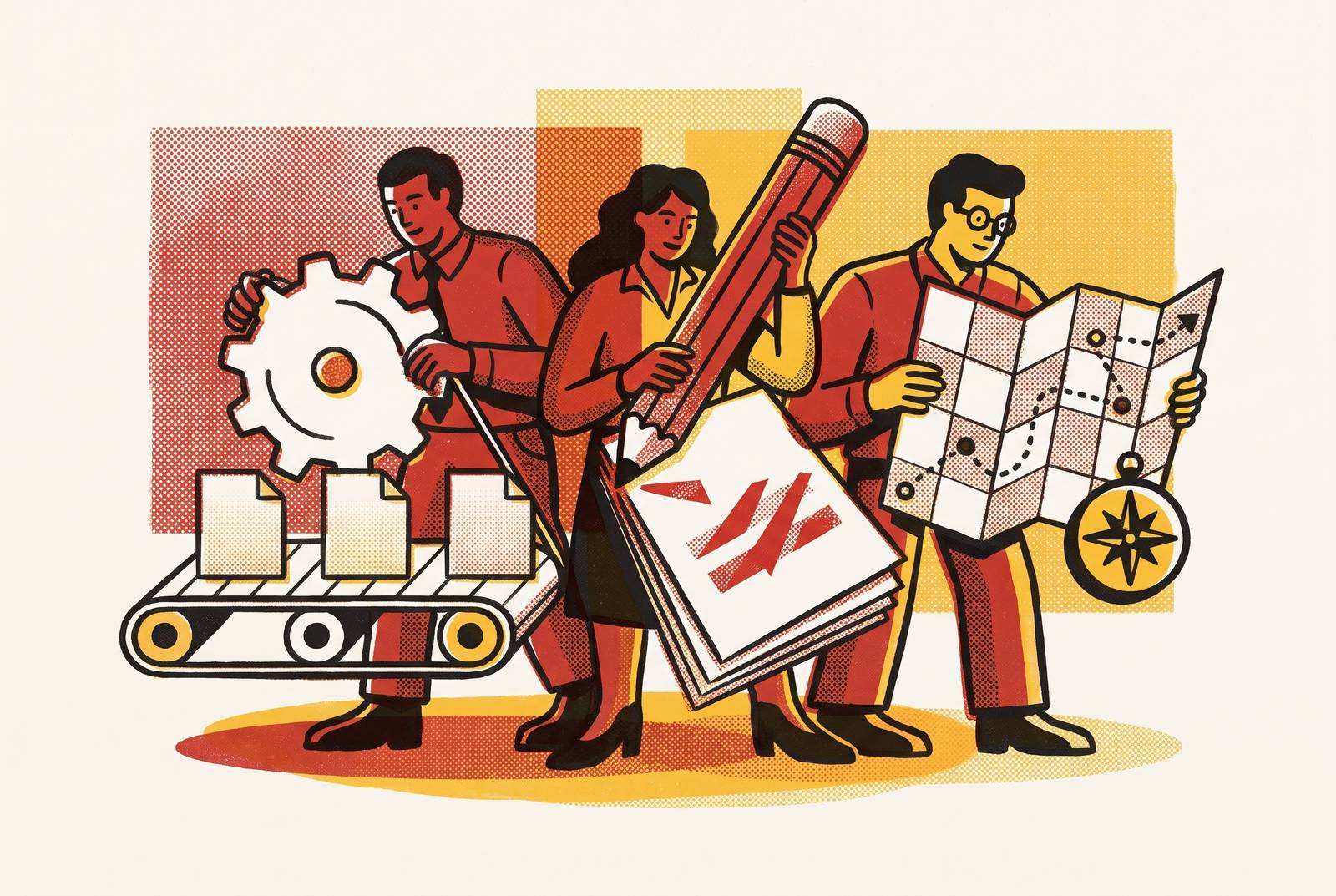
Content Operations Manager, Managing Editor, and Content Strategist own different layers of the content lifecycle: the system, production, and strategy. Mixing up who owns each layer is a main reason teams stay busy without getting results. The useful comparison is therefore not which role is most important, but which function lacks an owner and what breaks because of that gap.
Why content teams stay busy without producing results
Writing is easy to see in a report. The decisions about what the writing should achieve are harder to see, so teams often hire writers before they have briefs or hire agencies before they have set goals for the content. Work begins, deadlines accumulate, and publication becomes the clearest sign of progress. Yet a team can execute well against the wrong goals, or produce steadily without any shared direction.
Titles can make that gap harder to spot. A company hires a content strategist but assigns mostly writing work, while an agency sells a strategy package that consists of content production. The title suggests that someone owns direction, even when nobody has time to set it. This is an ownership problem before it is a talent or budget problem, because capable people cannot fill responsibilities that remain unnamed.
What the Content Strategist actually owns
The Content Strategist owns what gets made, for whom, and why. That responsibility includes audience research, keyword and topic architecture, the content roadmap, and the performance framework. None of these are writing tasks in disguise. These tasks help the team spend on content that serves its strategic objectives, instead of picking topics just because someone can write about them.
The strategist’s output is a plan. That distinction does not make the role remote from the work, because the plan must give production a usable direction. Audience research helps the team decide whom the content is for, while topic architecture and the roadmap set out what it should cover. The performance framework then defines how the content effort will be judged, rather than leaving success to whatever numbers happen to be available.
The strategist does not own daily scheduling, author management, or the infrastructure through which every piece moves. When those duties consume the same person’s time without an explicit division of responsibility, urgent production displaces planning. The boundary protects strategy from becoming a document that exists on paper but disappears as soon as deadlines press.
Can the production team act on its direction when urgent work appears? If not, the problem may be the missing connection between strategy and execution, regardless of the quality of the research. The next layer owns that connection.
What the Managing Editor actually owns
The Managing Editor converts strategic direction into scheduled, briefed, reviewed, and published content. The editorial calendar, content briefs, production timelines, quality standards, and author management belong here. This is the layer between deciding what deserves investment and getting a finished piece out the door. Without an owner, production becomes reactive and brief quality degrades, even when the underlying strategy is strong.
Governing production is different from doing production well. A senior author may produce excellent copy, but that does not establish a coherent publishing cadence for the rest of the team. The author manages words, while the managing editor governs the process that produces words at a standard and a pace. Treating those jobs as interchangeable can yield beautiful individual pieces without dependable output.
Quality responsibility makes this more than a scheduling role. In scaled teams, a tiered review structure typically gives junior editors initial quality checks, senior editors tone and narrative, and subject matter experts technical accuracy. A final approver then signs off on the piece. The managing editor decides how those reviews fit into production, because having several people look at a draft does not in itself give the team a process to follow.
Can the person running the calendar reject a brief, push back on a stakeholder, or uphold standards when a deadline is close? If not, the role has been reduced to a scheduling assistant. Responsibility for quality cannot hold when the editor has no power to stop work that fails the standard.
What the Content Operations Manager actually owns
The Content Operations Manager owns the production system itself. This includes documented workflows, content templates, toolstack decisions, calendar infrastructure, capacity planning, and performance reporting infrastructure. The managing editor runs that system from day to day. The operations manager builds and maintains the conditions that make the work repeatable, so production does not depend on someone solving the same problems afresh.
The managing editor owns the quality and readiness of briefs moving into production, while the operations manager owns how briefs are structured within the workflow. Similarly, the editor governs the calendar, while operations owns its infrastructure. Both roles touch quality standards, but at different layers, through editorial decisions on one side and the system supporting those decisions on the other.
Operations includes supplier relationships, vetting, onboarding, and capacity allocation. Without that ownership, knowledge of suppliers sits with individuals and disappears when they leave.
This explains why operations is not chiefly about software. Tools are part of the responsibility, but so are the workflows, templates, and capacity decisions that make those tools useful. In smaller teams, the managing editor often absorbs this work. As a result, it can go undone. The resulting failures are practical and familiar, including missed deadlines, inconsistent briefs, toolstack sprawl, and no repeatable process.
Where the three roles are most commonly collapsed and what breaks when they are
The first common collapse puts strategy and managing editor work into one job without an explicit split of time or authority. The roadmap may exist, and the person responsible may understand it well. Yet production has an immediate claim on their attention. Urgent briefs and deadlines win over planning, so the strategy is never executed consistently despite appearing to have an owner.
A managing editor also becomes responsible for toolstack and workflow decisions because nobody else owns the system. Time that should go toward brief quality and calendar governance goes into maintaining the conditions for production instead. Both layers suffer, even though the team can point to someone who nominally handles each task.
Hiring writers before either function exists creates a different failure. The company has added the most visible part of content production without establishing what the writers should work from. In the absence of briefs, writers define their own assignments. The work then drifts away from the goals because the company has left writers to make strategic and editorial decisions as part of a writing assignment, even when the writers’ choices are sound.
These patterns can look like problems with individual performance. A strategist seems distracted, an editor seems slow, or writers seem unable to deliver the right work. These failures stem from how the functions are sequenced and who owns them. More skill within the same arrangement does not settle who has the time and authority to make the decisions that keep being displaced.
How to audit which layer is actually missing on your team
To turn that diagnosis into action, start with ownership of each layer’s primary deliverable. An answer of “everyone” or “no one” identifies a coverage gap. A named person is only the beginning, however. The audit also needs to establish whether that person has time for the responsibility and authority to exercise it.
For strategy, ask who produced the content roadmap and when it was last updated. If nobody can give both, the strategist’s work is either going undone or buried in someone else’s role. A strategy title alone does not answer the question, because the audit concerns work that actually happens.
For production, ask who writes the briefs and what authority that person has to reject a topic or push back on a stakeholder. If writers create their own briefs or briefs are skipped, managing editor coverage is missing. Then ask who decided how the calendar works, how freelancers are onboarded, and how performance is reported. Decisions made by default, or held only in one person’s head, point to missing operations ownership.
The result need not trigger an immediate hiring decision. One person can cover more than one layer in a smaller team, provided each function is explicitly named and given time. Where added capacity is needed, the gap determines the next hire or fractional engagement. Missing direction calls for a strategist, missing production governance calls for a managing editor, and a system breaking under volume calls for operations, in that order because each layer depends on the one above it.
The same audit becomes more urgent with AI-assisted production. AI adds pressure across the three layers, each of which still needs distinct ownership.
How AI-assisted content pipelines change what each role must own
AI-assisted pipelines expose undefined ownership faster because greater output makes the gaps harder to contain. A team still needs to decide what deserves production, govern how it is reviewed, and maintain the system through which it moves. Faster drafting does not assign those responsibilities.
For the strategist, AI visibility is a direction-setting decision. GEO/AEO requires deciding which queries the brand needs to appear in across ChatGPT, Claude, Gemini, and Perplexity, and what content architecture supports that presence. This is not simply an SEO add-on. It belongs with the decisions about audiences, topics, and objectives that determine why content is made in the first place.
For the managing editor, the added responsibility is human review at each stage of a multi-stage AI pipeline. Who reviews the output, at what point, and with what authority to reject it? A vague “human in the loop” label leaves those questions unanswered. The NIST AI Risk Management Framework calls for clearly defined and differentiated human roles and responsibilities, with documented oversight processes. For content production, that means naming who can make decisions at review gates, since adding a review step alone leaves that open.
Operations owns the system behind that oversight and measurement. As part of owning the toolstack, it now handles AI pipeline configuration, prompt governance, and the infrastructure needed to measure AI answer-engine visibility. Tracking Share of Model across those answer engines is an instrumentation problem, because standard web analytics tools do not capture those signals.
Alation’s listing for a “Sr. Content Operations Manager, GEO & AI Visibility” illustrates how these duties are becoming explicit in hiring. The posting describes “a hands-on role leading generative engine optimization (GEO), SEO, agentic content workflows, and editorial production”. It combines editorial judgment with hands-on AI expertise. That hybrid scope makes naming the functional boundaries more important when one job spans several.
What a team looks like when all three layers are covered
The strategist sets direction, the managing editor turns it into a production cadence, and the operations manager measures what that cadence produces. The evidence then informs the next strategy cycle. No role is a dead end, because each produces something another layer needs to make a better decision.
This does not require a large content department. At small scale, one or two people can hold all three functions, with each responsibility explicitly named and given time. When everyone knows who owns what, a small team can work together in ways that a larger team doing a bit of everything cannot.
In an AI-assisted pipeline, that coordination extends across new demands. Strategy establishes content architecture that supports AI citation, production provides human review for accuracy and brand voice, and operations measures answer-engine presence together with traditional performance. Before hiring, adding AI tools, or commissioning more content, the practical next step is the three-question audit, so the team addresses its missing function.