Tech Stack Audit for a Modern Content Marketing Team
Most content stacks ignore whether AI systems actually cite your brand.

A modern content marketing tech stack audit needs to test more than whether a team can publish and promote. It must also ask whether the brand gets cited in AI-generated answers. Mapping tools to these three jobs exposes a common gap, strong creation and distribution coverage with almost no AI citation infrastructure, before that blind spot becomes a revenue problem.
Why the three-job framing is the right lens for a content tech stack audit
A buyer asks ChatGPT which platform to use, sees a brand named, then searches for that brand days later and converts. The attribution model credits branded search. The AI mention that started the journey gets no credit, even though it helped make the buyer consider the brand. A content team reading the conversion report could therefore miss the channel that first influenced the buyer.
This is not simply an attribution puzzle. Similarweb's 2026 Generative AI Brand Visibility Index found that a large share of US consumers now use AI at the product discovery stage, ahead of traditional search. For content teams, that changes the definition of coverage. A stack needs to support creating content, distributing it, and earning citations in AI-generated answers, because success in the first two does not establish success in the third.
What happens when the audit only examines publishing capacity and traffic? It can declare the stack healthy while leaving an entire discovery channel unexamined. The three-job frame makes that omission explicit. It shifts the question from whether the team has enough tools to whether those tools cover the ways buyers now find and consider brands.
What each of the three jobs actually requires, and why they don't share tools
Creation needs a CMS, editorial planning, help with drafts, and a way to keep the brand voice. Discovery also depends on search engine optimization, or SEO, which targets organic traffic and rank position through keywords, backlinks, and page authority. Its outcome is measured in organic clicks. These tools help teams publish useful pages and make them discoverable, but neither output nor ranking proves that an answer engine cites the brand.
Distribution extends into answer engine optimization, or AEO. This discipline targets featured snippets, AI Overviews, and People Also Ask boxes through structured content, FAQ schema, and extractable short answers. Its measures include zero-click impression share and AI Overview appearances. A rank tracker on its own cannot do all of that.
Generative engine optimization, or GEO, targets brand mentions and citations inside synthesized responses from ChatGPT, Gemini, Perplexity, and Claude. It needs entity clarity, extractability, third-party corroboration, and topic authority built across more than one page. Its measures include share of model, brand mention rate, and citation count by engine, none of which appear in Google Analytics. The disciplines overlap in the content they use. Their tools are not interchangeable, because preparing a page, distributing an answer, and measuring a citation require different capabilities.
How to run the audit by mapping every tool in your stack to one of the three jobs
To turn that distinction into an audit, start with a spreadsheet whose three columns are Job, Tools You Have, and What's Missing. List every tool the content team uses, including paid tools it shares with demand gen or product marketing. Include the CMS, analytics, CRM integrations, social scheduling, and content operations software.
For each tool, ask which job it primarily serves. CMS platforms, editorial calendars, AI drafting assistants, brief generators, and brand voice libraries belong under creation. Keyword research, rank tracking, backlink analysis, social publishing, email, syndication, and paid amplification belong under distribution. Tools for entity grounding infrastructure, structured data implementation, third-party presence builders, and AI visibility measurement go under citation. Assign by actual use.
Then count the tools assigned to each job. Most teams will find well-stocked creation and distribution rows and a nearly empty citation row. The count is a starting point because several tools can still leave the same capability uncovered. For each citation gap, name the missing mechanism, whether entity recognition, extractability, third-party corroboration, or measurement. That makes the exercise a coverage audit rather than simply a search for redundant subscriptions.
What the creation column of the audit should surface beyond standard tools
A creation stack can make pages that work well for human readers but are hard for AI systems to parse. Retrieval-augmented generation pulls text chunks from pages and uses them to synthesize answers. Context can be lost at that boundary. A passage that only makes sense after several surrounding paragraphs is less useful for extraction than a self-contained answer.
The creation audit should therefore examine the published page as well as the editor. Does the CMS deliver static HTML with schema on pricing, feature, and comparison pages, or do key sections depend on JavaScript rendering? With JavaScript-dependent pages, AI crawlers may largely encounter empty templates. Does the brief put the key claim or answer in the first section? These are content architecture questions as much as writing questions.
Ownership needs attention too. The audit should establish who handles FAQ schema, comparison tables, and organization schema. It should also check whether the workflow around AI drafting tools has source verification, claim review, and a human publish gate. Drafting speed is only one creation capability. The workflow faces a harder test when it must produce accurate content that still makes sense after it is extracted from the page.
What the distribution column should cover now that AI Overviews are a mainstream surface
Keyword rank and backlink tracking still have a purpose, but they do not describe every surface where content appears. The distribution audit should ask whether the SEO platform tracks AI Overview appearances on their own, apart from organic rank. Their appearance patterns differ. A report built around positions and clicks can leave direct-answer visibility unmeasured even when the team has a substantial SEO toolkit.
Access is another part of distribution coverage. Is robots.txt checked regularly for rules that inadvertently block AI crawlers? Cloudflare changed its default settings for new domains to block AI Training and Agent bots on pages that show ads while still allowing Search bots. Teams using that configuration may therefore have restricted AI bot traffic without choosing to do so explicitly. The audit needs to distinguish those bot categories rather than treating crawler access as a single setting.
Does the publishing plan cover the full sub-question map for a topic, or only one strong cornerstone page? AI systems use depth across related pages as a signal of topic authority when deciding which brand to cite. A strong individual page is not the whole structure.
The real gap most audits expose is almost nothing in the AI citation column
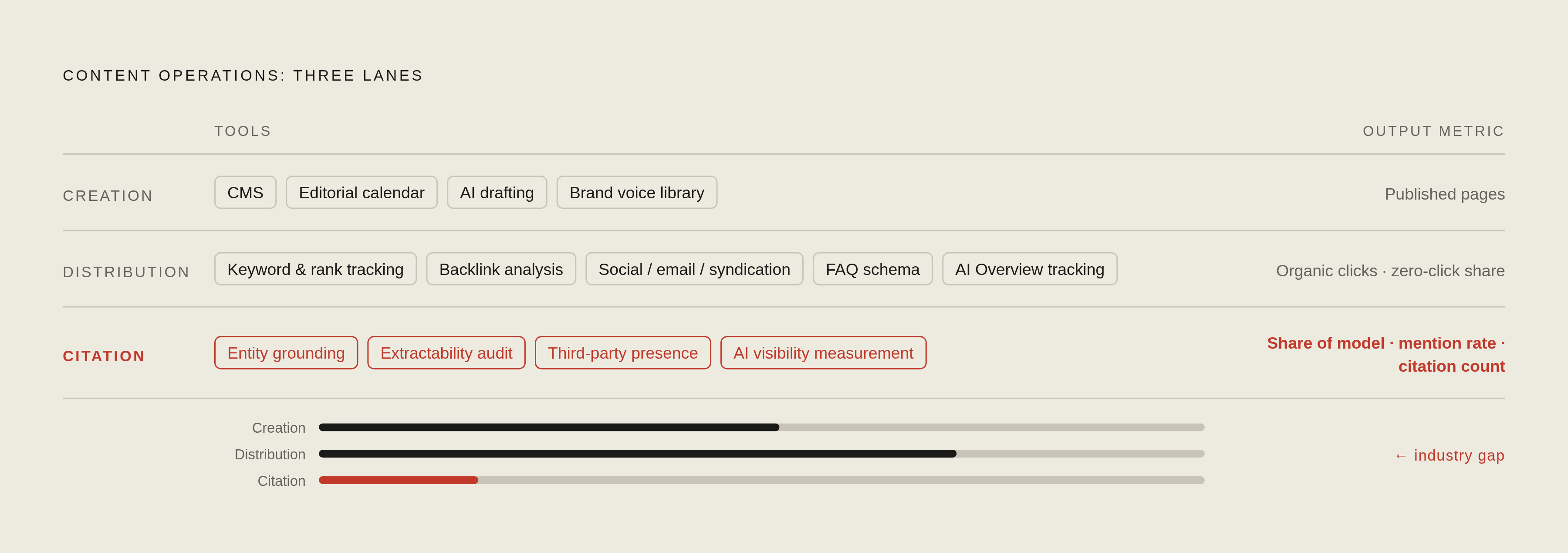
The citation gap is structural. A CMS publishes pages, an SEO platform tracks rankings, and analytics reports visits and conversions. None of those functions automatically establishes a brand's entity footprint or measures its presence in generated answers. A team can operate every existing tool well and still lack both capabilities.
The first missing layer is entity grounding. Without a Wikidata entry and consistent organization schema with same-as properties linking to LinkedIn and Crunchbase, a brand lacks the footprint described here for entity recognition. More publishing does not repair that absence. Whether the brand has useful things to say and whether AI systems can recognize the organization behind them both matter.
The second missing layer is measurement. Without a tool that sends category-relevant prompts to ChatGPT, Claude, Gemini, and Perplexity and tracks brand mentions and citations, the team has no feedback loop for GEO. It cannot tell whether its work is improving visibility in those answers.
What filling the AI citation gap actually requires in the stack
To evaluate what closes the gap, score four capabilities as covered, partially covered, or missing. Start with entity grounding. This includes a Wikidata entry, organization schema with same-as properties linking to LinkedIn, Crunchbase, and the About page, and a fact-dense grounding page in encyclopaedic HTML with JSON-LD. These assets give AI systems externally checkable evidence about the brand. Their accounts of the organization need to agree.
Next, score content structured for extractability. Look near the top of pages for facts that make sense on their own, and check for consistent heading hierarchies, FAQ schema that answers direct buyer questions, and comparison tables on competitive pages. This capability reaches back into the creation stack. A citation tool does not replace the publishing workflow that produces extractable material.
The third capability is a systematic third-party presence program. It places original claims, data, and expert commentary in the source pool AI systems draw from, rather than treating every placement as SEO link-building. Priority surfaces include Reddit, where freshness is important, Wikipedia, G2/Capterra and other review platforms, YouTube, and editorial media mentions. This work requires coordination among content, PR and community teams, making workflow and tooling part of the assessment.
Finally, score AI visibility measurement. The layer should run structured category prompts across all four engines and track whether they name the brand, cite it, and say positive things about it. Its outputs should include share of model, brand mention rate, and citation count by engine. All four capabilities belong in the stack as ongoing infrastructure.
How the content pipeline itself must evolve to serve all three jobs at once
For the revised stack to work, every piece must go through creation, distribution preparation, and AI-citation optimization as part of the workflow. The brief is where those requirements begin. It should specify which topic cluster the piece strengthens, which structured formats and schema it will use, and where human review occurs before publication.
AI drafting tools can accelerate creation, but they do not automatically make the output extractable by answer engines. A draft sent straight to publication skips that review. The pipeline therefore needs source verification and claim review, then checks that key passages make sense on their own and have the required structure. A human publish gate keeps speed from becoming permission to bypass quality control.
Advanced content teams are also moving toward agentic workflows. These include watchers that draft when something relevant happens, standing monitors that track competitor citations and content gaps, and publishing pipelines that run on a cadence. Their operational value is the ability to sustain the freshness that AI systems reward without dropping the review gate. The pipeline becomes the recurring engine behind all three jobs, turning new information and visibility signals into reviewed, prepared content.
Turning the audit into a repeatable process, not a one-time exercise
The audit needs a cadence because source diversity, content freshness, entity corroboration, and engine-specific mention rates change faster than a traditional SEO audit would catch. Engines also diverge. Brand mention rates differ across ChatGPT, Claude, Gemini, and Perplexity and shift as models are updated. Watching only one engine leaves the team unable to see that divergence.
Monthly, run structured prompts across all four engines and track brand mention rate, citation rate, and sentiment. Quarterly, repeat the three-column audit, assess new tools in the citation category, and review whether Wikidata, schema, llms.txt, and the grounding page are current and consistent. Treat llms.txt cautiously, because no major AI provider has confirmed parsing it. On publication, check each piece for structured headings, a self-contained key claim, schema, and key sections that do not depend solely on JavaScript rendering.
The aim is to add a separate view of the channel that may introduce a buyer to the brand before branded search receives the conversion credit. With recurring measurement, fresh publishing, and an ongoing third-party program, teams can manage that presence. The next invisible mention need not leave the team without a way to assess the channel behind it.