Model Context Protocol Impact on Content Team Workflows
MCP replaces manual copy-paste workflows with standard connections across content tools.
Advertisement
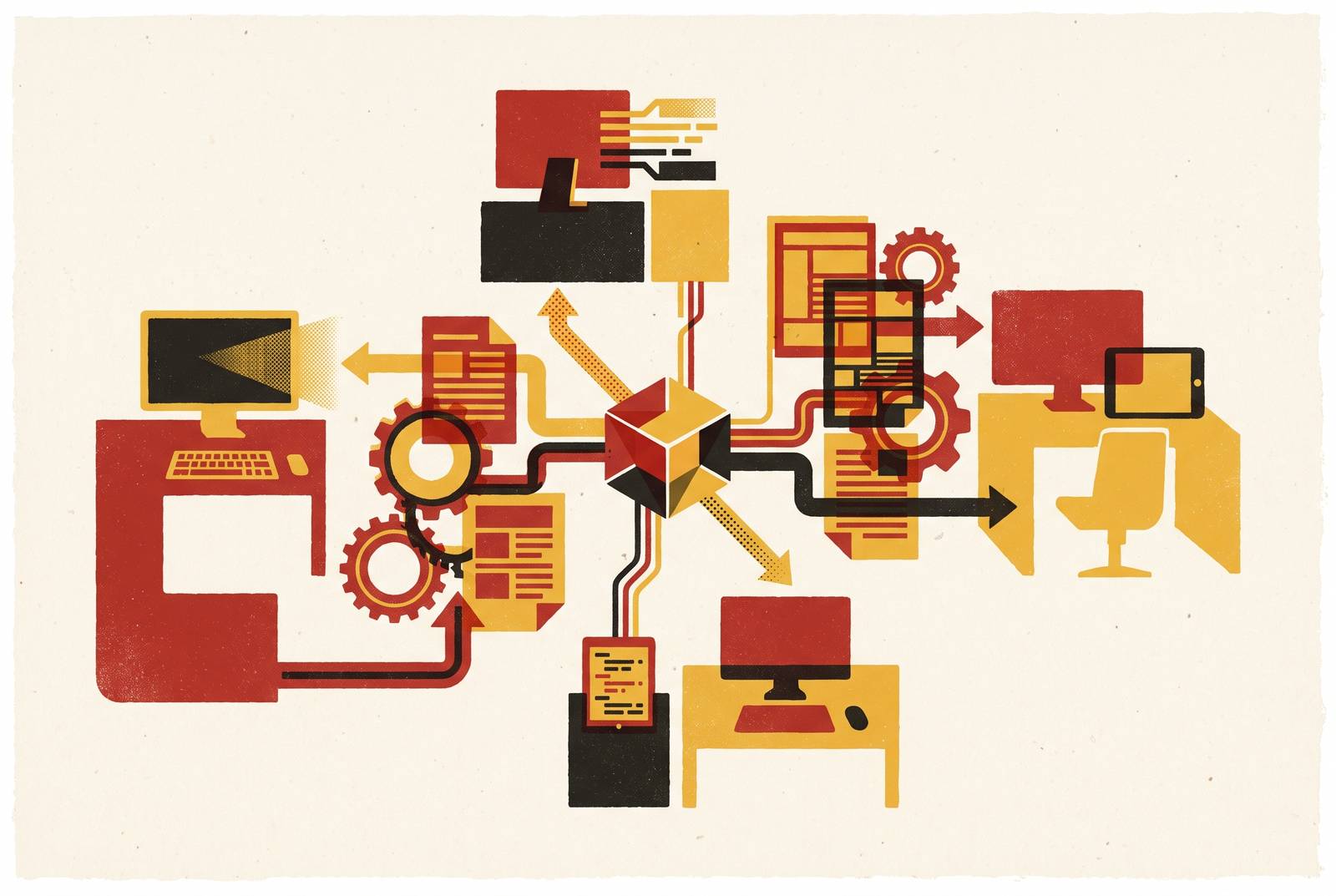
MCP changes what content teams do day to day, but not by putting writers out of work. That gap used to be filled by people copying, pasting, and re-uploading context between platforms. MCP replaces the copy-paste with a standard connection, and the rest of this piece works through what that actually changes on the ground. Model Context Protocol Impact on Content Team Workflows.
What MCP is and the problem it was built to solve
Anthropic released the Model Context Protocol in November 2024 as an open standard for linking AI applications to the systems around them: files, databases, APIs, and specialized prompt templates MCP Cheat Sheet: Complete Model Context Protocol Reference (2026). Before it existed, every connection between a model and a tool had to be built by hand. People got around this with prompt-engineering workarounds, pasting context into a chat window instead of building a real connection, which is a patch, not plumbing.
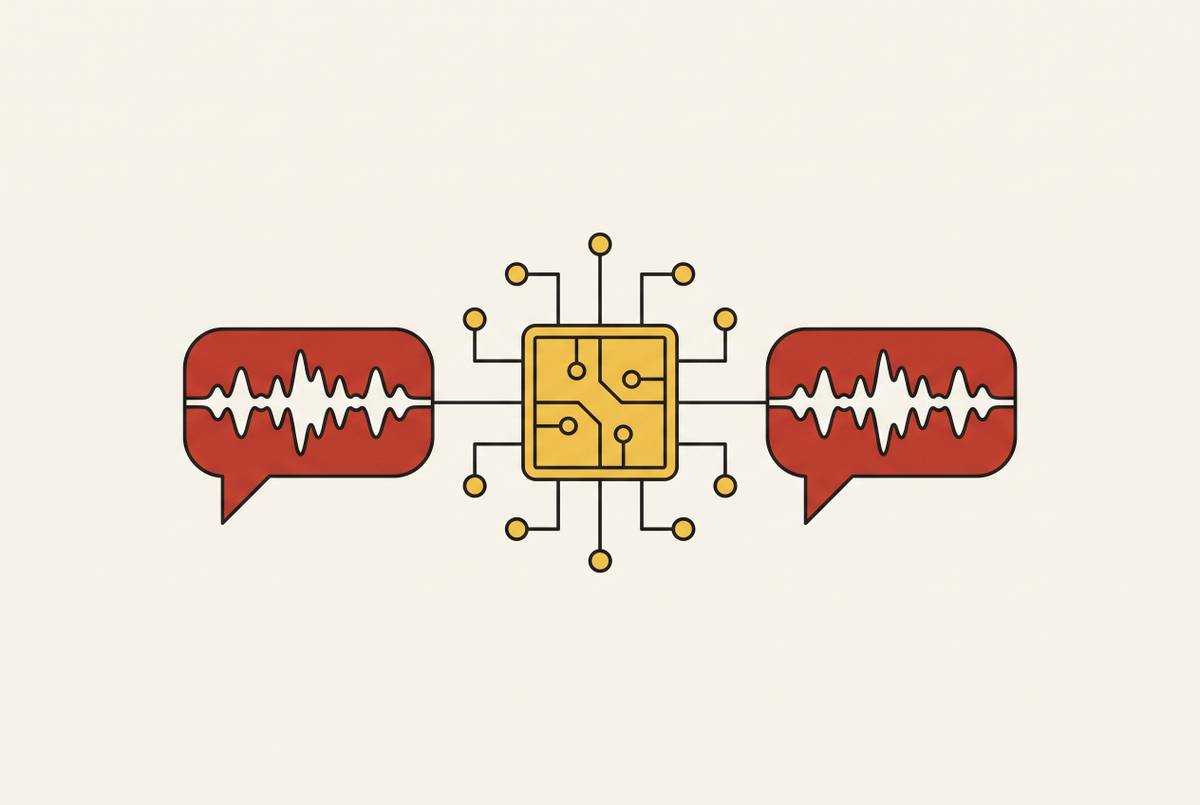
That image explains why a content team, not just an engineering team, should care. A port doesn't care what device you plug in. Once a brand guide, a CMS, or an analytics tool speaks MCP, any model that also speaks MCP can use it, without a developer rebuilding the wiring every time the team switches vendors.
The governance story backs up the "standard" claim rather than just asserting it. In December 2025, Anthropic handed MCP over to the Agentic AI Foundation, part of the Linux Foundation, which took it out of Anthropic's hands and made it a shared, vendor-neutral protocol rather than one company's proprietary layer. That matters for anyone deciding whether to build workflows around it: a standard controlled by one vendor is a bet on that vendor, but a standard governed by a neutral foundation is closer to plumbing that outlasts any single company's roadmap.
The adoption numbers are the clearest signal that this isn't a niche experiment worth watching from a distance. MCP went from 100,000 SDK downloads at launch to 97 million a month by March 2026, and OpenAI, Google DeepMind, Microsoft, and Salesforce all shipped support within 13 months of the initial release MCP Adoption in 2026: What Marketers Need to Know Model Context Protocol - Wikipedia. When four competing vendors converge on the same connection standard inside a little over a year, that's not a fad working its way through a hype cycle. That's infrastructure settling into place.
The three primitives content teams need to understand: Resources, Tools, and Prompts
MCP organizes everything a server exposes into three categories, and understanding them separates using MCP casually from actually redesigning a workflow around it.
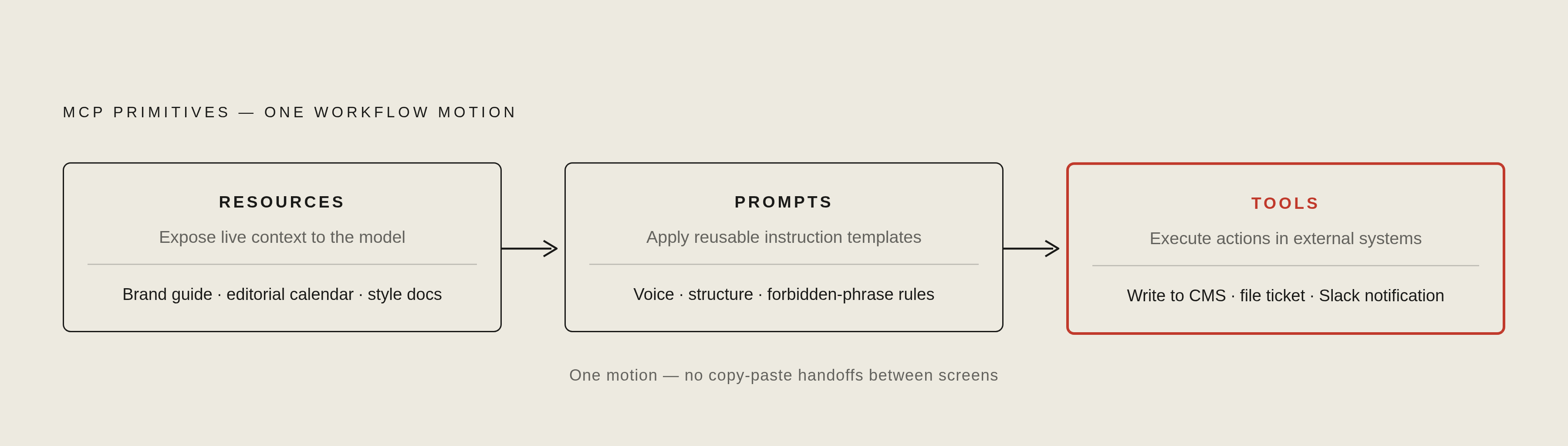
Resources are read-oriented context: files, database schemas, brand guides, editorial calendars, anything addressable that a server can hand to the model. The point of a Resource is that the AI reads from the live thing itself rather than from an export somebody made three weeks ago. Tools are the executable side: querying a CMS, filing a ticket in a project management system, running a validation check, calling an analytics API. A Tool is what turns the AI from a reader of information into something that can act on a system directly. Prompts round out the trio: reusable templates that standardize a recurring interaction, whether that's a voice guideline, a brief structure, or an approval checklist the model pulls up automatically instead of someone typing it in fresh each time.
The reason this triad matters for a content team specifically comes down to what it lets happen in a single motion. An assistant can read a live brand guide as a Resource, draft against a style Prompt built from that guide, and push the resulting draft into a CMS as a Tool call, all inside one connected sequence instead of three separate manual handoffs where a person has to carry context from one screen to the next. That collapsing of handoffs, not any single feature, is the actual mechanism behind everything the rest of this piece describes.
What the daily content workflow looked like before MCP, and why that friction mattered
In a content team's routine, analytics was pulled into a spreadsheet, downloaded, then uploaded to the AI, so the model was reading week-old data by default. Every model in use, whether Claude, GPT, or Gemini, needed its own adapter code, so adding a new model to the stack meant rebuilding integration work that had already been done once for a different model. Brand guides and style documents sat outside whatever the AI could reach on its own; someone had to paste them in by hand, and often that step got skipped entirely. There was no standard handoff connecting research, drafting, the CMS upload, and reporting back on how a piece performed, so people were the connective tissue between every one of those stages.
One team's benchmark makes the scale of that overhead concrete: deployment time for a new tool integration dropped from three days to eleven minutes after the team moved to a fully MCP-native setup essamamdani.com. Three days versus eleven minutes is a measure of how much of what looked like "content work" was actually systems work: file formats, authentication tokens, adapter code, none of which had anything to do with writing a good sentence essamamdani.com. It's a measure of how much of what looked like "content work" was actually systems work: file formats, authentication tokens, adapter code, none of which had anything to do with writing a good sentence. Writers and editors were quietly doing integration engineering as a side job, and most of them never signed up for that. Pre-MCP reality for a content team running AI tools:.
How MCP rewires the content team's core loops: research, drafting, and distribution
Research changes first. Supermetrics has described this as MCP becoming something like Plaid for marketing data: a shared language that lets an AI agent move across CRM systems, project tools, and calendars without a developer writing custom code for each one. That comparison holds up. Plaid didn't replace banks; it replaced the friction of connecting to them, and MCP is doing roughly the same thing for a content team's data sources.
Drafting is where the Resources and Prompts primitives start doing real work together. If the brand guide lives as a Resource inside a project management tool, the AI reads the current version on every single draft, instead of working from an excerpt someone pasted in three months back and never updated. Layering a Prompts library on top of that, encoding voice, structure, and the phrases a brand refuses to use, gives the model editorial taste baked into its process rather than reconstructed by trial and error each session MCP Cheat Sheet: Complete Model Context Protocol Reference (2026).
One practitioner's account of this in practice shows the mechanism rather than just the outcome. A hundred-article content plan got mapped out with Claude; three articles were written by hand first, to serve as taste references; the model was then pointed at a live brand guide; and the remaining articles came back brand-compliant and already uploaded to WordPress, with editor attention on the whole batch clocking in under an hour. MCP is what handled the tool connections in that sequence, the parts that used to require someone manually logging into WordPress and pasting content in field by field.
Distribution and reporting follow the same logic. MCP Tools let a workflow write drafts directly into a CMS, send a Slack notification, or open a ticket, all without the person operating it leaving the AI environment, though draft creation is the limit here; direct publishing stays a human decision. A growth team can build a workflow where an AI instance notices a drop in campaign performance, checks that against inventory data, and drafts an update for the team, entirely through MCP connections and without anyone relaying data by hand between tools. The actual sequence of calls happening in each of these examples is what matters: a query here, a Resource read there, a Tool write at the end. That's an operational description, not a marketing promise. AI can query live campaign analytics, CRM data, or competitor content gaps through one authenticated MCP connection, with no export step, no stale spreadsheet.
Where human review sits in an MCP-connected pipeline, and why removing it is a mistake
A workable AI content pipeline runs through five stages: intake, an automated first-pass scoring, human review, an approval gate, and post-publish monitoring. Skip any one of those stages and brand drift appears, quietly at first and then not so quietly.
Some parts of this are genuinely safe to hand to a machine. Strategic judgment calls, final brand-risk decisions, and anything touching legal or compliance exposure are not. Those need a person, full stop.
The reason is an error-rate argument backed by real numbers. It's an error-rate argument backed by real numbers. Analyst data from The Starr Conspiracy found editor rework on AI first drafts often runs between 20% and 35%, and the high-performing AI-augmented B2B teams are targeting 82% or better brand-voice compliance at the moment of publish Supermetrics 2026 Marketing Data Report promptbuilder.cc. MCP speeds up how fast a draft moves through the pipeline, but it doesn't touch those thresholds Supermetrics 2026 Marketing Data Report promptbuilder.cc. A faster pipeline that still produces a draft needing substantial rework a fifth to a third of the time is not a pipeline that's ready to skip its review stage.
Security reinforces the same point from a different angle. A Stacklok survey found that 64% of software-industry technical leaders named security as their top obstacle to adopting MCP supermetrics.com. The practice that's emerged in response is to grant read-only access for anything pulling analytics, and to cap write access at draft creation, never direct publishing, with human approval sitting as the final gate before anything goes live supermetrics.com. That's the design, because it builds human approval into the structure itself, not a workaround. That's the design, not a workaround, because it builds human approval into the structure itself.
MCP makes the pipeline faster and more connected, and a faster, more connected pipeline means a mistake also travels faster once it's in the system. Human review doesn't become less necessary as automation increases. It becomes structurally more important, because the cost of catching an error late goes up in direct proportion to how fast everything upstream is now moving.
How role clarity on content teams changes when the handoffs are automated
Automating the handoffs doesn't eliminate roles. It makes defining those roles clearly a much higher-stakes exercise, because when handoffs move fast, an error in who's responsible for what multiplies just as fast as everything else in the pipeline.
Writers shift toward brief-setting on the front end and editorial judgment plus quality assessment on the back end, which is less a retreat from the work and more a repositioning of where in the cycle their attention lands. Editors take on something new: keeping the Prompts library current, because that library now functions as infrastructure that encodes brand voice, not a style guide document somebody wrote once and filed away. A hybrid role is showing up at a number of teams too, filled by someone who understands editorial standards well enough to know what "on brand" actually means, and understands MCP server configuration well enough to expand what the pipeline can reach.
The review systems that hold up under real load share a specific set of features. Routing logic that sends only the uncertain outputs to a human reviewer, rather than routing everything and burying the reviewer in volume. Interfaces that show the AI's reasoning alongside its output, not just the output on its own. Audit trails built for compliance from the start, not bolted on later. The ability to adjust a parameter mid-process without having to restart the whole generation run. Systems missing these tend to collapse the moment volume rises past whatever a team tested with.
Post-publish review needs to function as a closed loop, not a report nobody acts on. If a review turns up a problem and nothing downstream changes, no brief, no prompt template, no model assignment, no review rule, no distribution decision, then that review step is just logging performance for its own sake rather than improving anything.
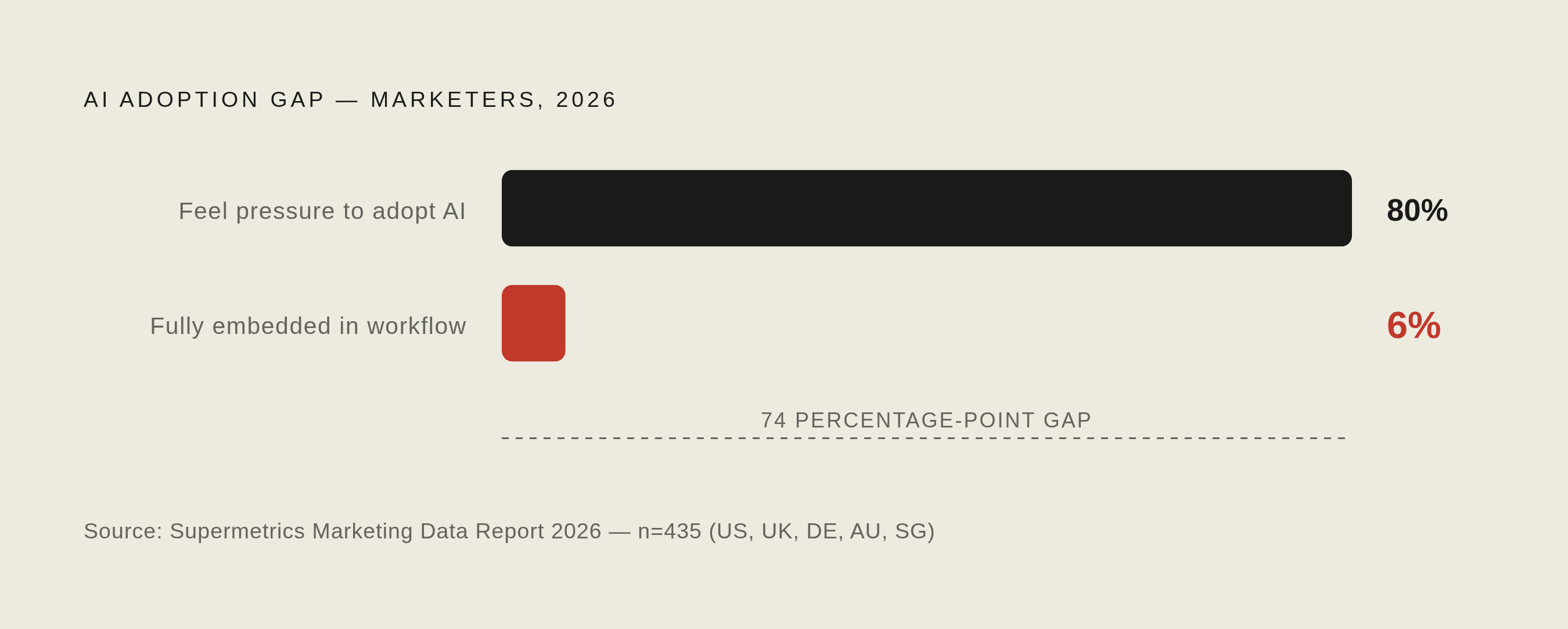
The scale of the gap here stands out sharply. Supermetrics' 2026 Marketing Data Report, based on 435 marketers across the US, UK, Germany, Australia, and Singapore, found 80% feel pressure to adopt AI, while only 6% have it fully embedded in their workflows Supermetrics 2026 Marketing Data Report. That's a wide gap between pressure and execution, and role ambiguity, teams not knowing who owns what once a handoff gets automated, is very likely a meaningful chunk of why that gap exists Supermetrics 2026 Marketing Data Report.
The July 2026 spec changes that matter for teams deploying MCP in production
The specification dated 2026-07-28 is the current version, and its headline change is a shift to a stateless protocol core.
For a content team running MCP at any real scale, that shift solves a specific, practical problem. Any request can now land on any server instance sitting behind a plain load balancer, with no shared session storage needed, which clears up the horizontal scaling issue that had been blocking some production deployments. Header-based routing, using Mcp-Method and Mcp-Name headers, lets a gateway route and authorize traffic without parsing the full JSON body of each request, which matters directly to teams under security or compliance requirements around their API traffic. List results, covering tools, prompts, and resources, are now cacheable, carrying cache hints that cut down on unnecessary re-fetching. That keeps upstream prompt caches stable, which is a real concern once a team's Prompts library is getting queried hundreds of times a day MCP Cheat Sheet: Complete Model Context Protocol Reference (2026).
A feature called Multi Round-Trip Requests, or MRTR, makes a stateless protocol compatible with keeping a human in the loop. It allows mid-call human input, confirmations, missing parameters supplied on the fly, even though the underlying protocol has no persistent session. That's the specific mechanism that keeps an approval gate workable inside a pipeline that's otherwise moving on its own.
On the authorization side, the spec formally deprecates Dynamic Client Registration in favor of Client ID Metadata Documents. Teams building new integrations from here forward should build to CIMD directly; DCR keeps working for now, but it's on a clock, with a minimum twelve-month deprecation window before it's pulled. Tasks, meanwhile, has graduated from an experimental feature to a formal extension, alongside MCP Apps, and Enterprise Managed Authorization had already stabilized as its own extension back in June 2026. For a content team running a multi-step workflow, research into draft into review into publish, Tasks is now something to build on, not something to treat as a beta feature that might change shape next quarter.
Enterprise readiness sits explicitly on the 2026 roadmap: audit trails, SSO-integrated authorization, gateway behavior, and configuration portability are all in scope, and a dedicated Enterprise Interest Group has been chartered. The roadmap itself notes that no Enterprise Working Group exists yet and invites practitioners to lead one. Teams with real enterprise security requirements have a reason to get involved now, while the shape of that work is still being decided, rather than waiting for a finished spec to arrive and adapting to it after the fact.
How MCP-connected content pipelines connect to AI visibility and citation strategy
None of the pipeline work above matters much if nobody sees what comes out the other end, and how audiences actually find content has shifted faster than most editorial calendars have caught up with. At Google I/O, Google reported AI Mode at 1 billion monthly active users and AI Overviews at 2.5 billion digitalapplied.com. The audience a brand needs to reach is sitting inside an AI answer layer now, not a ranked results page digitalapplied.com.
That changes what a pipeline needs to produce, not just how fast it produces it. Content pushed out at scale through an AI pipeline has to be built for AI citation selection, not human readability alone MCP Adoption in 2026: What Marketers Need to Know Model Context Protocol - Wikipedia.
Volume alone doesn't win this game. Citation concentration runs extreme: the top 20% of cited domains capture 80% of all AI references Supermetrics 2026 Marketing Data Report promptbuilder.cc. Publishing more doesn't move that needle by itself; what moves it is retrievable authority on a given topic Supermetrics 2026 Marketing Data Report promptbuilder.cc. And most teams aren't even watching the scoreboard. Roughly 14% of marketers currently track AI citations at all, even though GEO is now a $7.3 billion market growing at a 34% compound annual rate, with 98% of enterprise CMOs already investing in it quickseo.ai. A pipeline is only doing half its job if nobody on the team is checking whether ChatGPT, Claude, Gemini, or Perplexity is actually naming the brand in its answers quickseo.ai.
This is where the pipeline argument and the citation argument fold into each other. Teams that build MCP-connected pipelines purely for speed and scale get the best return only when what those pipelines publish is built to earn citations in the first place; speed without a citation strategy just produces more volume that nobody downstream sees. B2B SaaS and dev-tool teams have particular exposure here, since their buyers increasingly start evaluating a product through AI-assisted research rather than a search bar, which makes a brand's presence in an AI answer a pipeline question and not just a marketing one. Whether an answer engine actually names and cites a brand is now something a team can measure and track, not something to assume based on how much content went out the door. Platforms running multi-stage AI content pipelines depend on real-time connection to live systems, brand guides, analytics, and CMS data rather than static exports; each model, Claude, GPT, or Gemini, needed its own adapter code, and switching or adding a model meant rebuilding those integrations https://www.200oksolutions.com/blog/best-guide-to-the-model-context-protocol-mcp-in-2026/. SparkToro's analysis of Similarweb clickstream data shows 62% of users now start their search journey with AI tools rather than traditional search engines, AI-referred sessions jumped 527% between January and May 2025, and about 68% of Google searches ended without a click in early 2026 frase.io frase.io. GEO (Generative Engine Optimization) and AEO (Answer Engine Optimization) are the disciplines that govern how AI tools use indexed content: GEO shapes how AI tools use indexed content to generate responses, while AEO focuses on getting individual pieces selected as the basis for specific answers.
A practical starting point for teams moving from initial curiosity about the protocol to running it in production
Most teams are somewhere between curious and stuck. It's a lack of a starting sequence Supermetrics 2026 Marketing Data Report.
Start by auditing the friction itself. Map every place where a writer or an editor is manually carrying context between tools, downloading an analytics report, pasting a brand guide into a chat window, uploading a finished draft by hand. Each one of those is a candidate for an MCP connection. From there, connect read-only Resources first: the brand guide, the editorial calendar, the style documentation, all wired in before any write access gets granted to anything. Establish what the AI can see before deciding what it's allowed to do.
Once that's in place, build the Prompts library on purpose rather than letting it accumulate by accident MCP Cheat Sheet: Complete Model Context Protocol Reference (2026). Encode editorial taste, structure, voice, and the specific patterns a brand won't tolerate, as reusable Prompts. This is the actual infrastructure work that lets a team scale output without brand drift creeping in behind it. Next, decide where the human gates sit before building any automation around them: identify which decisions carry brand risk or legal exposure, keep those with a person, and only after that's settled, design the Tool connections for the steps on either side of that gate. Last, build measurement in from day one rather than bolting it on later, tracking whether what gets published is actually being cited by AI answer engines like ChatGPT, and by whichever other assistants a team's audience is actually using. A pipeline that publishes fast but never checks whether anything it produces gets cited is optimizing for the wrong number. SOURCE PAGES (what the pages behind the outline's links say).