Hybrid Content Models Mixing In-House Strategy With External Execution
Companies are splitting strategy in-house and execution outside to survive modern marketing's pace.

Advertisement
Hybrid content models, where internal teams hold strategy and outside partners handle production, have become the default operating structure for marketing organizations in 2026. Adoption spread this widely for a plain operational reason: neither a fully in-house team nor a fully outsourced one survives the current pace and channel count.
B2B marketing now runs across paid search, paid social, SEO, content, email, events, account-based marketing, web optimization, and reporting, often at the same time. A generalist team can keep those channels alive, but it cannot out-perform a specialist who works one channel full-time across dozens of accounts. Traditional agencies, meanwhile, carry overhead and pace problems of their own when a brand tries to route all execution through a single external shop.
The numbers confirm the shift is structural. The share of companies running hybrid models has climbed year over year and is expected to reach 46% by the end of 2026, making it the majority operating model in B2B marketing. Among multinational brands, roughly two-thirds already operate some form of in-house agency capability, yet most of those same companies still lean on external partners for parts of the work. The operative question inside marketing organizations has moved from whether to use an agency at all to how internal and external capacity should be combined.
AI adds urgency to that question rather than settling it. Content production that once justified a standing agency retainer can now run faster and at greater volume through AI systems than through an outsourced production team. The old logic for what gets outsourced no longer holds. The hybrid structure is now the assumed shape of the organization, and the work is designing it with intention rather than backing into it by accident.
The one principle that separates a functioning hybrid from an expensive mess
Deciding what stays internal and what gets handed off should follow the type of work involved, not which budget line happens to have room. One category of work can never leave the building: strategic accountability for revenue outcomes. Most hybrid failures trace back to outsourcing that accountability rather than outsourcing tasks, since somebody internal has to answer for what the numbers do.
The clearest documented example of the split working as designed comes from Slack's early build with the design studio MetaLab. Stewart Butterfield's team kept product strategy, messaging architecture, and core engineering inside Slack's San Francisco office, while MetaLab, a Canadian studio that declined an equity stake in the company, built the UI and UX, the brand, the mobile app, and the marketing site that launched what became a company valued at $27 billion. The arrangement held because the "what" and the "why" of the product never left Slack's building.
MetaLab did not run user research, did not debate product positioning, and did not sit in on Slack's internal strategy meetings. Information moved in one direction on anything strategic. That discipline is part of why the engagement reportedly ran about six weeks from kickoff to a shippable design system: the guardrails were already set before execution began, so there was nothing left to negotiate mid-project. The formula that falls out of the case is simple to state and hard to enforce: keep the why and the what internal, delegate the how.
The obvious objection is that external partners often know more about their specialty than the internal team does, so why shouldn't their expertise shape strategy directly? It should inform strategy. It shouldn't own it. Once strategy ownership moves outside the building, the brand loses the institutional memory and market context it needs to make fast calls when conditions shift, and no amount of specialist polish on the execution side makes up for that loss.
Drawing the line between in-house, outsourced, and in-between work
The boundary between internal and external work follows a consistent logic once the accountability principle is in place. Positioning, budget allocation, audience definition, revenue accountability, brand voice, editorial judgment, stakeholder relationships, and approval authority stay in-house. Paid media management, technical SEO, creative production, content writing at volume, email development, analytics implementation, and asset production variants are suited to specialist execution partners, because these are the tasks that improve with repetition across many clients. A paid media specialist running dozens of accounts sees pattern breaks and creative fatigue signals that someone managing a single account never will. In agency terms, client communication, brand strategy, campaign planning, creative direction, and approval workflows stay with the brand, while production design, front-end development, asset resizing, and routine content formatting move to the execution partner.
The Pedowitz Group notes a third category, fractional or embedded senior resources, which fills genuine leadership gaps without full-time executive overhead, useful when a team needs strategic guidance to set direction and manage vendor relationships while determining a permanent hire. A related variant, sometimes called embedded partnership, has the external team plug into the brand's daily rhythm through shared communication channels, weekly check-ins, and a common project management tool as part of the brand rather than a separate vendor at arm's length, cutting coordination overhead without handing over strategic direction.
None of this is a fixed org chart. Regulatory and platform constraints can redraw the line. Media buying in China is the sharpest example: even brands that in-house aggressively everywhere else rarely run China alone, because a single partner portal can reach roughly 98% of the country's digital consumers, and partner-gated inventory, data localization law, and fragmented identity infrastructure make a pure in-house approach impractical there. The hybrid shape that survives in that market has the brand owning strategy, budget, and audience definition, with a platform partner supplying compliant access and cross-platform execution.
Go-to-market execution adds one more layer that the org chart alone doesn't capture. Content governance, meaning who creates content, who approves it, and how updates cascade across channels, has to be a designed system rather than an assumption. Skipping that design step lets message inconsistency erode buyer confidence even when the execution quality on any single asset is high.
Where hybrid models break
Getting the division of labor right solves half the problem. The handoff itself is where most hybrid arrangements fail. When outsourced design work goes wrong, the failure almost always traces back to an ambiguous strategy handoff, where the external team gets asked to design a homepage without knowing the conversion goal, the audience segment, or the competitive positioning, and the internal team then burns revision cycles arguing about things that should have been settled before the first wireframe existed.
MetaLab received briefs, constraints, and feedback, and returned designs, prototypes, and asset packages. The boundary was deliberately clean: MetaLab had no access to Slack's product roadmap and no seat in Slack's internal strategy meetings. Teams that replicate that success tend to do one specific thing before any brief goes out the door: they write a concise strategy brief covering audience, goals, brand constraints, and success metrics, and they do it before execution starts, not during it.
The structural supports that keep a handoff functioning include shared dashboards, aligned creative briefs, defined review cycles, and a single project management tool that both sides actually use. Without those supports, the feedback loop that keeps quality consistent across a growing volume of work simply doesn't exist. On the governance side, a content framework covering version control, approval workflows, and sales enablement integration is essential infrastructure. It's what prevents the message mismatches that compound as execution scales up.
Clear ownership and decision rights are what prevent the coordination overhead that turns a hybrid model into an expensive mess. Ambiguity at the boundary, not the boundary itself, is the actual failure point. A related trap catches even teams with a clean division of labor on paper: internal staff get pulled into every urgent execution request, and the strategic work that would compound over time never gets protected time to happen. The hybrid structure only pays off if someone actively defends the internal team's calendar against that pull.
How AI is changing the case for outsourcing execution tasks
AI production tools now generate content faster, cheaper, and at higher volume than most outsourced teams can match, which weakens the old case for a standing agency retainer built around bulk output. That doesn't mean human oversight matters less. AI content fails in predictable, specific ways, including factual hallucinations, outdated information, tone mismatches, and compliance gaps that read as confident even when they're wrong, and catching those failures requires a human reviewer who knows the domain.
The right depth of review scales with the risk of the content in question, ranging from a single reviewer for internal drafts, to a structured checklist for customer-facing copy, to multi-approver workflows with a full audit trail for anything touching legal or compliance claims. A practitioner framework described by Scalevise, drawing on reporting in Search Engine Land, lays out a multi-stage approach that starts before drafting even begins, adds checks around research and sourcing during production, and folds editorial feedback back in after publication to improve the next round. Human judgment stays the decision layer throughout; AI does the work that structured prompts, retrieval, and iteration can accelerate.
What's emerging inside leading in-house teams looks like a pipeline made up of a researcher agent, a writer agent, a critic agent, and a publisher agent, all working against the CMS as the source of truth and staging every change for human review before it goes live. That pipeline is a new layer of execution infrastructure that the internal team now controls directly.
The constraint holding most companies back isn't the technology itself. Only a minority of companies have managed to scale AI deployment in content operations past the pilot stage, and the ones that do build a structural speed and cost advantage that gets harder for slower competitors to close with each passing quarter. That reframes what external partners are actually for. Bulk content production is now an AI job. What a partner supplies instead is judgment AI can't replicate: domain expertise, proprietary research, platform access, and regulatory knowledge specific to a market or channel. Framed this way, the speed-versus-quality tradeoff that used to force a choice between fast, cheap output and reliable output stops applying, because a well-built pipeline with human checkpoints delivers both.
The new execution layer: why content execution must reach beyond your own domain
The reason to scale content execution at all has changed. Brands used to produce volume to rank on a search results page. Increasingly, they produce it to be cited inside an AI answer, since AI systems are becoming the first point of contact between a buyer and a brand. ChatGPT, Perplexity, Google AI Overviews, Gemini, and Claude are functioning as a front door to discovery, and a large and growing share of sessions on these systems end without the user ever clicking through to a website. When that happens, the citation inside the AI's answer is the only impression the brand gets.
This is the terrain that Generative Engine Optimization and Answer Engine Optimization cover. GEO is the broader discipline of structuring content and brand presence so that AI systems cite and recommend a brand in their answers, while AEO focuses on whether a brand is being surfaced as the answer itself.
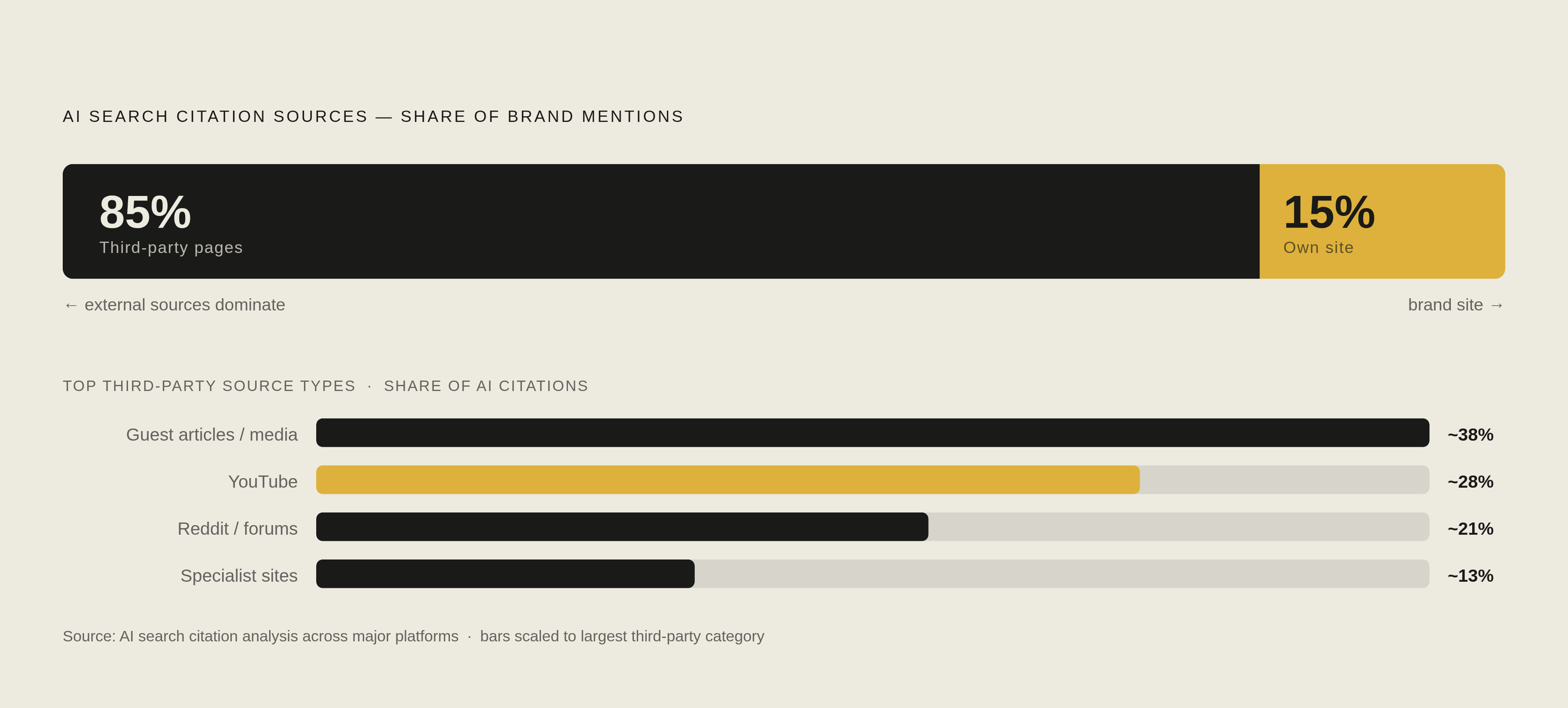
The most consequential fact in this shift is where citations actually come from. Roughly 85% of brand mentions inside AI search responses originate from third-party pages rather than from the brand's own site. A brand is substantially more likely to be cited through someone else's domain than through its own. That single fact turns distributed content, guest articles, forum contributions, placements in credible outside media, and video, from a nice-to-have into a structural requirement for showing up in AI answers at all.
A large share of AI citations trace back to community platforms such as Reddit and specialist forums, alongside YouTube, which ranks as the second most-cited domain across AI platforms. Video transcripts are searchable by AI systems, and YouTube's own domain authority gives cited videos real weight inside generated answers. Brand mentions across this wider footprint correlate strongly with the likelihood of being cited, making cross-platform presence the single strongest predictor of citation.
None of that makes the brand's own site irrelevant. It still has to be formatted so AI systems can extract it cleanly: modular paragraphs short enough to stand alone when pulled out of context, each chunk making sense on its own without the surrounding page. Technical access matters just as much, since default Cloudflare configurations can block AI crawlers outright, and someone has to explicitly check the disallow rules for ChatGPT-User, GPTBot, PerplexityBot, and ClaudeBot. Peer-reviewed research out of Princeton, Georgia Tech, the Allen Institute for AI, and IIT Delhi found that content structured around citation density, definition-lead formatting, and statistical enrichment achieves measurably higher visibility in generative engine responses, with expert quotations, statistics, and clean fluency ranking among the strongest tactics.
Earning a citation in the first place comes down to offering something AI can't reproduce on its own, such as original survey data, a proprietary case study, or a named expert quoted from an actual conversation. Generic content at volume doesn't build citation authority no matter how much of it a brand publishes. Citation concentration is the competitive dynamic to watch here: research from BrightEdge shows citations flowing disproportionately to a small number of domains, even though more than half of brands still have no GEO strategy in place. The window to build citation authority is open, but it will not stay open indefinitely.
This is where the hybrid model and the GEO argument converge. GEO forces coordination across PR, content, SEO, and product marketing all at once, and the hybrid structure, with its ability to deploy specialized execution across several content surfaces at the same time, is the practical vehicle for doing that without inflating internal headcount past what the budget can sustain. The execution layer, meaning specialized content production, paid media management, and technical implementation, is where partners and automation systems create the most measurable value: they can handle volume and variation at a scale internal generalists can't match. Letterstory is one example of a system built around that division, producing content at the volume GEO requires while leaving positioning, audience definition, and editorial judgment with the in-house team rather than buried in formatting and publishing logistics.
Measuring whether the hybrid content model builds AI visibility
A hybrid content model that can't show its output actually gets cited by AI systems is running on assumption, and assumptions don't respond to optimization. Measuring AI visibility is a distinct discipline from measuring SEO performance, and it calls for different tools and different metrics than a search-ranking dashboard was ever built to provide.
That distinction matters for how a marketing organization justifies its own structure. The argument for splitting strategy from execution rests on the claim that internal judgment plus specialist production produces better outcomes than either one running alone. Citation tracking across AI platforms is what turns that claim from an assertion into something a team can actually check, quarter over quarter, against the specific third-party domains and content formats the answer engines are pulling from. Without that measurement layer, a marketing team can point to volume of output and call it progress, but volume was never the point. Citation was.