Multi-Channel Content Distribution Strategy for B2B Campaigns
AI engines now cite independent sources more than brand websites, forcing a distribution rethink.
Advertisement
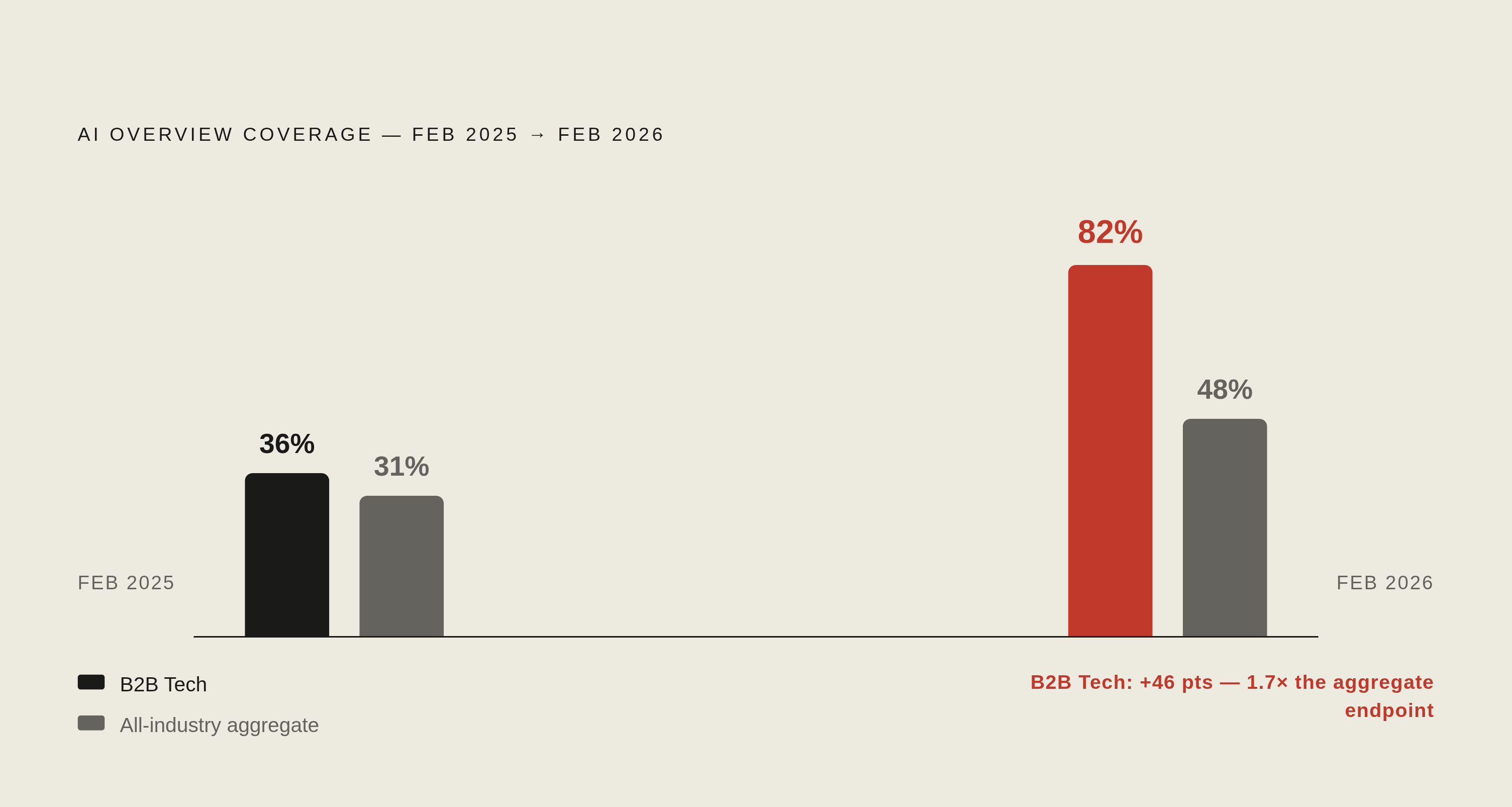
A B2B buyer researching a software category today is more likely to be handed a synthesized AI answer than a page of ranked links, and that single fact should reorganize how marketing teams think about distribution. Industry tracking covering nine sectors from February 2025 to February 2026 found that AI Overview coverage in B2B tech grew from 36% to 82% of tracked queries, far outpacing the aggregate growth across all nine industries, which moved from roughly 31% to roughly 48%. The old distribution model assumed a buyer would see a result, click it, and land on a vendor's page to form an impression. AI answers skip that step: the synthesis happens before the click, and for a growing share of searches, the click never happens. Content that never gets pulled into that synthesis loses access to a buyer at the exact moment they're forming their shortlist, no matter how well it ranks in a traditional search result. If this is where B2B buyers now start their research, distribution planning has to start there too, not treat it as a downstream optimization once the "real" channels are funded.
Ranking on Google versus being cited by an AI engine
Strong organic rankings do not guarantee AI visibility, and that gap makes a reorganized distribution strategy a necessity. Traditional SEO is built to win a ranked list: it rewards domain authority, backlink volume, and keyword targeting that earns a page position. Generative Engine Optimization, the discipline of earning citation inside an AI-generated answer, asks a different question entirely: how does a large language model decide which sources to retrieve, which claims to trust, and which brand name to actually surface in its response? The two disciplines overlap, and a well-built SEO program is not wasted effort. Content quality, topical authority, and crawlability still matter in both worlds. But the correlation data on what actually predicts AI citation inverts a lot of what SEO practitioners have optimized for over the past two decades: YouTube mentions, branded mentions across the open web, and branded anchor text correlate far more strongly with AI visibility than domain authority or raw backlink count do. A brand can hold page-one rankings across its core terms and still be functionally absent from ChatGPT's or Gemini's answers, because the model isn't counting backlinks. It's weighing how often and how credibly the brand gets mentioned across a wide, independent set of sources. Generative Engine Optimization sits on top of SEO rather than replacing it, but it demands its own set of distribution decisions, decisions that a well-run SEO program does not make on its own.
The "ghost citation" problem: why being cited is not the same as being chosen
Appearing in an AI answer is not the same as being recommended by it, and most brands that think they've "cracked" AI visibility have actually just discovered a more subtle failure mode. Two distinct problems hide under the single label of "AI visibility." The first is the ghost citation: the AI pulls facts, numbers, or phrasing directly from a brand's content, but never names the brand in the answer itself. The content does the work and a competitor, or no one, gets the credit. The second is the ghost ranking: the brand is named, even described favorably, but the AI's final recommendation, the "go talk to this vendor" moment, points the buyer to someone else. Both leave a brand technically "present" in AI search while delivering none of the commercial benefit that presence is supposed to produce. This is why distribution strategy has to be built platform by platform rather than as one undifferentiated push: what earns a named recommendation inside Gemini's answer structure is not the same mix of signals that earns a named citation inside ChatGPT's. The real objective is getting named in a recommendation context, not simply showing up as a source buried in a footnote. The metric that captures this distinction is Share of Model: the ratio of times a brand appears, by name, across a tracked set of AI answers to relevant queries. Tracking citation count alone hides the ghost-citation and ghost-ranking problems. Tracking Share of Model forces the question that actually matters: is the brand being chosen, or just being used?
How content structure shapes AI extraction and brand naming
Before any distribution channel can help, the content itself has to be built so an AI retrieval system can pull out a specific, attributable claim and attach a brand name to it. This is a prerequisite for citation, not a formatting nicety layered on afterward. AI crawlers and the retrieval-augmented generation systems behind most answer engines tend to skip pages that lack clear structure: content without defined header hierarchies and direct, self-contained answer sections may get indexed without ever getting extracted into an answer. JSON-LD schema markup helps disambiguate what a page is about, but it isn't the deciding factor, since these crawlers primarily read the visible HTML text on the page, not the hidden markup. Length matters inconsistently across platforms, so you can't treat long-form as a universal fix. On ChatGPT, longer pages tend to earn more citations, but in Google's AI Overviews, length and citation rate barely move together. What holds across platforms is structure and density: content organized so a single paragraph answers a single question, clearly enough that a model can lift it cleanly. Freshness compounds this. If content gets updated regularly, it earns substantially more citations, but if it sits untouched, it's considerably more likely to lose citations it already earned. That turns content maintenance into a distribution activity in its own right, not a one-time editorial task finished at publication. The sequence has to run in order: structure the content for extraction first, then distribute it. Pushing poorly structured content across more channels just spreads the same invisible content further without raising citation rates.
Off-site distribution footprint as the driver of AI visibility
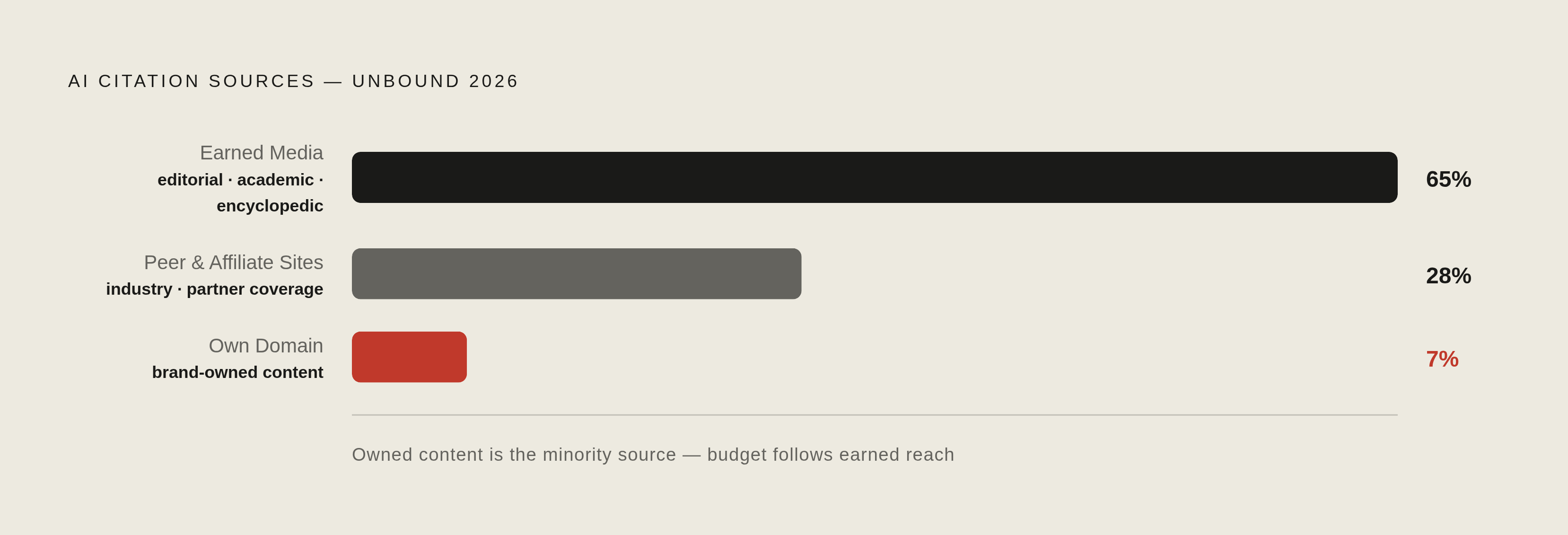
A brand's own website is just a minority source among the ones AI engines actually cite from, and that should reshape budget allocation more than almost anything else in this argument. Data presented at UNBOUND 2026 confirmed that a brand's own domain accounts for only a small share of AI citation sources, with earned media, meaning independent editorial coverage, journalism, academic references, and encyclopedic sources, taking the largest share, followed by peer sites and affiliate sites. This echoes, in a different form, how traditional search engines weighted backlinks as a signal of authority for decades. But the mechanism isn't link equity anymore. For AI engines, the signal is brand mentions and contextual co-occurrence, how often and how credibly a brand's name shows up in the same breath as the topic, across sources the model treats as trustworthy. The implication for distribution teams is direct: publisher syndication, earned media placements, analyst coverage, community participation, and partner content aren't nice-to-have supplements sitting beside the "real" owned-content strategy. They are the primary mechanism by which AI engines come to trust and cite a brand. When a brand syndicates across publisher networks, intent-data platforms, and specialist media outlets, it builds exactly the kind of distributed footprint these engines read as a trust signal. A structured content placement experiment run by Stacker in December 2025 documented measurable citation increases from content distributed across a third-party publisher network, which shows that even content a brand doesn't own outright, placed through earned channels, contributes meaningfully to that off-site signal. Syndicating to a single platform concentrates effort on one surface and narrows the breadth of co-occurrence signals an AI engine has to read. Multi-channel syndication is what builds the distributed footprint these systems are actually designed to weigh.
Organizing a B2B multi-channel distribution stack around AI citation
A distribution stack built around AI citation looks different from one built to maximize lead volume, because it weights channels by what they add to off-site brand co-occurrence and earned authority, not just by cost-per-lead or direct conversion rate. Owned channels, the blog, email list, podcast, and YouTube presence, remain the foundation of the stack. They don't disappear in this model. They produce the anchor content that gets syndicated and cited elsewhere, and they establish the structured, citable material that the rest of the off-site footprint ultimately points back to. Earned channels carry the heaviest weight specifically for AI citation purposes. When a brand syndicates into niche B2B media outlets, analyst hubs, and technology portals, it builds the peer-site and earned-media citation sources AI engines favor most. When brands take part in specialist forums and peer communities, it generates brand co-occurrence in genuinely conversational contexts, and these engines increasingly index and draw from that. Guest content placements and analyst coverage don't just build brand awareness for its own sake. They function as citation infrastructure and feed the exact signal type that drives AI visibility. LinkedIn occupies a distinct tier in this stack: it offers direct audience reach to a B2B buying committee, and it generates a form of brand co-occurrence that behaves similarly to YouTube mentions in the correlation data. LinkedIn document ads and sponsored content reach senior decision-makers that publisher syndication alone tends to miss, so you can run the two channels as complements, not duplicates, inside an account-based marketing program aimed at a full buying committee. Intent-data-activated syndication, meaning distribution targeted at accounts actively showing in-market research signals, adds a layer of precision on top of all this: multi-channel coverage of the same account list accelerates trust-building and pipeline velocity, not just general awareness. None of this should come at the expense of a program that already works. A tiered allocation makes sense here: the bulk of distribution effort stays with proven channels carrying documented ROI, such as email, blog SEO, and publisher syndication; a meaningful but smaller share goes to emerging surfaces still being validated, like short-form video and niche online communities; and a small, clearly bounded share goes to experimental placements. That structure keeps AI-visibility ambitions from destabilizing a demand generation program that is already producing pipeline.
AI content pipelines with human review for distribution at scale
The publishing cadence that AI citation demands, frequent updates, coverage across many channels, and structured content built for extraction on every one of those channels, is hard to sustain through manual production alone. It becomes operationally realistic when AI systems handle the classifiable, repeatable parts of production and humans retain ownership of positioning, original claims, and final approval. Freshness isn't optional at this point: pages that go unupdated on a quarterly basis are more than three times as likely to lose the citations they once held. Distribution has to function as an ongoing operational discipline attached to every asset, not a single event that happens once at launch. This isn't a theoretical model. Contentful's own documentation describes bulk AI-generated changes being routed through a review screen, where a team approves, declines, or adjusts suggestions before anything goes live in the environment, which is the same review-gate principle at work inside a widely used CMS. Sanity's Content Agent, which reached general availability in January 2026, follows the identical logic: the agent produces drafts or proposes changes inside a content release, but publishing always remains a separate, deliberate step the team takes itself. The cost and time savings from these pipelines show up in practice, but the share of effort spent on review goes up, not down, inside a properly designed system. As more of the raw production work shifts to AI, human attention concentrates on the decisions that make a piece of content accurate, citable, and worth putting a brand's name behind. That means assigning work by risk level rather than by how novel or interesting a task looks: AI handles research classification, outline generation, reformatting of already-approved material, and consistency checks across assets. Humans hold the line on positioning, original claims, interpretation of customer or market data, and the final decision to publish. That gate structure isn't negotiable, because volume without quality is a direct liability under this strategy, not just a reputational risk in the abstract. AI engines actively deprioritize thin, low-confidence content as a citation source. A pipeline producing more content faster, without raising the floor on accuracy and usefulness, actively works against the goal it was built to serve.
Measuring AI citation performance
AI visibility is volatile enough that it has to be tracked continuously rather than checked occasionally, so none of the structural or distribution work in this piece matters if a team can't tell whether it's producing AI citations. Only a minority of brands stay visible from one AI-generated answer to the next for the same query, and fewer still remain present across five consecutive runs of it. Because of that instability, a single snapshot, one query, checked once, tells a team almost nothing about whether its distribution strategy is working. Measurement has to be platform-differentiated as well as continuous, because platform behavior doesn't generalize cleanly from one engine to another. ChatGPT, Google Gemini, and Perplexity carry the large majority of AI-referred traffic for most B2B brands, so track and optimize for these first. Tracking that traffic in practice means setting up GA4 referrer filters for chatgpt.com, the legacy chat.openai.com domain, perplexity.ai, gemini.google.com, and the equivalent domains for any other platform a brand decides to monitor. To track branded query lift, meaning whether more people search for a brand by name as a downstream effect of AI citations driving awareness, you watch the brand-name trend inside Google Search Console. Put together, these measurements turn AI visibility from an assumption a marketing team hopes is happening into an engineered, monitored outcome that can be reported, defended to stakeholders, and adjusted when a platform's behavior shifts. A distribution strategy built on the arguments in this piece, structured content, off-site footprint, a layered channel stack, and an operational pipeline, only proves itself out at the point where someone can show, in the data, that the brand's name is the one the model actually says out loud.