Speed Benchmarks for AI-Assisted Content Campaigns
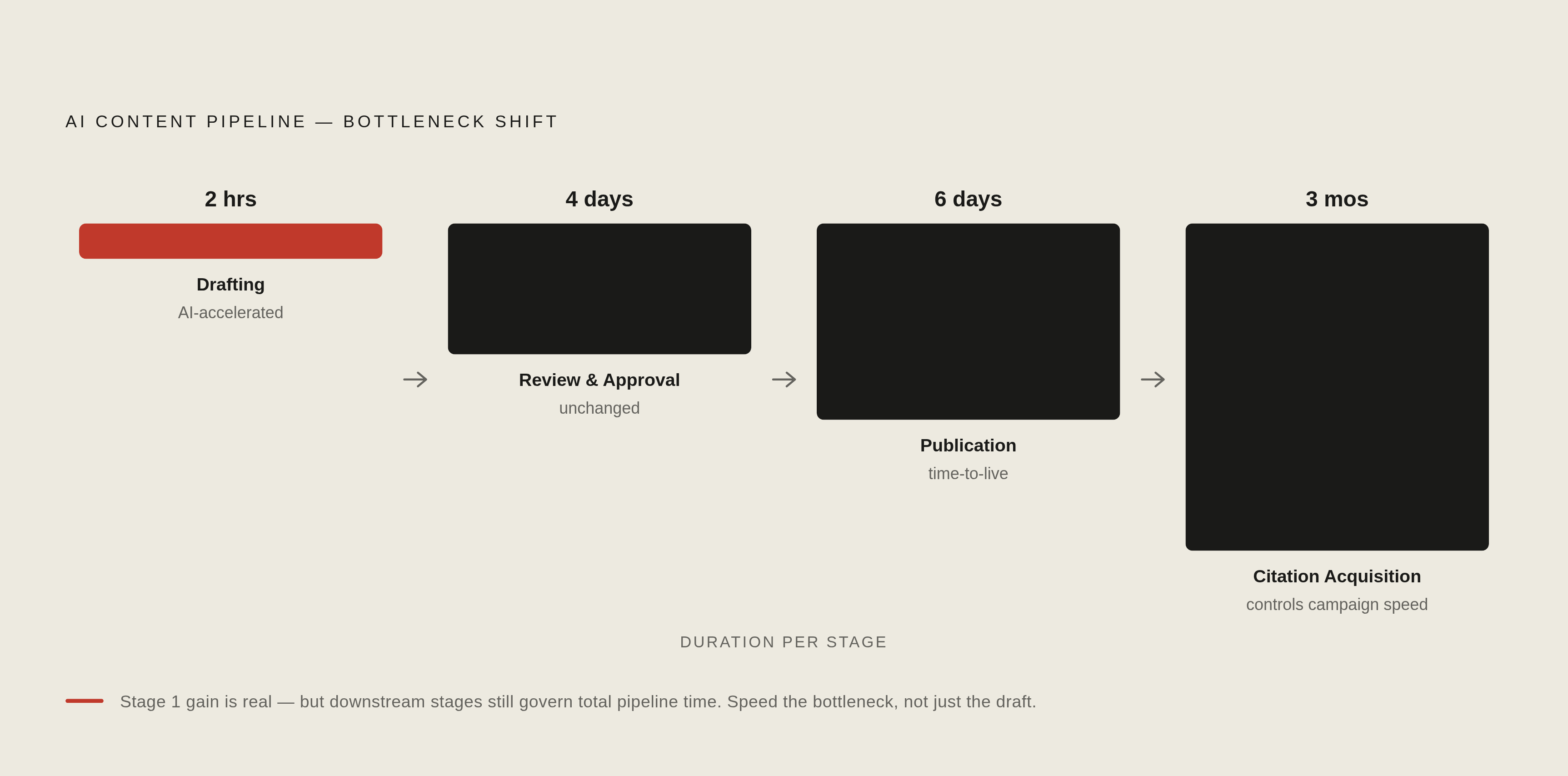
AI speed gains evaporate if review, publication, and citation stages aren't redesigned to match.

Advertisement
Most published speed gains for AI-assisted content are stage-level numbers dressed up as whole-pipeline numbers, and that substitution is what makes them misleading. A headline claim about drafting time or turnaround can sound like a statement about how fast a campaign moves from idea to audience, when it actually describes one narrow slice of a much longer process. Four distinct stages produce four distinct clocks: drafting, review, publication, and citation acquisition. Collapse one stage without tracking the other three and the delay does not disappear, it just moves somewhere else in the queue. Only a small minority of content marketing teams track AI-specific KPIs at all, so even organizations seeing genuine speed gains often cannot say which stage produced them or whether the gain survived contact with everything downstream.
What drafting speed measures
Drafting is the stage where AI produces the most consistent, best-documented gains in the entire content pipeline. A task that once took hours of staring at a blank page now takes minutes, and that part of the story holds up under scrutiny. But drafting is also the narrowest slice of total campaign time, and treating it as a proxy for the whole process is where the trouble starts.
Every one of those steps still exists after AI enters the picture, and most of them are not eliminated by faster drafting on their own. Cutting draft time from hours to minutes does not automatically cut total campaign time from weeks to days. Unless the downstream stages are redesigned to run alongside the drafting gain rather than after it, the bottleneck simply shifts forward in the queue, landing on whoever has to review, approve, or publish what AI now produces far faster than any human team can process it.
The real bottleneck: review, approval, and the tiered human-in-the-loop model
Once drafting speeds up, review and approval become the step that actually sets the pace of the whole campaign. How that step is built shapes whether a faster draft turns into a faster launch or simply a longer line of unread content waiting on one person's calendar. Review is the stage that decides whether the speed gained upstream is worth anything at all, because a draft that has not been checked for accuracy, tone, or compliance is not a finished piece of content, no matter how quickly it was produced.
A tiered human-in-the-loop model addresses this directly by placing review at strategic checkpoints across the process, at the brief, at the draft, and at the point of publication, rather than saving all human judgment for a single pass over finished output. Checking work at each checkpoint rather than only at the end catches problems earlier, when they are cheaper to fix, and produces better results than reviewing a finished piece and sending it back to the start. Solving that problem takes a defined same-day service-level agreement with clear escalation rules for who picks up the overflow, not a faster drafting tool. More AI throughput aimed at a human bottleneck only makes the backlog bigger.
Publication speed: where workflow design determines whether drafting gains reach the audience
The gap between a reviewed draft and a piece of content actually live and visible to an audience comes down to how the workflow between those two points is built. Most teams that have adopted AI for drafting have never gone back and redesigned the publication workflow to match the new pace of the drafting stage, so the old handoffs stay in place even after the writing speeds up.
A legacy campaign activation timeline accumulates delay at every handoff in that chain: a creator submits a piece, the draft sits in a shared drive until someone notices it, brand reviews, legal reviews, revisions get requested, the piece goes back for another round. Strung together, that sequence can take many weeks before a single piece of content reaches anyone. An AI-assisted workflow compresses that same timeline by automating the connective tissue between each handoff. Compliance scanning can flag an issue in minutes; a manual legal pass can take days. Same-day fixes replace revision cycles that used to stretch over several days each. Parallel processing means a Tuesday draft can enter review while Monday's draft is still being formatted, instead of every piece waiting in a single-file line.
The number that actually matters here is not time-to-draft, it is time-to-live, the interval between campaign approval and the moment the first piece of content reaches its audience. Teams running workflows built around AI from the start can hit that milestone in days rather than weeks, but only when the approval chain and the content management steps have been redesigned to match the drafting speed, not left as they were before AI entered the process.
The fourth clock: how long it takes AI answer engines to cite newly published content
Publishing a piece quickly is necessary but it does not guarantee that the piece will ever be cited by an AI answer engine, and that distinction marks where the argument shifts from how fast content can go live to how fast that content actually earns visibility once it does. A piece that goes live within hours of approval can still take weeks or months to appear in an answer from ChatGPT, Claude, Gemini, or Perplexity. Among those four, Perplexity is the only one that officially describes itself as an answer engine, while the other three are best understood as AI assistants that happen to have search capability built in. The factors that govern how quickly any of them surface a new piece of content are not the same factors that govern how quickly Google indexes a new URL, and teams make the mistake of treating the two processes as equivalent often enough that it deserves stating.
Different AI answer engines draw their citations from different kinds of sources, which adds a layer of complexity most teams have not accounted for. Some favor pages owned directly by the brand making the claim. Others lean heavily on third-party directories or established industry publications instead. That split means a single piece of content published on a single surface cannot be optimized for citation speed across every engine at once. A page built to earn a fast citation from one engine may be structurally invisible to another.
What determines citation speed
Citation acquisition speed is a function of decisions made at the level of content strategy, format, and distribution.
Content type is the single strongest lever available. Original research, benchmark data, and "State of X" style reports earn citations from AI answer engines far more often than generic blog content does, and brands that publish this kind of material appear in AI citations at a rate many times higher than brands producing standard articles. Content architecture matters just as much as content type. A grounding page is a fact-dense, neutrally written HTML page built with structured data that gives an AI answer engine something concrete to retrieve and reason from when it builds a response. A promotional page or one with loose, inconsistent structure is far less likely to get picked up as a citation source, regardless of how accurate or well-written it is.
Distribution through third parties often beats owned content alone as a path to citation. Analysis of AI Overview citations shows that the sources cited most often are predominantly third-party platforms. Seeding claims, data points, and brand mentions into authoritative external sources shortens the citation clock more reliably than publishing everything on the brand's own domain and waiting. Strategy also has to flex by engine, since different AI systems weight source types differently: some lean on encyclopedic and established media sources, others lean on community and technical forums, and still others draw heavily on user-generated content and official government sources. A content strategy aimed at a single surface will not produce consistent citation results across an ecosystem built on that many different sourcing habits. Spreading content across multiple kinds of surfaces is a structural requirement, not an optional refinement.
Measuring AI mentions to optimize citation speed
A team that has sharpened drafting, review, and publication but has no system for measuring AI citations has optimized three-quarters of the pipeline and is flying blind on the one outcome that increasingly decides whether content reaches buyers at the moment they are actually looking for answers. The gap here is large: only a small minority of marketers currently track AI citations at all, even though a much larger share of marketers already treat visibility in AI search as a core strategic priority. The distance between what teams say matters and what they actually measure amounts to an accountability failure, one that echoes the early years of web analytics, when traffic mattered enormously to everyone's strategy and almost nobody had a reliable way to measure it.
Traditional rank tracking cannot fill that gap. It measures where a brand shows up in classic search results, and it says nothing about whether ChatGPT, Gemini, Claude, or Perplexity actually name and cite that brand when a buyer asks a relevant question. Citation behavior also varies sharply from one platform to the next, with brand mention and citation rates differing substantially across engines, so an aggregate number that blends all engines together hides the platform-level picture a team would need to decide where to put its next piece of content. Platforms built around this problem, including Letterstory, embed human review at the brief, draft, and publish stages rather than saving it all for finished output, which shortens the review bottleneck described earlier while also giving a team a structured point to begin tracking what happens to a piece after it goes live. The industry needs a system that tells a team whether the content it already published is being cited.
How to read a speed benchmark
A speed benchmark for an AI-assisted content campaign is only useful once the reader knows which stage of the pipeline it describes, what it leaves out, and whether the stages it skips are being measured somewhere else. Four questions separate a usable benchmark from a misleading one. Does the number describe drafting, time-to-live, or citation acquisition, or is it presented as a single figure covering all three without distinguishing between them? Does it account for the time a human reviewer actually spends with the content, or does it stop at the moment AI finishes generating output, before anyone has checked it? Is the publication workflow built to run in parallel across pieces, or does faster drafting just stack a longer queue in front of the same reviewers? And is citation acquisition tracked, broken out by individual AI engine and checked on a defined schedule?
The practical move for any team setting its own internal benchmarks is to establish a baseline for each of the four stages separately before trying to optimize the pipeline as a whole. A gain made in one stage is invisible, and often worthless, against the noise of a stage nobody is measuring. Teams that instrument all four stages gain a real advantage over teams chasing a single aggregate speed number: they can see precisely where their bottleneck sits, whether in drafting, review, publication, or citation, and put their next investment into the stage that actually controls total campaign speed rather than the stage that was already fastest to begin with.