Launching a Content Campaign in Under Two Weeks
Speed matters now because AI answers, not websites, are where buyers first encounter brands.
Advertisement
By May 2025, zero-click search had climbed to 69% of U.S. Google queries, a 13-point jump in a single year. A content campaign launched today is competing for a buyer's attention at a moment when that buyer may never visit a website at all, and the two-week sprint this piece lays out exists because the old six-week approval cycle no longer reaches the discovery window in time.
Why the two-week window is not arbitrary, and why it matters now
The purchase journey now opens inside an AI-generated answer, before a buyer ever types a query into a search bar or lands on a brand's homepage. A brand absent from that answer at the moment a category conversation starts loses a form of consideration that rarely comes back around a second time. Zero-click behavior keeps rising, and a large share of U.S. Google searches in early 2026 end without a single website visit, so the AI-generated answer is frequently the only contact a buyer has with a brand at the discovery stage.
The stakes compound when the user moves from a search engine to a conversational one. Someone typing a question into ChatGPT tends to ask something more specific and more conversational than a search query, and tends to act on what the AI tells them at a meaningfully higher rate. The buyer's path no longer has to run through a brand's website, so being cited inside the answer functions as the conversion event, not a precursor to one.
Freshness is what makes the two-week window a strategic lever: structured content placed into the market quickly has a chance to enter the recency window that AI engines prioritize when selecting sources to cite. CUT
What "Launching" Means for AI Visibility
A content campaign in 2026 has to do two separate jobs at once: earn a position in traditional search rankings, and earn a citation inside an AI-generated answer. Content built to win one of those contests does not automatically win the other, and a team that plans only for search rankings will watch a competitor get cited in the answer that actually reaches the buyer.
Generative Engine Optimization, or GEO, is the discipline built around the second job. Researchers at Princeton University and IIT Delhi formalized the term in a 2024 paper, and the practice involves structuring content and building brand authority so that AI platforms select, cite, and surface a brand when they generate a response. Traditional search optimization aims for a ranked link a user might click. GEO aims for a brand's name and sourcing to appear inside the synthesized answer itself, with no click and no impression if the brand doesn't make the cut.
The signals of success look different, too. When GEO is working, a brand shows up as a citation with a source link, gets mentioned by name in the generated response, receives positive sentiment when it's mentioned, and holds a consistent share of voice across the range of prompts relevant to its category. None of those four outcomes appear in Google Analytics, which is part of why so many teams underinvest in this track: the dashboard they already trust simply doesn't measure it.
SEO and GEO work as complements. A sound approach builds the foundation with tactical, technical SEO and then layers a dedicated GEO strategy on top to earn AI citations specifically. That means the practical target for a launch is a two-track output: owned content built to be structurally readable and retrievable by AI systems, paired with earned or distributed content placed on third-party sources that AI engines trust and cite at higher rates than a brand's own pages. A sprint that produces only one of those tracks has planned for half the job.
The structural signals that determine whether content gets cited before a word is written
AI engines don't reward how much a brand publishes. They reward content that is structurally readable, authoritative, and retrievable, and the decisions that make a piece eligible for citation get made before drafting starts, not fixed afterward with a revision.
Most AI systems answering a query run on Retrieval-Augmented Generation: the system retrieves candidate documents from an index, then an LLM synthesizes those documents into the response it gives the user. Getting indexed is a precondition, not a guarantee. The content also has to be clear and authoritative enough, structurally, for the model to pull from it and cite it with confidence. A page can rank and still never get quoted if the model can't easily parse what it says.
That parsing requirement has concrete, checkable consequences. Clear heading hierarchies, FAQ sections, and schema markup all correlate with higher AI citation rates, because each gives a retrieval system a cleaner unit of meaning to extract. JavaScript-rendered content, by contrast, fails AI parsing at a high rate: a page that loads its real content dynamically can be read by an AI crawler as an empty template, invisible despite looking complete to a human visitor.
Topic authority outweighs any single strong page. AI systems break a user's question into smaller sub-queries, a process known as fan-out, and match each sub-query to the clearest available answer across the index. A brand with several well-structured pages covering a topic from different angles gets cited more often than a brand with one excellent page and nothing else around it, because fan-out rewards coverage. These three properties, retrievable structure, authoritative depth, and topic breadth, are the design brief the entire two-week sprint has to satisfy. Everything that follows is about hitting them on a fourteen-day clock.
Days 1–3: campaign architecture decisions that the rest of the sprint depends on
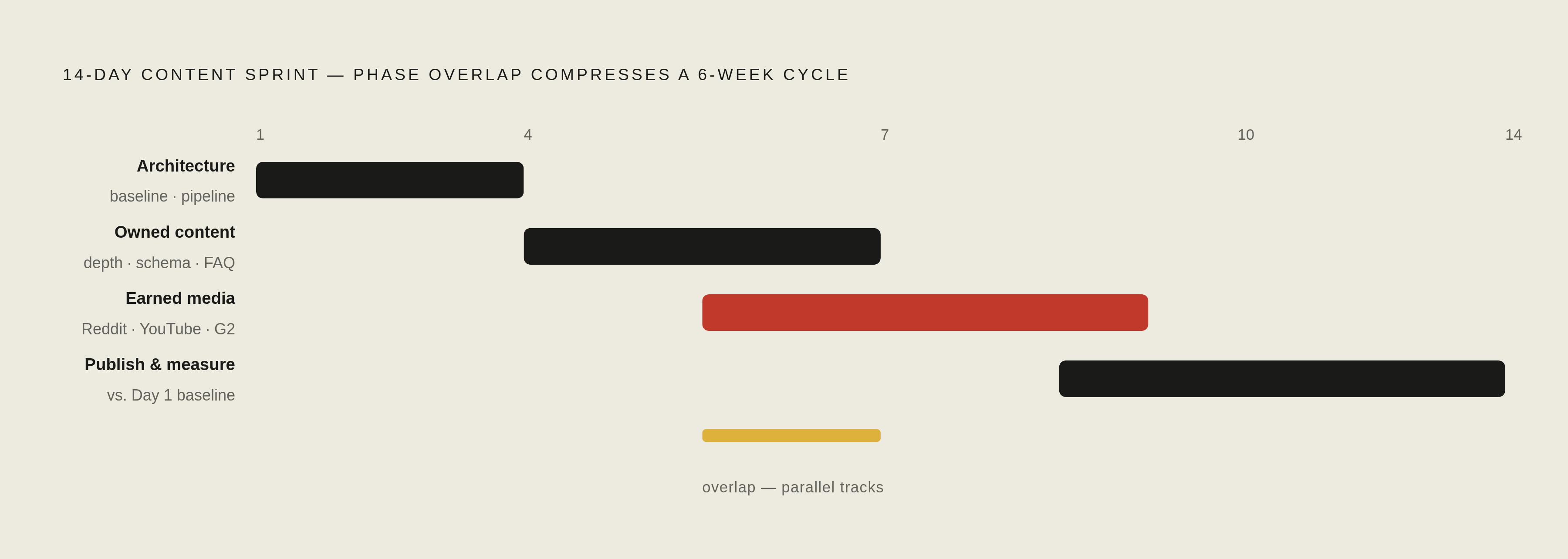
The first three days of the sprint produce decisions, not deliverables. Teams that blow a two-week deadline almost always trace the failure back to the same root cause: they started writing before the architecture was locked, and every hour spent producing content against an unsettled plan has to be redone once the plan settles.
One decision commits the team to the two-track architecture described above: owned content on the brand's own site, and earned or distributed content placed on third parties. The mix matters because AI systems cite third-party sources at substantially higher rates than brand-owned pages, so a team that skips the distribution track ends up with content that may rank in search but still goes uncited in AI answers. Setting this split on Day 1 means both tracks can start production in parallel instead of the distribution work getting bolted on late, when there's no longer enough runway to execute it properly.
A second decision locks in baseline measurement before a single piece of content ships. That means building a set of prompts spanning category questions, comparisons, problem-solution queries, and review-style queries, then running each prompt at least twice per AI engine and logging whether the brand appears, where it appears, what sentiment it carries, and which sources the engine cited instead. The exercise takes two to three hours, and it establishes the reference point against which the campaign's actual impact gets measured two weeks later. Skipping this step leaves no way to know, at the end of the sprint, whether anything moved.
A third decision sets the pipeline gates before production begins: brief approval before any work starts, an outline review before drafting, a pre-publish human check before anything goes live, and a post-publish performance trigger that flags content for a second look once it's in the wild. Defining these checkpoints on Day 1 prevents the judgment-call shortcuts that otherwise creep into a compressed timeline, the kind of shortcuts where a tired team skips the fact-check because the deadline is tomorrow. The gates exist precisely so speed never gets purchased by cutting the review step that catches a bad claim before it carries the brand's name.
Days 4–7: building the owned content layer AI can retrieve
Owned content published in this window has to be structurally correct the first time it goes live. There's no second revision cycle built into a fourteen-day sprint, and a page that fails AI retrieval criteria on publication day stays broken for the rest of the campaign's measurement window.
That constraint starts at the brief stage. Every brief template needs an explicit rule against fabricating facts or sources, and human verification of factual claims functions as a gate the content has to clear before publication, not a cleanup pass applied after the fact. The fact-check chain runs upstream of drafting, not downstream of it.
Each piece that comes out of this stage needs the same structural properties the design brief demands: a clear heading hierarchy, at least one FAQ section, a comparison table where the topic supports one, and schema.org markup applied correctly. Each of these properties is independently associated with improved AI citation rates, so skipping any one of them narrows the piece's odds of being picked up and quoted.
Depth affects citation odds more than volume does at this stage. One well-structured piece that covers a topic cluster from several angles is more likely to get cited than three shallow posts that each touch the topic once. The planning question for each piece should be which specific sub-queries it needs to answer for the brand's category, not how many keywords it can work in.
None of this is achievable on a fourteen-day clock without a production pipeline built for it. Content that clears the automated stages of that pipeline routes to a lighter human sign-off, often completed the same day. Only flagged content enters the full review queue. That structure is what compresses what used to take six weeks of back-and-forth approvals into two or three days, and it's also what preserves the one gate that cannot move under any circumstance: no content publishes without a human checking it for accuracy and compliance. Speed applies to the mechanical steps, research retrieval, draft generation, structural formatting. It never applies to the judgment call about whether a piece is safe and accurate to publish under the brand's name.
Days 6–10: the earned-media and distribution layer AI engines cite
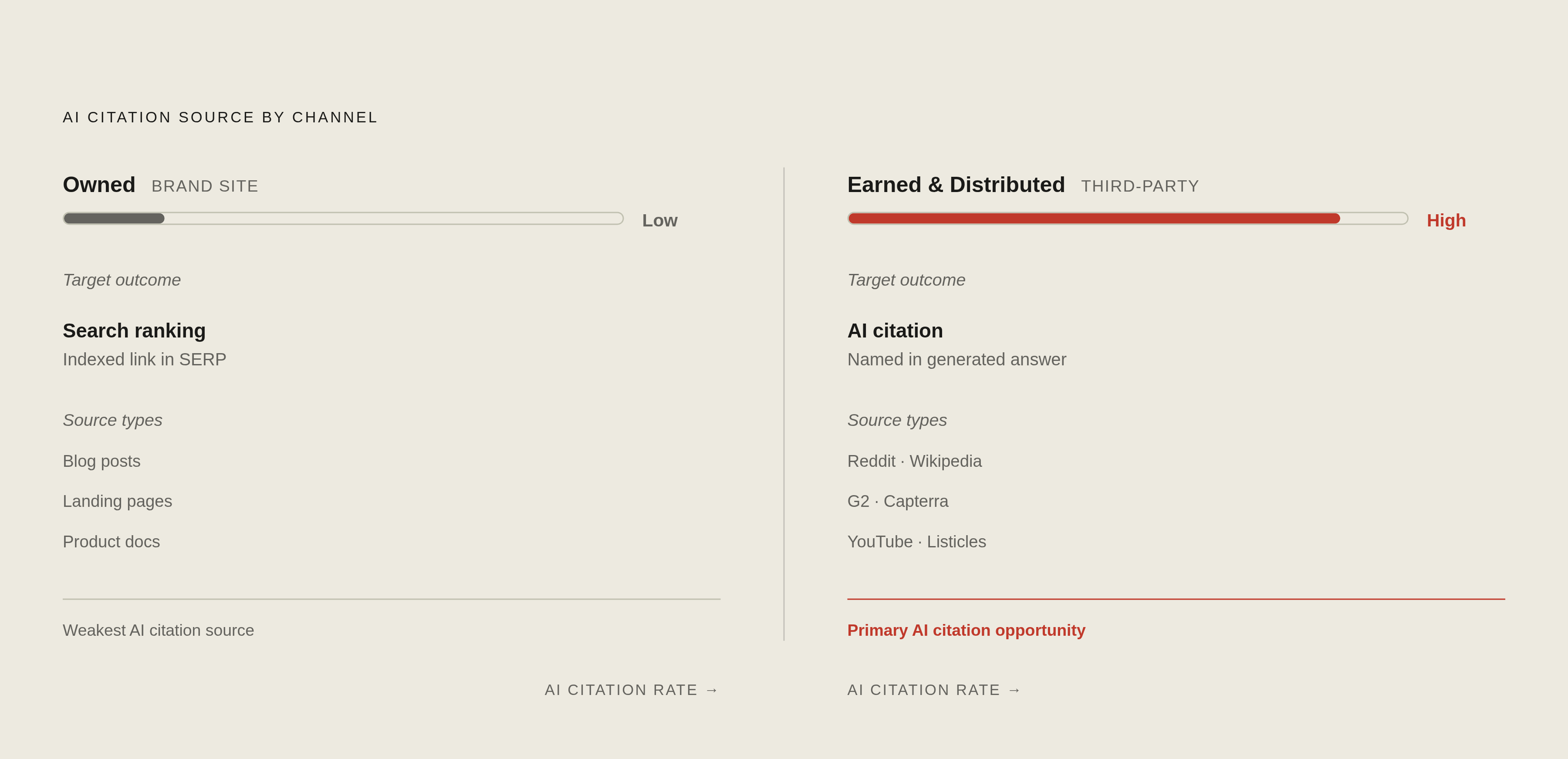
The finding that reorders how most teams think about this sprint is that a brand's own website is its weakest citation source. A campaign that publishes exclusively on owned channels, no matter how well structured, leaves most of the available AI citation opportunity untouched.
Reddit discussions, Wikipedia, review platforms such as G2 and Capterra, and YouTube all produce citation lift well above what owned content generates on its own. Freshness requirements differ by platform. Reddit discussions perform best when they're recent or carry high karma as evergreen threads, with content in between, old enough to feel stale but not old enough to feel established, underperforming both. Review platform content needs to stay recent to carry weight. Wikipedia entries, by contrast, hold their citation value at any age.
Third-party listicles carry particular weight for queries with commercial intent: roundups, comparison posts, and curated lists published on neutral sites drive real citation volume. For B2B SaaS and developer-tool brands, placement in these formats functions as a core visibility lever.
The distribution plan should also match the sourcing habits of the specific AI engines a brand cares about. ChatGPT cites Reddit and YouTube heavily. Perplexity leans toward research-credible sources, including G2 and LinkedIn. Claude favors premium long-form outlets. A distribution plan aimed at the wrong engine's preferred sources wastes the lead time it took to build it.
Distribution also guards against a specific failure mode: a brand can be cited by an AI engine for general category information and still lose the sale if the same engine recommends a competitor when the user asks what to actually buy. Building a presence in comparison and recommendation formats on third-party sites is what closes that gap between being mentioned and being chosen.
The earned-media track starts on Day 6, running in parallel with owned content production. Outreach to third-party publishers, submission of guest content, and participation in relevant communities all carry a lead time that can't be compressed below a certain floor. Starting this track late in the sprint keeps it from producing results inside the two-week window.
Days 10–14: publishing, technical checks, and the first measurement pass
The final four days of the sprint turn the production work into a published campaign and give the team its first real read on whether the architecture decisions from Day 1 are holding up. Every owned piece clears the pre-publish human check locked in during the Day 1–3 planning stage before it goes live, and every technical property defined in the design brief, including heading structure, FAQ sections, and schema markup, gets confirmed on the live page. A piece that renders correctly in a content management system can still fail silently in production if a template strips schema markup or loads a section in a way that an AI crawler can't parse. Checking the published page, not the draft, is the only way to catch that failure before it costs the piece its citation eligibility.
Once the owned and distributed content is live, the same prompt set built during Day 1's baseline measurement gets run again, across the same AI engines, logged the same way: whether the brand appears, where, with what sentiment, and against which competing sources. This is the first comparison point against the reference baseline, and it's too early in most cases to expect dramatic movement. AI citation patterns shift as engines re-crawl and re-index third-party sources, a process that unfolds over weeks, not days. What this first pass is built to catch is whether the architecture is directionally sound: whether the brand has started appearing in answers where it was absent at baseline, whether sentiment is neutral or positive rather than absent entirely, and whether the distribution track has begun generating citations from sources the AI engines are known to trust. The fourteen-day sprint ends here, with a published campaign and a working baseline, not with a finished verdict on performance. The verdict comes from what the next measurement cycle shows against this one.