Content Campaign Performance Measurement and Iteration
Brands now need to track AI citations alongside traditional metrics to measure campaign success.

Advertisement
Content campaign measurement has split into two separate jobs, and the split happened because buyers now meet brands inside AI-generated answers long before they reach a search results page or a company's own website. The discovery journey has moved upstream. Buyers type full questions into ChatGPT, Claude, Gemini, and Google AI Overviews, and they get synthesized answers back, often without clicking through to any site. Similarweb's zero-click research found that nearly seven in ten news-related Google searches, 69%, resolved without a single click as of May 2025, up sharply from the year before. The pool that click-based metrics can even see is shrinking in real time.
That shrinkage has a direct consequence for how campaigns get judged. A campaign can look entirely healthy in a GA4 dashboard, with steady sessions and stable rankings, but it can quietly lose the category conversation on AI surfaces where no click ever registers. These are two different outcomes happening at once, so no single measurement system can describe both. One layer is traditional engagement: rankings, traffic, clicks, conversions. The other is AI citation presence: mention rate, citation frequency, share of model, and sentiment across ChatGPT, Claude, Gemini, and Perplexity.
Neither layer can be dropped without cost. If a team ignores the traditional signals, it loses the conversion data that justifies budget. But if that team ignores the AI citation signals instead, it loses sight of the stage where shortlists now form, before a buyer ever opens a search bar. The two layers track different moments in the same buyer's decision, so a campaign only gets judged fairly when you watch both at once.
AI citation signals versus traditional engagement signals
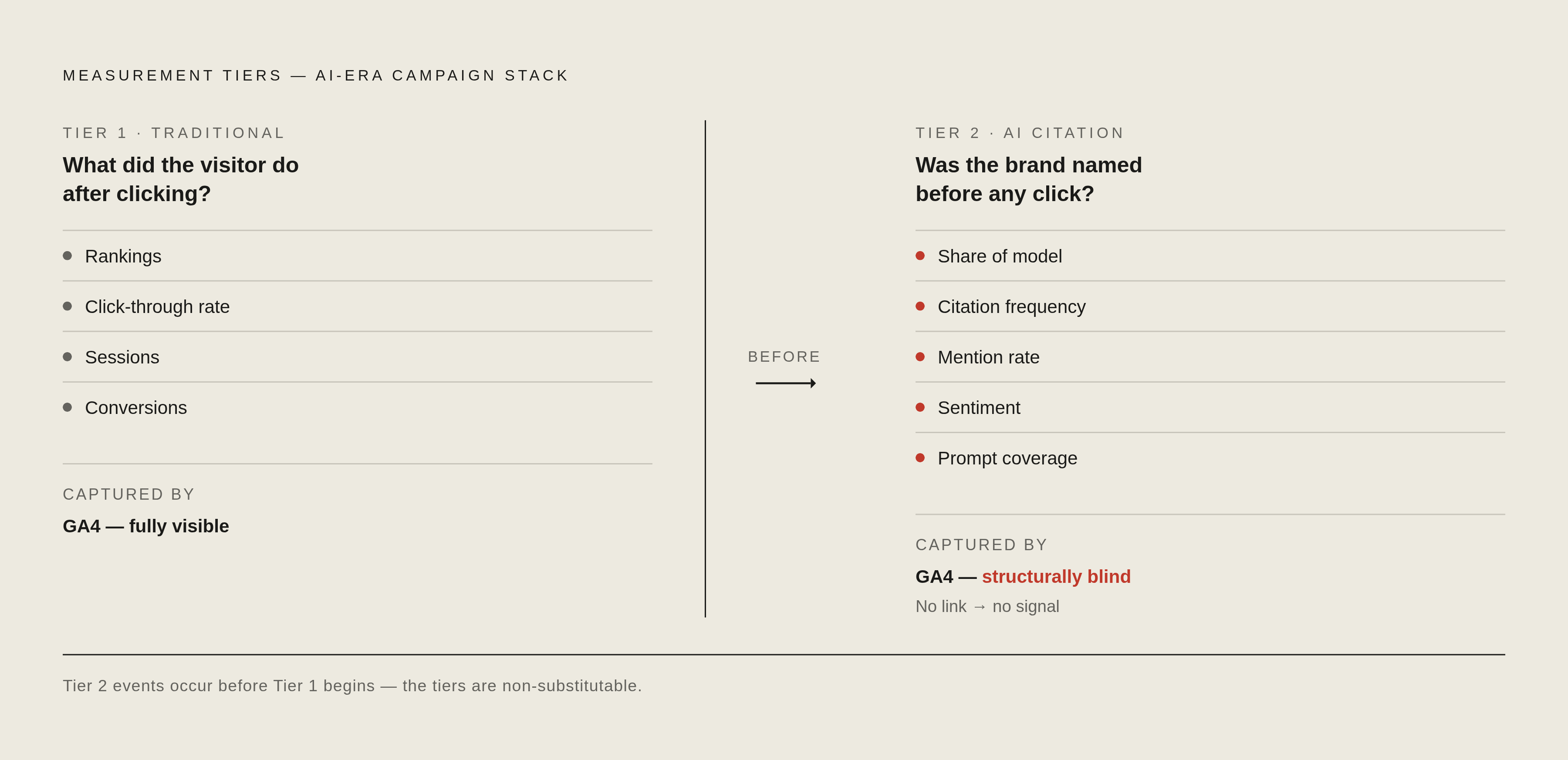
AI citation signals aren't a noisier version of engagement signals. They answer a different question, so no single dashboard can hold both. Traditional metrics, rankings, click-through rate, sessions, conversions, describe what a visitor did after clicking. AI citation metrics describe whether a brand got named before any click happened at all, and that's a different kind of event to measure, not a delayed version of the same one.
The platforms themselves behave in ways that make this split concrete. Similarweb's GEO guide lays out three distinct, measurable outcomes: citation with a source link, brand mention with or without a link, and positive sentiment. It gets treated as equivalent to brand mention share, not as a separate fourth category. None of these three outcomes appear anywhere in Google Analytics. ChatGPT names brands far more often than it links to them. Perplexity, by contrast, makes its citations clickable in the large majority of its responses. So the same brand visibility leaves two very different footprints in GA4: one nearly invisible, the other at least partially traceable.
Google AI Overviews adds a further wrinkle: the pages it pulls citations from shift over time, sometimes without warning. A page can hold a stable top-10 ranking in organic search and still lose its AI citation coverage, with no ranking change to explain it, and a page with a modest rank can start getting cited too. Treating AI visibility as a stand-in for SEO performance leads to wrong conclusions in both directions at once: content that ranks well but earns no citations gets more credit than it deserves, while content that gets cited constantly but drives few measurable clicks gets dismissed as underperforming.
The "dark traffic" problem for teams relying on GA4 alone
GA4 was built to measure a world where interest turned into a click, and it still does that job well. The trouble is the fraction of AI-driven brand interactions it simply never sees, and that fraction sits at the top of the funnel, right where buyers form their first impression of a brand. GA4 can log a session, but only when someone clicks a citation link inside an AI platform's answer. Most ChatGPT responses that mention a brand carry no clickable link, so GA4 has nothing to record for most ChatGPT brand interactions.
Perplexity breaks that pattern. Every Perplexity citation is clickable, so Perplexity referral traffic appears in GA4 far more reliably than ChatGPT traffic does, even though it lands under a generic "Referral" label rather than GA4's native "AI Assistant" channel, and some of it still gets lost to referrer stripping. So Perplexity is the one AI platform where click-based analytics come close to telling the whole story.
The gap left by the rest isn't a minor reporting annoyance. A buyer who saw a brand recommended inside ChatGPT, then later searched for it directly or typed the URL from memory, appears in GA4 as direct or organic traffic, with no trace connecting that visit back to the AI answer that actually drove it. The acquisition event is logged, but the attribution for it is gone.
Two workarounds close part of that gap, but neither one gives you real AI measurement. You can filter a GA4 Exploration report by session source to see whatever referral clicks do exist. Adding "ChatGPT" or "AI search" as explicit choices on a contact form's "how did you hear about us" field captures intent signals that referrer data never catches on its own. Both help. Neither solves the underlying problem: a team iterating purely on GA4 data is tuning its decisions to the visible minority of AI-driven interactions while the invisible majority goes unmeasured, and every adjustment made from that data is an adjustment made on incomplete signal.
The metrics that belong in an AI-era campaign measurement stack
Closing that gap means building a second tier of metrics and running it alongside the traditional one. That second tier covers share of model, citation frequency, mention rate, sentiment, and prompt coverage, tracked on its own terms.
Citation frequency measures how often a brand gets cited with an actual source link, kept separate from mentions that carry no link, since the two behave differently across platforms and conflating them erases exactly the distinction that matters. Sentiment and accuracy track whether an AI's description of a brand reads as positive, neutral, or negative, and whether the facts it states about that brand are even correct, since a confidently wrong AI description is a brand risk that no ranking report will ever flag. Prompt coverage measures the share of a tracked query set in which a brand shows up. A brand that dominates a handful of prompts but is absent from most of the rest holds a weaker position than one with moderate presence spread across the full set, even if the first brand's peak numbers look more impressive. AI referral rate, the actual click-through traffic arriving from AI platforms where it can be tracked, still matters as a directional signal, even with the undercount built in.
None of this replaces the traditional layer. Organic rankings and traffic still matter, because crawlability and page authority remain prerequisites for a page to get retrieved in the first place, which makes ranking data essential for diagnosing why citation is or isn't happening. Conversion rate by traffic source matters just as much: AI-referred visitors convert at materially higher rates than organic search visitors, based on data cited by Seer Interactive, making source-level conversion tracking a real pipeline question.
None of it works without a fixed foundation underneath it: a stable panel of prompts, submitted to ChatGPT, Perplexity, Gemini, Claude, and Google AI Overviews on a set schedule. Without that fixed panel, you can't compare share of model and citation frequency across time or across platforms, because the baseline keeps shifting under you. Similarweb's GEO guide confirms the same structural point from a different angle: citation with source link, brand mention, positive sentiment, and high share of voice are each measurable on their own terms, and none of them appear in Google Analytics. The two tiers need separate instrumentation because each captures outcomes the other structurally cannot register.
A workable cadence keeps both tiers moving. Rank movement and AI citation changes get checked daily. Content performance and query groupings get reviewed weekly. A monthly narrative explains what changed and why, and it turns raw numbers into a decision record. Quarterly reviews recalibrate the prompt sets, the benchmarks, and the KPI definitions themselves, because the AI platforms keep changing how they behave, and a measurement stack that doesn't update with them will quietly go stale.
Tools that currently instrument AI citation alongside traditional performance data
A small set of purpose-built tools has emerged to track AI citation presence across platforms, and choosing among them comes down to three questions: how the tool sources its prompts, which platforms it actually covers, and whether its citation data connects back into content workflow or just sits in a separate report.
Ahrefs Brand Radar, which launched in beta in March 2025 and came out of beta in June 2025, tracks brand mentions across seven AI indexes: Google AI Overviews, Google AI Mode, ChatGPT, Perplexity, Gemini, Microsoft Copilot, and Grok. It draws its prompts from real search behavior rather than synthetic queries, and that matters for benchmark validity, because synthetic prompts can inflate citation rates on questions no real buyer ever asks.
Semrush's AI Visibility Toolkit tracks brand appearance across ChatGPT, Gemini, Google AI Overviews, AI Mode, and Perplexity. Its Prompt Research feature estimates topic-level AI demand, built from a large database of prompts and the responses they generate, so you can use it as a GEO equivalent of keyword search volume.
Brandi AI positions itself as an enterprise AI visibility and GEO platform, and it tracks AI citations and recommendation patterns for mid-market and enterprise customers. The company's CEO frames the product as a complement to SEO work.
Letterstory takes a different approach to the same problem. Its measurement layer tracks whether ChatGPT, Claude, Gemini, and Perplexity actually name and cite a brand, measured directly against the content the platform has published, closing the loop between publishing cadence and citation outcome instead of treating measurement and content production as two separate systems that happen to share a client. So if you want citation data built into the content pipeline itself rather than living in a separate analytics product you have to check on your own, this design suits B2B SaaS and dev-tool teams.
Whichever tool a team picks, the same checklist applies. Check whether it draws on real-world prompts or synthetic ones. Confirm which platforms it actually covers: a tool that only tracks Google AI Overviews misses ChatGPT and Perplexity entirely, and those two platforms source citations in genuinely different ways. Confirm whether it reports sentiment and factual accuracy, not just raw mention counts. And confirm whether its output feeds back into what gets written next, or only into a report that gets read and filed away.
What content earns AI citations and why it differs from what earns rankings
The content that earns an AI citation is built differently from the content that earns a search ranking, and a team iterating only on ranking data will keep making the wrong adjustments as a result. AI systems are trained on enormous corpora that already contain the generic version of nearly every topic. What they cite is content that adds something those corpora don't already have: a proprietary fact, fresh data, a detail that extends what the model already knows. A guide that reads like a thousand other guides on the same topic won't get cited, no matter how well it ranks.
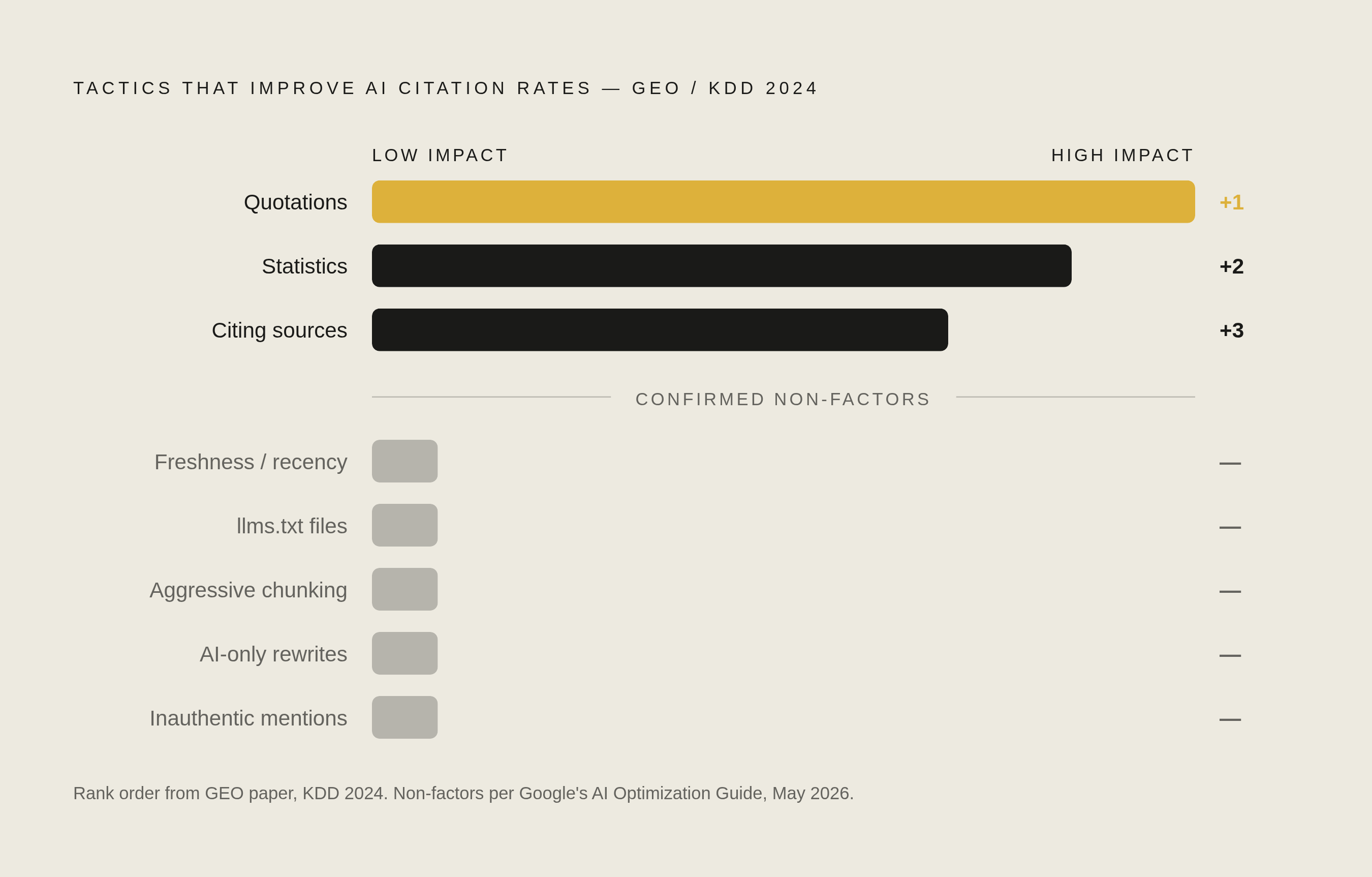
Format carries real weight here too, no matter how good the writing underneath it is. The GEO paper presented at KDD 2024 tested nine distinct strategies for improving AI citation rates, and the top performers were adding quotations, adding statistics, and citing outside sources, not freshness or recency, which a separate, later paper examined on its own. Question-led headings and self-contained answer blocks help too, because they give retrieval systems a clean, quotable passage to pull, so the system doesn't have to dig an answer out of a paragraph built for a human reader skimming top to bottom. The goal is to be quotable, which is a narrower and more specific target than simply being indexable.
Google's own AI Optimization Guide, published May 10, 2026, rules out several shortcuts directly: creating llms.txt files, chunking content aggressively, rewriting pages solely for AI consumption, and generating inauthentic mentions all fail to move AI visibility. The tactics that look like clever workarounds turn out to be confirmed non-factors.
That has a direct bearing on how a team should read flat citation numbers. When citation metrics stay flat even as rankings hold steady, you should read that as content depth and format almost every time, not as a technical SEO problem. The fix is original data, an updated table, or a third-party source that backs up a claim, not another pass at keyword optimization. Rankings and citations are earned by different kinds of work, and treating them as the same work is the fastest way to misread why a campaign's citation numbers aren't moving.