From formulation to first production run: what actually gates a consumer brand launch timeline
Successful launches depend less on speed and more on running the right steps at the same time.
Advertisement
The real subject here isn't formulation, packaging, or regulatory review individually — it's the sequencing between them, and specifically, how many founders discover the sequence is wrong only after they've already lost six weeks to it.
I've sat through enough of these launches, on both the brand side and the contract manufacturing side, to notice a pattern. The founders who hit their date figured out early which steps could run at the same time and which ones had to wait their turn. Miss that distinction and you can burn three months without a single person doing anything wrong. Get it right and a six-month timeline stops being a fantasy and just becomes ambitious.
Formulation Isn't the Bottleneck You Think It Is
Founders obsess over formulation because it's the part they can control from a laptop. Tweak the ratio, taste it, tweak again. Feels like progress, and it is, the same way a chef tasting soup is making progress. But formulation R&D rarely eats more calendar time than everything that comes after it, at least in my experience. A contract manufacturer can usually turn a bench sample into something batch-ready in a handful of iterations, unless the brand is chasing something genuinely hard: a shelf-stable probiotic surviving 18 months at room temperature, or a rheology that has to behave a certain way under specific packaging pressure.
The real time sink shows up when formulation and packaging stop talking to each other. I watched a skincare brand lose six weeks reformulating a serum because the viscosity that felt perfect in a beaker turned syrupy and useless in the airless pump they'd already tooled for. Nobody checked whether the two would get along before committing to both. That's a coordination failure, and coordination failures are exactly the kind that quietly double timelines. Nobody owns catching them, so nobody does.
Formulation gates the timeline less through its own complexity and more through how late its outputs get tested against everything downstream of it. Lock a formula without running it through the actual container at the actual fill line speed, and the delay doesn't disappear. It just resurfaces later, somewhere more expensive.
Regulatory Review: The Gate Nobody Puts on the Gantt Chart
This is where it gets category-specific, and where first-time founders get blindsided most often. A snack brand and a supplement brand are not playing the same regulatory game, even if both call themselves consumer packaged goods on their pitch deck. Food products generally move through nutrition labeling and facility compliance that a decent co-packer has handled a thousand times; routine, if not always quick. Supplements carry more scrutiny around ingredient claims and dietary ingredient documentation. Cosmetics run their own track on ingredient safety and labeling. None of it compresses just because a founder is in a hurry.
Paperwork sitting behind someone else's paperwork is still a queue, and if a brand doesn't submit documentation until after the first production run is already scheduled, they've built a timeline that assumes a reviewer somewhere shares their sense of urgency. That's an optimistic assumption, to put it kindly.
Regulatory complexity is rarely the actual gate. What gates it, more often, is when the brand starts the process relative to everything else running alongside it. Regulatory review can happen in parallel with packaging design and early supplier sourcing, provided someone remembers to kick it off that early. What it cannot do is run in parallel with itself.
Packaging Lead Times: Where Optimism Goes to Die
Ask anyone in operations at a contract manufacturer what actually blows up launch dates, and packaging comes up before formulation, before regulatory, before almost everything else on the list. Custom tooling for a mold, a specific pump mechanism, a proprietary bottle shape: none of that gets expedited by asking nicely, because physical tooling has to be cut, tested, and adjusted, and that process does not care how excited your seed investors are.
A brand will spend four months perfecting a formula down to a tenth of a percent, agonizing over whether the vanilla note reads "warm enough," and then order custom glass with an eight-week lead time as an afterthought, three weeks before they wanted product on shelves. The training wasn't wasted. The sequencing was.
Stock packaging, when it comes in the right size and material, sidesteps almost all of this. There's a real argument for wanting something proprietary. But that argument has to get weighed against actual weeks on a calendar, not vibes, and a founder insisting on custom closures for a launch six weeks out is negotiating with physics. Physics doesn't negotiate back. It just shows up late.
Minimum Order Quantities and the Cash Flow Question Hiding Inside Them
MOQs get talked about like a manufacturing constraint, but more often they're a cash flow constraint wearing a manufacturing costume. A co-packer sets a minimum run because their equipment has setup costs that don't scale down, not because they enjoy making founders sweat. Running a filling line for 500 units costs almost the same in labor and changeover time as running it for 5,000. The materials are the variable. The setup isn't.
That raises a real question for anyone mapping a timeline: is the gate here actually manufacturing capacity, or is it how much inventory the business can afford to sit on before it sells through? Usually it's the second one, and mixing the two up leads to strange decisions, like chasing a manufacturer with a lower MOQ instead of asking whether a smaller first run at a higher per-unit cost actually protects runway better. I've watched brands walk away from a manufacturer because the MOQ felt intimidating, then sign with someone whose MOQ was smaller but whose per-unit cost, packaging compatibility, and lead time were all worse. They optimized for the number that scared them and ignored the numbers that actually mattered.
Worth remembering here: a contract manufacturer is juggling a line schedule across dozens of other clients too. A smaller brand that shows up with finalized specs, approved packaging, and an actual purchase order can sometimes move through a production queue faster than a bigger brand that's still changing its mind. Readiness beats size more often than people assume walking in.
The Parts That Actually Run in Parallel, If You Let Them
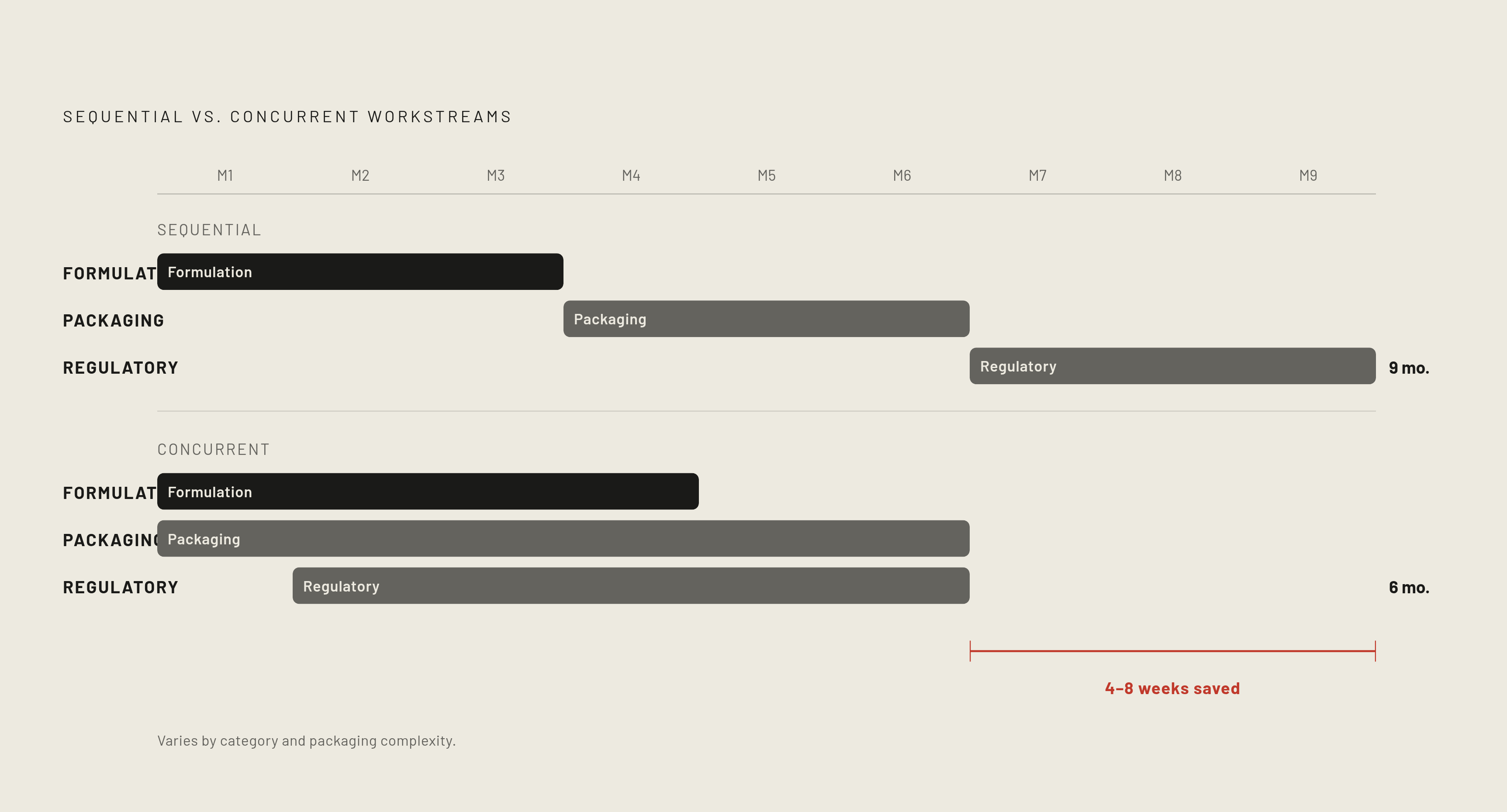
Formulation finalization, packaging sourcing, and regulatory documentation don't have to happen one after another. They get treated that way anyway, mostly because founders process their business like a single long to-do list, checking off item one before touching item two. A contract manufacturer worth working with (and I've seen operations like Legacy Companies structure early onboarding around exactly this) will often start scoping packaging compatibility and pulling documentation before the formula is fully frozen, because they've learned the hard way that waiting for perfect sequencing is how a six-month timeline turns into nine months.
So the gate really comes down to whether the brand and manufacturer are structuring these workstreams to overlap, or stacking them like dominoes and hoping nothing tips over in the wrong order. A brand that starts packaging conversations the same week it locks a working formula, instead of after, can save four to eight weeks depending on category and packaging complexity. Nobody brags about this on a launch story, because "we ran two workstreams concurrently" doesn't make for a good Instagram caption. It's still the actual mechanism behind every timeline that beats expectations.
So What Actually Gates the Timeline?
Formulation complexity rarely explains the delay, and manufacturing capacity usually doesn't either, at least not in the way founders tend to mean it. What tends to matter more is sequencing literacy: knowing which steps are hard-blocked by physical lead times, like packaging tooling or sourcing for anything that isn't commodity-grade, which are blocked by external review queues, and which are flexible enough to compress if brand and manufacturer coordinate early instead of late.
Understanding this doesn't guarantee a faster launch in every case. Sometimes the honest timeline really is six or nine months, and no amount of clever parallel processing changes that for a genuinely novel formulation running through custom everything. Founders who get this stop being surprised by their own calendar, though, which counts for something. And they stop blaming a contract manufacturer for delays that were baked in the moment they ordered custom packaging with an eight-week lead time nobody checked against the date already promised on Instagram.
Worth asking, honestly: which of these gates have you been treating as sequential that could actually run side by side? And which have you been treating as flexible that's actually hard-blocked by something physical, sitting on a boat or in a mold somewhere? Answer that with your manufacturing partner in the room early, not looped in after the fact, and the calendar has a way of sorting itself out on its own.