Which parts of consumer brand operations can actually be automated, and which still need a human in the loop
Automation handles routine volume; humans own decisions where reputation is on the line.
Advertisement
This piece looks at consumer brand operations, everything from customer service to inventory forecasting to social content, and sorts out what software can genuinely run without a person watching it versus what still falls apart the moment you walk away. The short version: automation handles volume and pattern-matching well, but it still struggles with judgment calls that involve reputation, ambiguity, or a customer who's furious for a reason the system has never seen before. Let's get into where that line actually sits, because it's not where most vendor pitch decks say it is.
The stuff that's basically solved
Inventory replenishment is probably the least controversial win in this whole conversation. Demand forecasting models, the kind Blue Yonder and o9 Solutions sell into retail supply chains, have gotten good at predicting reorder points based on seasonality, promo calendars, and historical sell-through. Nobody's manually recalculating safety stock for 40,000 SKUs anymore, and nobody should be. The math is the math; a Tuesday in July behaves like the last ten Tuesdays in July unless something structural changes.
Email and SMS marketing operations sit in a similar spot. Klaviyo and Braze both run trigger-based flows, abandoned cart, post-purchase follow-up, win-back campaigns, with close to zero human intervention once the logic is set up. A customer abandons a cart at 11:47pm, gets an email at 1pm the next day, and nobody on the brand's team lifted a finger. A timer with a template attached handles it end to end.
Basic tier-one customer service has moved the same direction. "Where's my order" and "how do I return this" account for a huge chunk of inbound support volume at most direct-to-consumer brands, and chatbots built on platforms like Gorgias or Zendesk's AI tools now resolve a large share of that without escalation. Accuracy on these narrow, well-defined intents runs high in vendor studies, often in the low-to-mid 90s percentage range for correct routing or resolution. The underlying questions were never that hard to begin with; they just used to eat up a human's morning.
Social listening and sentiment tagging round out the list. Tools like Sprout Social and Brandwatch scan mentions across platforms and flag spikes in negative sentiment faster than any social media manager scrolling Twitter at 9am ever could. The categorization is automated, but the response to the flag still requires a person, and that's where section three picks up.
Where it gets messy: the "almost automated" middle
Content moderation is the classic almost-there case. An algorithm can catch a slur in a comment section instantly; that's pattern matching against a known list, trivial by machine learning standards. But sarcasm, coded language, and context-dependent offense (a joke that's fine from a friend and a lawsuit from a stranger) still trip up automated moderation constantly. Meta's own moderation systems, and TikTok's, still route millions of edge cases to human reviewers every year because the model's confidence score drops below threshold. The machine knows what it doesn't know, which is actually the encouraging part. The cases where it's confidently wrong are the ones that should worry a brand manager.
Personalized product recommendations land in the same gray zone. Recommendation engines from Salesforce Commerce Cloud or Nosto are excellent at "customers who bought X also bought Y." They're much worse at reading a moment. A brand that recommends a birthday gift category to someone who just searched "funeral flowers" has software with zero situational awareness, which in consumer-facing contexts amounts to an embarrassing outcome regardless of the technical cause. One might argue this is a data problem that better models will eventually solve. Maybe. But "eventually" has been the answer to this specific complaint for a while now, and the failure mode keeps showing up in different clothes.
Then there's influencer and creator vetting, which brands increasingly try to semi-automate through platforms like Grin or CreatorIQ. These tools are genuinely useful for surfacing candidates based on engagement rate, audience overlap, and follower authenticity scores. But whether a creator's tone fits the brand, whether their old tweets are a landmine waiting to detonate during a campaign, whether their audience actually trusts them versus just watches them: that's still a human scrolling through eighteen months of posts with a cup of coffee and a growing sense of dread. Automated audience-fraud detection catches bot followers well; catching "this person seems fine until you learn what they said in 2019" still requires a person doing the reading.
Where a human absolutely has to stay in the loop
Crisis response is the clearest case, and it's worth pausing on why. A brand's Twitter account tweeting the wrong thing during a product recall reflects a trust failure, and trust failures require a human to read the room in a way no sentiment classifier currently can. Consider the well-worn cautionary tale of automated social posts firing on schedule during a tragedy or controversy, oblivious to the news cycle around them, because the queue was set a week in advance and nobody hit pause. It's happened enough times across enough industries that "check the news before your scheduled post fires" is basically an unwritten rule of the trade now. Software reads a calendar, not a room.
Brand voice and creative direction fall into the same bucket, though for a different reason. End-to-end content platforms that pair AI drafting with human editorial review are built that way precisely because the two stages need each other. Generative AI tools, whether that's Jasper for copy or Midjourney for imagery, can produce serviceable drafts fast, and plenty of brands now use them for first-pass ideation. But the actual voice, the thing that makes a brand's Instagram captions sound like a specific, slightly weird person rather than a committee, still gets shaped and approved by a human editor who knows what the brand would never say. AI can generate fifty taglines in ten seconds. Picking which one avoids getting the brand mocked on TikTok by Tuesday afternoon requires someone who has actually been mocked on TikTok, or at least watched it happen to a competitor.
High-stakes customer complaints belong here too, and this is really an extension of the tier-one point from earlier. The "where's my order" bot works great until the order in question was a wedding dress that arrived four days after the wedding. At that point the brand needs a person who can apologize like they mean it, offer something beyond a coupon code, and use judgment about how much goodwill the situation is worth. Zendesk and Gorgias both build in escalation triggers for exactly this reason, routing anything emotionally loaded or financially significant to a human agent. The software is smart enough to know its own limits, which, again, is the one genuinely reassuring part of this whole discussion.
So what's the actual dividing line
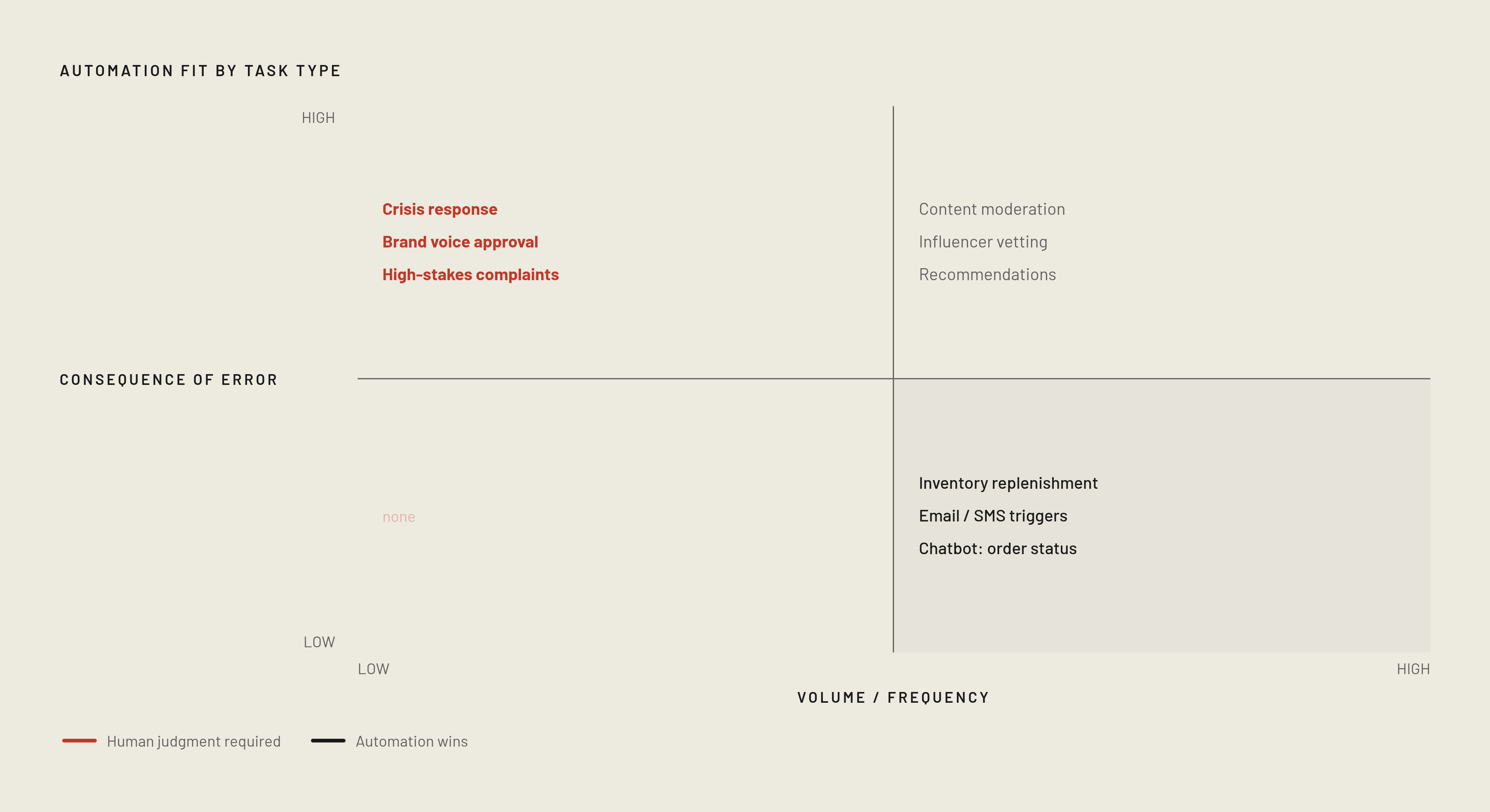
Pull back from the specific tools and a pattern emerges: automation wins whenever the task is high-volume and low-ambiguity, and it loses whenever the task is low-volume but high-consequence. Inventory forecasting runs across tens of thousands of SKUs with fairly predictable variance, so the cost of being wrong on any single item is small. A crisis tweet happens once, maybe, in a brand's whole year, but if it lands wrong, it's the only thing anyone remembers about that brand for months.
That raises an obvious follow-up: does this line move over time as models improve? Almost certainly, at least at the edges. Content moderation is meaningfully better than it was five years ago, and tier-one customer service bots handle a wider range of intents than they used to. But moving the line and erasing the line are different projects. The line exists because judgment about reputational risk, emotional nuance, and context isn't a data problem in the way inventory is a data problem. It's closer to taste, and taste is stubborn.
Which is really the whole point of walking through it this way, task by task rather than department by department. Asking "is customer service automated" misses the point, because customer service contains both a shipping-status lookup and a wedding-dress catastrophe, and those two things have nothing in common except that they both arrive in the same inbox. Ask instead: how many times does this happen, and how bad is it when the answer is wrong? Answer that for any given task in a brand's operation, and the automation question mostly answers itself.