Building a Freelance Contributor Network for Content Scale
Expert attribution and compliance are now essential to ranking in both search and AI answers.

Advertisement
A content leader checking rankings this quarter has likely noticed two things at once: a competitor's name sitting inside an AI answer box where the brand's own link used to be, and a compliance officer flagging a freelancer-written page for a claim nobody can trace back to a source. Both symptoms point to the same cause. The era of anonymous, high-volume content production has ended, and both search engines and AI answer engines now penalize it, which makes expert attribution a functional requirement rather than a brand preference. Google updated its Search Quality Rater Guidelines in January 2025 to assign the lowest possible quality rating to pages where all or nearly all of the main content is auto-generated, AI-generated, or copied and paraphrased from other sources with little effort, originality, or added value. Google's own Search Central documentation goes further, naming the use of generative AI to mass-produce pages without adding value as a practice that may violate its spam policy on scaled content abuse.
The mechanism behind both penalties is the same one that undermines anonymous freelance marketplaces and AI-only generation platforms: without a verifiable expert standing behind a piece of writing, that writing earns trust from neither human readers nor AI systems. This is not a volume problem. Most brands running a freelance program are already meeting their monthly output targets, publishing on schedule, filling the calendar. The trouble is that the content sitting on the calendar doesn't show up where it needs to: competitors occupy the answer boxes above them, and legal or compliance teams flag the freelancer work that did get published because nobody can verify who wrote it or where the claims came from. Producing more of that same content does not fix either problem. It compounds them, because scale without verifiable expertise just multiplies the number of pages carrying the same structural weakness.
How AI answer engines have redefined what "performing content" means
Earning a citation in an AI answer and ranking on a search results page are different jobs, and content built to do one does not automatically do the other. Search Engine Optimization gets a page discovered. Answer Engine Optimization gets a specific answer extracted from that page. These are three separate disciplines with three separate sets of requirements, and a contributor network now has to produce content that satisfies all three at the same time, which changes what goes into a brief before a single word gets written.
A meaningful share of what AI systems cite comes from third-party platforms, not brand-owned domains, so brands need a presence on review sites, in analyst reports, and inside trade publications, alongside owned content structured with answer-first writing, question-based headings, and original data. Formatting decisions that used to belong to a post-production checklist now belong at the network-design stage. Pages built with consistent heading intervals and structural elements such as tables, ordered lists, and numbered steps earn substantially more AI citations than pages written as unbroken paragraphs. That is a specification, not a style preference, and it has to flow down from editorial standards into every individual contributor brief. A network built to hit keyword density and word counts was built for a search engine that no longer works the way it used to. A network built for AI visibility needs contributors who can write extractable, structured, source-backed content from the outset, because retrofitting that structure after the fact rarely produces the same result.
Why a Freelance Network Reaches Places a Brand's Domain Cannot
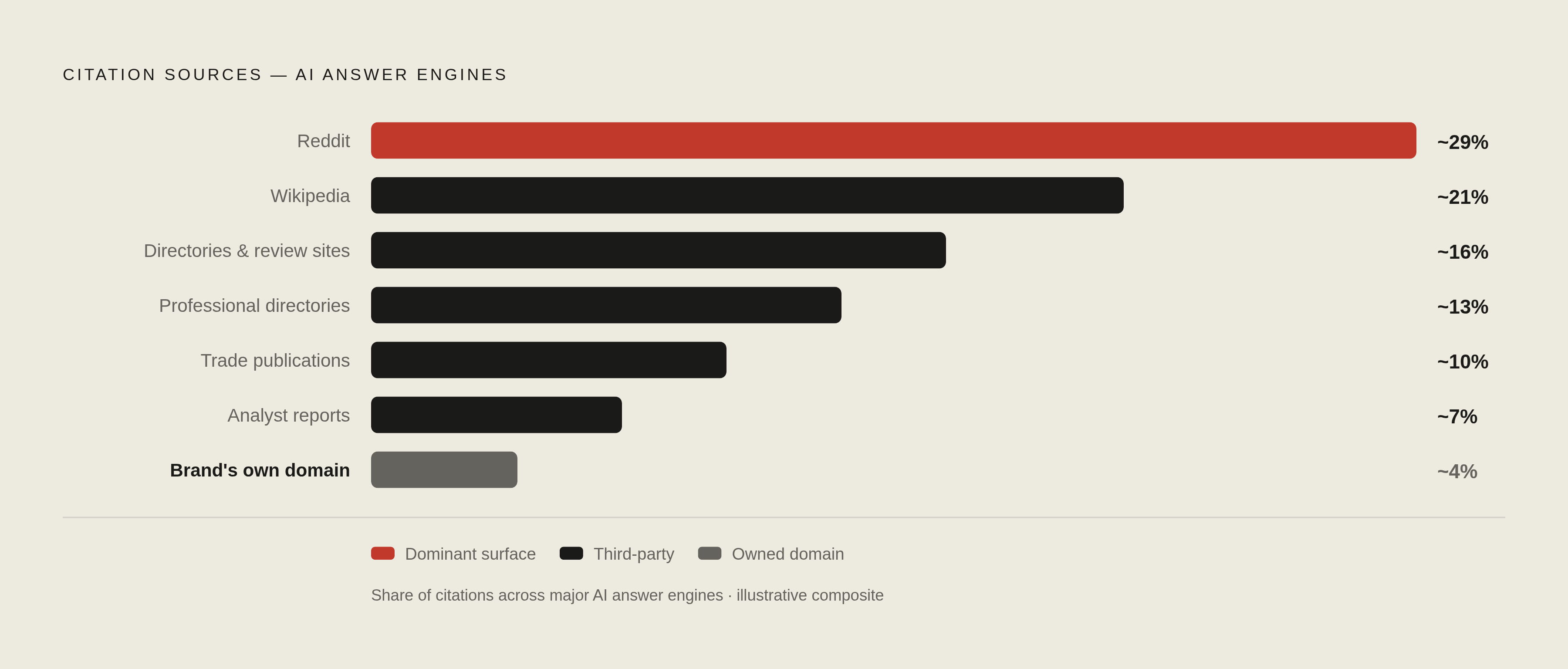
Owned content remains necessary, but it is no longer the primary source AI answer engines draw from when constructing a response. The surfaces those systems cite most heavily are third-party, and a contributor network functions as the mechanism for getting a brand onto those surfaces. Reddit accounts for a disproportionately large share of citations in AI answers, and Reddit, Wikipedia, and third-party directories such as review sites and professional directories together account for the majority of citations across the major AI engines, though the mix varies sharply by platform. A brand's own primary domain sits in the minority of what gets cited. That fact alone reframes the entire argument for owning a distribution engine beyond the company blog.
A brand can rank first on Google for its core terms and be functionally invisible inside ChatGPT, because the audiences, the citation graphs, and the ranking signals governing each system do not overlap in any reliable way. The divergence runs deeper than a single platform gap. An analysis of a large set of AI-generated answers across ChatGPT, Perplexity, Google AI Mode, and Claude found that only a small fraction of the domains cited appeared across more than one of those platforms. Dominance on one engine carries almost no weight on the others. A contributor network exists to solve exactly this problem: it can place expert bylines, contributed articles, and data-rich pieces on the third-party surfaces AI systems actually pull from, rather than simply adding another post to the brand's own blog calendar. Digital PR, media coverage, review site presence, community discussion, and publisher relationships are not optional add-ons layered on top of a content strategy. They are where AI citation weight actually concentrates, and a well-run contributor network is the production engine that reaches them at the scale a single in-house team cannot match.
The four-layer architecture that makes a contributor network trustworthy at scale
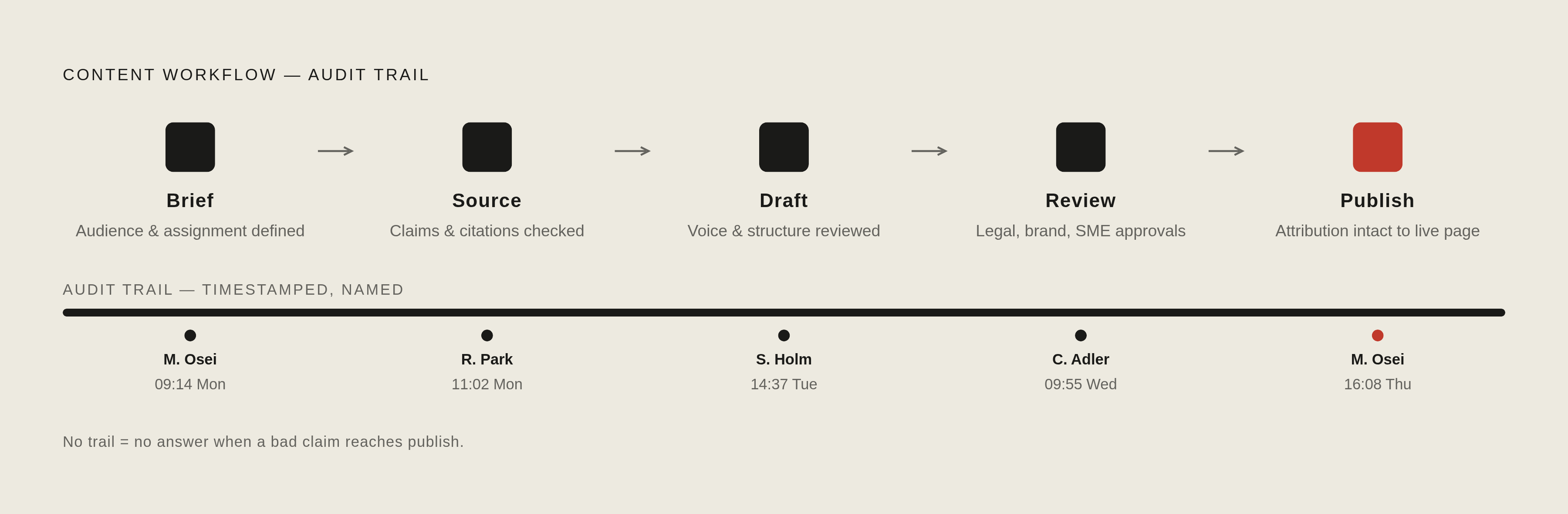
A contributor network that can produce content earning AI citations while surviving legal and compliance review depends on four interlocking layers: vetted creators, structured workflow, AI kept inside defined guardrails, and governance.
Layer one is the vetted creator network. Vetting requires ongoing attention well beyond a one-time credential check performed at onboarding. It means verifying identities, reviewing portfolios, testing subject knowledge where the topic demands it, and continuously scoring contributors against editorial outcomes over time. Subject-matching carries equal weight. Networks that source journalists from established newsrooms such as The New York Times and The Wall Street Journal treat contributor identification, vetting, and subject-area pairing as the structural foundation everything downstream depends on.
Layer two is structured workflow. As output volume climbs, editors buried in project management lose the time they need to make the writing excellent, and voice drift, endless revision cycles, and missed deadlines follow as symptoms of a broken workflow rather than a shortage of talent. A five-stage structure with mandatory checkpoints, brief, source, draft, review, publish, keeps each stage accountable to the next: the brief defines the assignment against a specific audience, the source stage subjects expert claims and citations to scrutiny, the draft stage checks voice and structure, the review stage runs legal, brand, and subject-matter approvals, and publish keeps attribution intact through to the live page. An audit trail that timestamps every brief, source, edit, approval, and publish action, tied to a specific team member, forms the compliance backbone of the whole system. In a regulated industry, that trail lets a company defend its content, while its absence turns a bad claim into an incident on a Friday afternoon with no one able to explain how it made it into print.
AI belongs mapped to specific steps in the workflow, research synthesis and citation surfacing, first-draft scaffolding from a tight brief, SEO and metadata work, structured-data generation, rather than deployed as a replacement for the whole process. Style and structure suggestions offered during editing still require an editor's approval. Factual claims made in regulated subject matter, the final voice attached to a named byline, and anything that would ship without a human ever reading it stay off-limits for AI to generate independently. AI-generated output moves through the same editorial checkpoints that human-written work moves through, and no AI content goes live under a real byline without a person having edited it. A working AI content QA process runs five stages, intake, an automated first-pass score, human review, an approval gate, and monitoring after publication, and skipping any single stage is where brand voice starts to drift.
Layer four is governance. Governance ties output to brand voice, compliance, and a feedback loop, and the metrics that operationalize it are voice consistency, editorial pass rate, and AI overview citations. A role-clarity model that separates agencies (built for volume and specialization), freelancers (built for flexibility and deep subject-matter expertise on specific formats or topics), and internal teams (holding strategy, standards, and final-stage quality control) gives each contributor type clear primary ownership and a defined escalation path. When a freelancer misses a brief or an agency interprets a brand guideline differently than intended, a named person with the authority to resolve it steps in, rather than the question circulating through a group email thread until it dies of neglect. Escalation paths matter as much as the role definitions themselves. Without them, a freelance network scales confusion at exactly the same rate it scales content output.
What the Brief Must Carry
The brief is the mechanism through which AI-visibility requirements travel from an organization's content strategy down to the individual freelancer who has never met the person who set that strategy, and most briefs currently in circulation were never built to carry that weight. A brief functions as more than a work order. It is how intent survives the handoff between strategist and contributor, and a brief missing audience context, formatting guidance, or sourcing standards does not save anyone time. The unmet gap costs more hours in revision than writing a complete brief would have taken.
A brief built for AI citation has to specify things a legacy SEO brief never needed to mention: answer-first structure that puts the direct response near the top of the page, question-based headings that mirror how a user actually phrases a query, required structural elements such as tables, ordered lists, and numbered steps, sourcing standards that call for named experts and verifiable citations rather than paraphrased claims, and the specific third-party surfaces the content needs to reach beyond the brand's own domain. A legacy brief, by contrast, typically specifies a target keyword, a word count, and a due date, none of which tell a contributor anything about how the piece needs to be structured for extraction by an AI system.
Subject-matching at the brief stage operates as a lever for AI visibility, not merely a quality-control checkpoint. A contributor with real domain expertise produces claims that are specific, verifiable, and citable because that contributor already understands the subject's edge cases and terminology. A generalist writing to a keyword produces claims that are vague and forgettable. None of this works, though, unless every contributor across a network, agencies, freelancers, internal staff, shares the same taxonomy: the same content categories, the same audience definitions, the same funnel stages, the same topic clusters. Without that shared vocabulary, a brief means one thing to the agency that receives it, something else to the freelancer, and something else again to the internal editor reviewing the draft, and the AI-visibility requirements buried inside it get lost somewhere in translation.
How human review fits into a pipeline that also runs at speed
Scaling a contributor network raises a recurring objection: that rigorous editorial review and fast publication work against each other, and something has to give. That tension dissolves once human review gets placed at the right checkpoints instead of functioning as one blanket check applied to everything at the end. Human-in-the-loop systems embed review at specific strategic points, prompt refinement, source verification, final quality assurance, rather than saving all judgment for a single pass after a draft is finished, and that structure produces both faster turnaround and higher-quality output than a single end-stage gate does.
Mapping AI to specific workflow steps, research synthesis, first-draft scaffolding, metadata and SEO work, while keeping factual claims in regulated subject matter, final byline voice, and anything shipping without review off-limits to AI, is what makes that placement work in practice. A set of seven feedback loops published for self-improving AI content workflows starts before drafting even begins, adds checks around research and sourcing as the piece develops, and folds editorial feedback gathered after publication back into how future assignments get briefed. The structure runs as a loop that improves itself over time, checking a piece at multiple points rather than passing it once through a single gate.
High-performing AI-augmented content teams hold themselves to measurable thresholds for this, strong brand-voice compliance at the moment of publication alongside a low rate of factual hallucination, and those numbers function as operating targets rather than editorial impressions someone forms after skimming a draft. Hitting those targets consistently depends on the audit trail built into the structured workflow layer described earlier, because a target only means something if there's a record showing whether it was actually met on a given piece.
The strongest version of the counterargument holds that centralizing production entirely in-house protects brand integrity more reliably than a distributed network of freelancers augmented by AI. That argument rests on a premise that doesn't hold up under the volume and surface diversity AI citation now demands: an in-house team, however well-run, cannot scale to cover the range of third-party surfaces, review sites, trade publications, community platforms, that AI systems draw citations from. The governance layer of a well-run contributor network replicates the integrity controls of in-house production, an audit trail, named ownership, escalation paths, while extending reach across third-party surfaces no internal team can cover.
Measuring whether the network's output is actually earning AI citations
None of the preceding architecture means anything without a way to confirm it is working. A contributor network has no signal for whether its output is actually reaching AI answer engines unless it runs a measurement layer purpose-built for that question, and traditional rank tracking cannot supply that signal. Rank trackers built for search engine results pages are structurally blind to mentions inside a large language model's output. A brand can dominate Google's first page for its core terms while remaining invisible across ChatGPT, Claude, Perplexity, and Gemini, with no tool in its existing stack capable of flagging the gap.
The problem compounds because a large share of AI Mode sessions end without the user clicking through to any source at all. A brand's only impression, in those sessions, happens inside the AI response itself, a surface standard web analytics cannot see. Platform divergence makes a single-engine reading actively misleading rather than merely incomplete: since only a small fraction of cited domains show up across more than one AI platform, a measurement approach has to cover all the major engines at once, or it risks mistaking strong performance on one system for strong performance overall.
Citation behavior itself varies sharply by engine. The right measurement approach differs by platform too. ChatGPT tends to mention brand names frequently but attaches a clickable citation link less often than other systems do. Perplexity runs the opposite pattern, generating far more per-response citations and links than ChatGPT does for a comparable query. A brand well-cited on one engine can be functionally absent on another, and only a measurement layer built to track all of them at once will show which is actually happening.
Sources
- Scaling Content Operations with External Partners
- Scoring With the Engine: Retrieval Exposure, Cross-Engine Divergence, and the Limits of Engine-Agnostic GEO Scores
- Generative Engine Optimization at Scale: Measuring Brand Visibility Across AI Search Engines
- What Gets Cited by ChatGPT, Claude, Gemini, and Perplexity (2026 Data)
- AI Content Workflows With Human Quality Gates