Editorial Standards for AI-Assisted Content at Scale
Human editors must intervene at four pipeline stages to prevent AI content failures.

Publishing AI-assisted content at scale requires editorial standards that govern the pipeline, including the finished draft. Human judgment must intervene before generation, during verification, and before publication, with the intensity of review matched to risk. These gates protect accuracy, brand authority, and the evidence AI answer engines need to cite a source. They are the mechanism of reliable production.
Why AI content pipelines fail without structured editorial gates
Teams expect AI pipelines to turn briefs into publishable material, but fluent output still requires editorial work. A sentence can be grammatically correct while its claim is false, and an accurate claim can still lack the evidence that makes it trustworthy. Generation does not resolve those distinctions. When production grows without a corresponding review structure, the gap between readable text and credible publishing grows with it. The default output is therefore a draft, regardless of how finished it sounds.
That gap matters beyond the page itself. AI answer engines, including ChatGPT, Gemini, Claude, and Perplexity, select citations using authority signals that volume alone cannot supply. Generative Engine Optimization, or GEO, depends on making content credible and usable as evidence, with entity authority central to that work. A program that publishes weak claims or conflicting descriptions of the brand undermines the signals it needs to build.
Where machines are most likely to fail: the four points in a pipeline where human judgment is irreplaceable
The four failure modes are hallucination, strategic misalignment, entity and factual inconsistency, and regulatory exposure. Hallucination is the most serious because invented facts, statistics, and citations can look exactly like accurate ones. This is a structural property of large language models that requires checks beyond fluency. Strategic misalignment presents a different problem because the machine generates toward its prompt rather than the brand’s actual positioning or the audience’s need. Thousands of well-written words can hide a draft that goes in the wrong direction.
Entity and factual inconsistency can occur across documents even when each draft seems sound on its own. Brand names, product details, and attributed claims may change from one document to the next because AI systems need an explicit structure to keep them consistent. Regulatory exposure arises when a publisher fails to meet the terms of an applicable disclosure exemption that calls for substantive human oversight and an editor who is responsible for what gets published. These failures happen at different stages, and each calls for a different kind of judgment. An end-of-pipe review encounters all of them only after production resources have been committed, which explains why a single approval pass cannot serve as the pipeline’s editorial architecture.
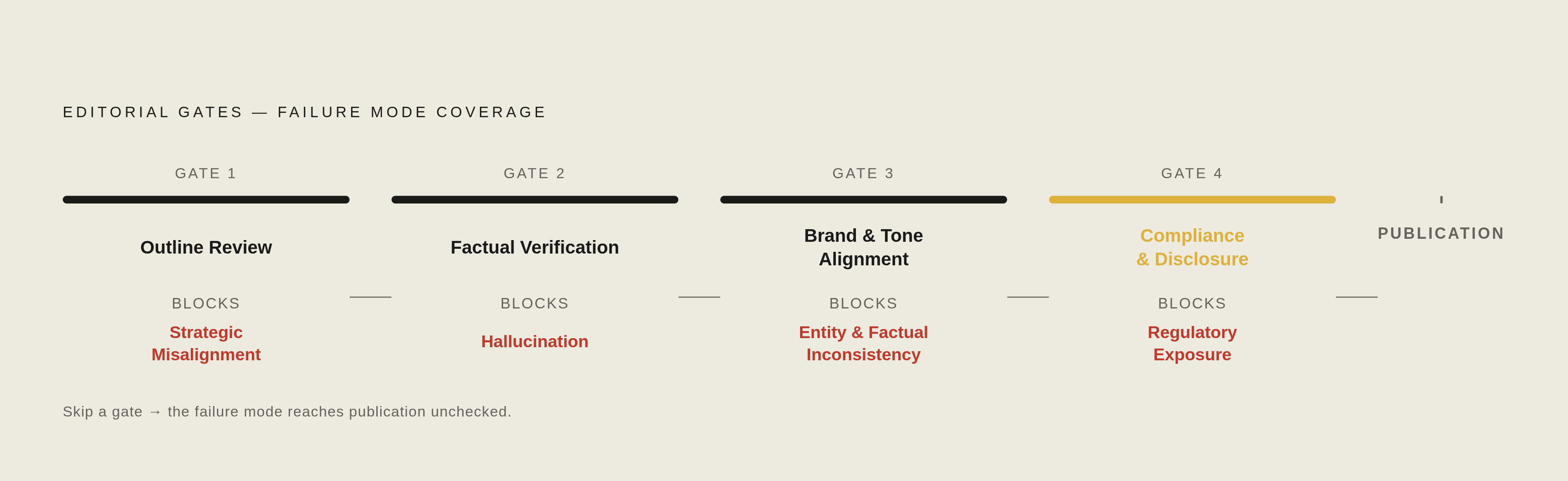
The outline gate: why human editorial judgment belongs before generation, not after
Before generation begins, a human editor checks whether the planned angle answers the audience’s real question, fits the brand’s positioning, and builds the topic authority the program wants. This is a resource decision as much as a quality decision. Rejecting a direction before drafting avoids the generation and correction work that would otherwise follow.
A pipeline can make senior editor sign-off the mandatory boundary before generation. At that boundary, the editor looks for duplication that would fragment existing topic coverage and for a structure capable of producing independently extractable answers. The editor also establishes whether the plan contains a named, attributable source claim that gives an AI engine a reason to cite the primary source. Draft review may uncover these defects later, but it cannot recover the resources already spent developing them.
The factual verification gate: what to check, in what order, and why AI cannot do this itself
Generated claims require factual verification to function as evidence. AI engines look for verifiable, contradiction-free, extractable statements, so indexing alone does not make a page a credible citation candidate. The first priority is statistics and data points, with every number traced to a named, retrievable source. Invented or misattributed statistics are especially damaging because they give unsupported claims the appearance of precision. Asking the generating system to judge its own fluency cannot establish whether that evidence exists.
The next priority is named entities, including products, companies, people, and dates. What the text says about them must match the evidence across the web, because inconsistency weakens entity authority. Attributed quotations then require comparison with an original source, rather than acceptance because the wording sounds plausible. Verification also extends beyond body copy to titles, meta descriptions, structured data, and image alt text, where inaccurate claims remain inaccurate despite being less visible to readers.
This sequence ties editorial effort to the claims an engine might retrieve or use. It is not a housekeeping exercise in making the draft look complete. Strategic and thought-leadership content need a thorough review, while routine material can go through lighter checks that suit its level of risk. The standard remains grounded evidence, even when the intensity of verification changes.
Brand and tone alignment review: the gate that protects entity consistency across a high-volume program
Brand alignment protects the entity authority that GEO depends on. AI systems aggregate signals across pages and sources to form a model of what a brand is and where it has authority. Individually accurate articles can still create a contradictory evidence base if they describe the brand’s capabilities or category differently. At volume, those differences fragment the program’s account of the entity that an answer engine is being asked to cite.
This gate checks whether brand and product names match those used on the brand’s own properties and on third-party properties. It also checks whether positioning claims conflict with what other published content establishes. Tone belongs in the same review because a consistent, authoritative voice supports E-E-A-T. A brand style and entity guide, maintained as a machine-readable reference, gives every pipeline agent a common standard against which its output can be evaluated. The purpose is not to make every article sound identical, but to prevent differences in expression from becoming contradictions about the brand.
Structure and extractability review: editing for AI retrieval, not just human readability
Extractability review checks whether a passage can answer a query on its own as well as whether the whole article reads smoothly. Retrieval-augmented generation systems break pages into passages and check how well each fits the query and how much factual detail it holds. A section that depends on surrounding prose to reveal its subject or main claim is poorly suited to answering a sub-query on its own. Human readability and machine parseability overlap, but they are not the same editorial test. The editor must therefore examine the page at passage level as well as article level.
A clear H2/H3 hierarchy gives each passage an identifiable topic, while a direct-answer opening states the claim before supplying context. Question-answer pairs make the relationship between a query and its answer explicit. Schema markup, including Article, FAQ, HowTo, and Organization, helps engines interpret the content correctly. These are structural decisions about how evidence can be found and understood.
The Princeton/Georgia Tech/Allen Institute for AI/IIT Delhi study presented at KDD 2024 showed that citation rates rose measurably when content cited sources, added statistics, and included quotations.
The pre-publication compliance and disclosure gate: what the regulatory environment now requires
The compliance gate turns editorial oversight into a demonstrable act with a responsible publisher. EU AI Act Article 50, effective 2 August 2026, requires deployers to disclose AI-generated text on public-interest matters as artificially generated unless the exemption applies. That exemption requires human review or editorial control and a natural or legal person holding editorial responsibility for publication. The conditions are cumulative. Having a human somewhere in the workflow does not, by itself, satisfy them.
Substantive engagement is what separates editorial control from a superficial approval. Spell-checking, grammatical correction, or cursory sign-off does not provide the oversight described by the exemption. For that reason, the pipeline needs a record of who reviewed what and when, together with clear responsibility for the published output. Gates must be logged as well as performed. Without that record, the publisher cannot demonstrate where accountable human judgment entered the process.
Google’s guidance, updated 1 October 2026, specifies that manual fact-checking and review of all AI-generated content is critical before publication. This guidance covers article body text and the less visible parts of a published page that the factual gate already checks. The compliance review therefore checks both the substance of oversight and its coverage, rather than treating a reviewed article body as approval for everything attached to it.
How to decide which content tiers need which gates
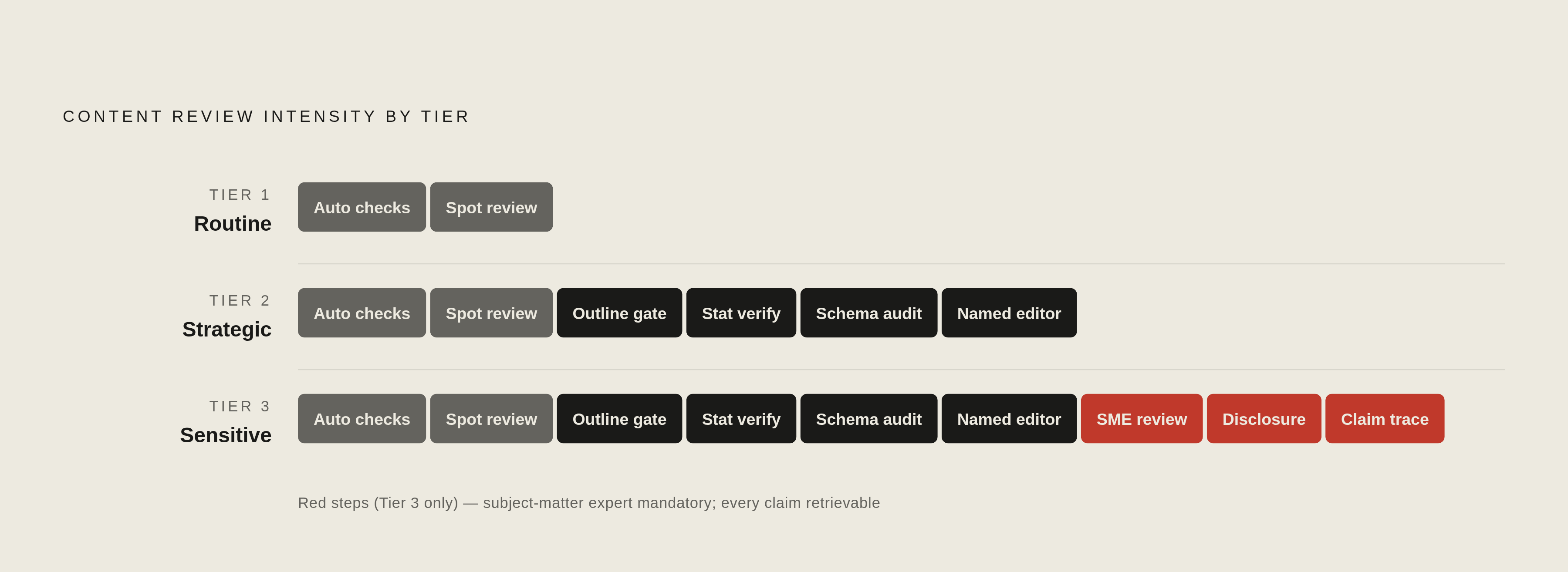
How much review a gate requires should depend on the type of content and its risks, so every item need not go through the most thorough review. Tier 1 covers routine content, including product updates, short-form material, and repurposed summaries. Automation does most of the production work, and some checks for extractability and brand consistency can be automated using the style guide. Human reviewers focus on factual spot-checks and entity consistency, with less attention to line editing.
Tier 2 is for strategic content, which includes cornerstone blog posts, category thought leadership, and original research. It requires the full outline gate, thorough verification of every named statistic and attributed claim, and an explicit schema and heading audit. A named editor takes responsibility, and a record of that human responsibility supports the EU AI Act exemption where it applies. Tier 3 covers financial, medical, legal, and regulatory topics, where a human subject-matter expert reviews the work before publication. Every claim traces to a retrievable, authoritative source, and disclosure review remains mandatory regardless of other editorial investment.
The practical routing mechanism uses confidence signals, including topic sensitivity flags, entity-match scores, and factual-claim density, to assign the appropriate review level automatically. The tiers change the depth and expertise of review while preserving the underlying need for human judgment.
Measuring whether the editorial gates are actually working
Editorial gates need a feedback loop to test whether content gains AI visibility after review. Citation rate measures whether an engine links to a specific URL as evidence, tracked per prompt and per engine. Brand mention rate measures whether the answer names the brand, with or without a link, and must remain distinct from citation. Share of model tracks how often the brand appears across the full range of prompts that fit its category. Sentiment shows whether those mentions present the brand in a positive, neutral, or negative light.
These measures need more than one observation because AI answer engines are non-deterministic. The same prompt can get different answers on different runs, so teams must run each prompt at minimum 3–5 times and report the results as statistical ranges. A single response provides only a snapshot of visibility. Similarweb’s GEO research establishes that citation and mention rates vary substantially by engine. Measurement must therefore cover ChatGPT, Gemini, Claude, and Perplexity.
Changes in citation rate provide the feedback needed to judge whether changes to an editorial gate are helping. With it, the program can connect editorial decisions to the visibility those decisions are meant to support. The return on editorial discipline is not simply more polished output, but content that AI engines can credibly use as evidence.