Content Campaign Failure Modes and How to Avoid Them
Identify the three predictable failure patterns before your campaign launches.

Advertisement
Content campaigns do not fail at random. You can identify these fault lines before launch, and they repeat across industries, budgets, and years. The pattern behind most advertising failures documented through 2026 is consistent: a clever concept that nobody challenges, an automated process that nobody checks, or a distribution channel that nobody audits for context. Separating these failures into two axes makes the diagnostic work possible. Execution failures happen when the campaign ships wrong, carrying a message, image, or tone that damages the brand on contact with an audience. Strategic-visibility failures happen when the campaign ships cleanly but lands in a place buyers no longer look, which produces no damage and no result either. Both are process gaps, and a team that understands the difference can find and close each one before launch.
How campaigns ship with the wrong message baked in
When a campaign offends, confuses, or alienates its audience, you can almost always trace it back to a review process where nobody was positioned to catch the problem. A campaign brief moves through strategy, creative, copy, and design in sequence, and by the time it reaches the public, tone, metaphor, and framing have already hardened into decisions nobody is still questioning. Nike's "Never Again" billboards for the London Marathon illustrate the mechanism precisely. Nike apologized and removed them, but the apology came after the phrase had already been interpreted outside the context the creative team had in mind.
American Eagle's "Great Jeans" campaign with Sydney Sweeney, launched in July 2025, followed the same structural path toward a different outcome. Bumble's anti-celibacy billboards show a third variation on the same failure: the brand treated a customer's stated boundary as a sales objection to be overcome, a message that directly contradicted Bumble's own positioning around women's agency. Each of these campaigns is different in subject and tone, but all three share one structural condition: the review process lacked the perspective that would have caught the problem before it reached an audience. It is a staffing and process failure dressed up as a campaign problem, not a lapse in creative judgment.
What pre-launch review needs to catch
A functional pre-launch review is not a final proofread performed after every creative decision has already been locked. It needs to be a structured, adversarial read, run while decisions can still change, and built around a small number of specific tests. The metaphor test asks what the audience will see being celebrated and what will be seen as destroyed, a question Apple's 2024 "Crush!" ad failed on directly. Apple apologized and dropped its planned television run.
A meaning-check has to search every phrase for historical or cultural weight before it goes live, and it has to assume the widest possible reading of the material, not the reading the creative team intended, because once an ad is shared outside its original context, the context does not travel with it. A brand-values stress test asks if the campaign proves out the brand's stated position, or if it exposes how thin that position is once it meets commercial pressure. None of this works without the right people in the room: the review process has to include people the campaign could actually affect, and if nobody present would have been offended or alienated by the material, the review is structurally incomplete regardless of how many people signed off on it. One more gate belongs in this list, specific to automated and scheduled content: a scheduling tool cannot decide whether a campaign should still run during a crisis, a product recall, or a public emergency. Automation can distribute a campaign reliably. A human has to decide whether the campaign should still be sent at all, and that decision has to be built into the process.
How over-automation erases brand voice without anyone noticing
AI-generated content does not usually fail because the technology is incompetent at the sentence level. It fails because there is a gap between technical accuracy and marketing effectiveness, and brand voice disappears into that gap without anyone noticing until the damage is visible externally. At scale, AI introduces a specific set of failure modes: invented product details that sound plausible but are not true, visual assets that distort in ways nobody catches at a glance, synthetic people presented as though they were real customers, testimonials that are fake or altered, visual stereotypes baked into generated imagery, and large volumes of unreviewed variations shipping before a single person reads them closely.
Platform automation compounds the risk. The ad reveals what is wrong with the pipeline that produced it. Because AI drafts quickly and with total confidence, errors that sound entirely plausible, hallucinated product claims, wrong specifications, a register that does not match the brand, move through production pipelines unchallenged simply because nothing in the process stops to question them.
Where human review belongs in an AI content pipeline
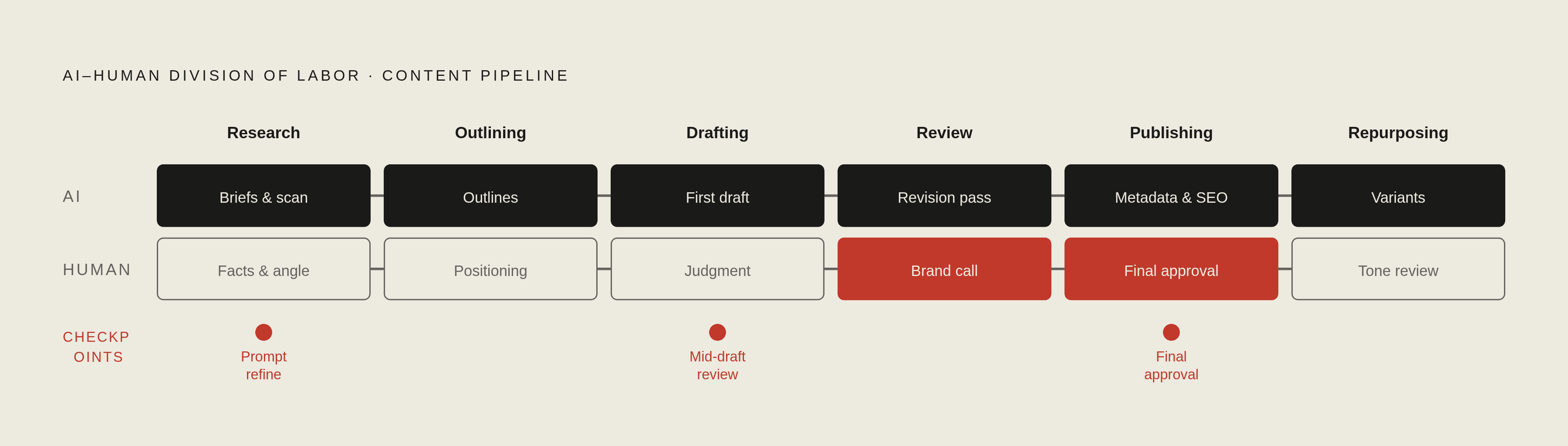
The fix for over-automation is human review built into checkpoints that are weighted to the risk of the decision being made at each stage. A six-stage separation of labor works well in practice: research, outlining, drafting, review, publishing, and repurposing. AI performs strongly on briefs, outlines, first drafts, metadata, variant generation, and repurposing existing material into new formats. Humans own the facts, the positioning, the expert judgment, the final approval, and any call that touches brand sensitivity.
Human-in-the-loop review works best when you place it at checkpoints throughout the process, not just at the finish line. Embedding review at prompt refinement, at the midpoint of a draft, and at final approval produces higher-quality output than reviewing only the finished piece, because it catches errors before they compound into the next stage of production, making the process more efficient. Nothing in that chain ships without a human approval step, and you can replace or retrain each agent in the chain without disrupting the others. AI-generated content fails in predictable ways, hallucinations, outdated information, tone mismatches, compliance gaps that read as confident even when they are wrong, so review depth should scale with the risk the content carries rather than apply uniformly to every piece regardless of stakes. Every AI-generated suggestion needs to be reviewable and reversible before it reaches an audience. Automation should speed up production. It should never mean losing the ability to say no.
The measurement gap that makes failure invisible until it is expensive
Most content measurement systems report what a team produced, not whether that production moved a buyer, so failures can accumulate across campaign after campaign before anyone has grounds to stop them. The "publish and pray" pattern shows the trap clearly: a B2B software company can publish hundreds of articles, watch organic traffic stay flat, and generate almost no marketing-qualified leads from any of it, because each piece exists as an island, disconnected from the buyer's journey, with no defined next step for the reader to take. That is a structural trap built into how the content program was designed.
Closing the loop requires mapping every piece of content to a stage of the buyer's journey, awareness, consideration, decision, post-purchase, and attaching a measurable KPI to that stage, so that a performance review has something to evaluate beyond page views. The quantity trap follows directly from skipping this step: more content without measurement produces more wasted effort at scale, and volume without intent-matching generates technically competent work that no buyer actually needed.
Ranking well in search no longer helps buyers find you
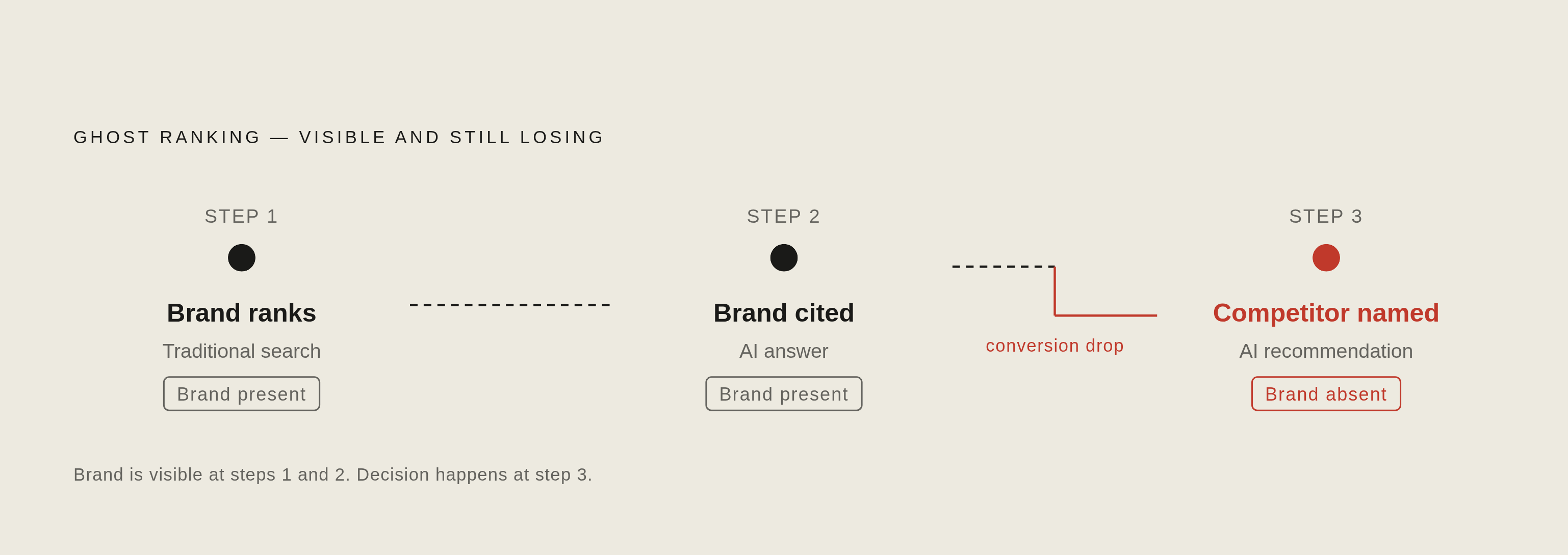
A campaign can rank well in traditional search and still be functionally invisible on the surface where buyers now build their shortlists, and most measurement systems currently in use cannot see that difference. Search visibility and AI-answer visibility have structurally decoupled from each other: a piece of content can lose clicks from Google and gain citations from large language models in the same quarter, and optimizing for one surface does not transfer any benefit to the other.
The "Ghost Ranking" pattern names the specific risk inside this decoupling. ChatGPT or Perplexity can cite a brand's content and mention the brand by name in an answer, and then recommend a competitor when the user is ready to actually buy, leaving the original brand visible, cited, and still losing the conversion. A brand can dominate every named search and still be absent at the exact moment a buyer is deciding who belongs on a shortlist. This is the measurement blind spot that search-rankings-and-traffic dashboards were never built to see: a team watching only those numbers has no instrument pointed at whether it is being cited on this surface, how favorably, or whether a competitor is being recommended in its place. The AEO and GEO framing gives this problem useful vocabulary, answer engine optimization asking whether a brand is named as the answer, generative engine optimization asking how visible, trusted, and favorably represented the brand is across every AI surface, but the vocabulary matters only because it points at a gap that needs its own measurement.
What earns a citation in an AI answer
AI answer engines do not cite everything they have indexed. They cite content that is extractable, internally consistent, and corroborated by other sources the model already trusts. A page can be fully indexed and still generate no citations if it fails to deliver clean, contradiction-free, self-contained statements that a model can lift directly into an answer; structure has to be answer-first, with clear entity identification and one verifiable fact carried per statement, or the model finds nothing clean to extract.
Entity consistency across every surface is not optional. A brand's name, description, founding year, and list of services need to match exactly across its own website, LinkedIn, industry directories, and, where applicable, Wikipedia and Wikidata, because any drift between those sources becomes fuel for hallucination, and conflicting information across sources can result in neither version being cited. Off-site presence turns out to be the strongest driver of citation, stronger than backlinks, and the highest-impact move available to a brand is earning third-party mentions on the specific URLs that already appear in AI responses for the category prompts that matter to it, through PR placements, expert contributions, and partnerships. Format shapes the odds as well: listicles account for the largest share of LLM citations overall, that pattern holds for commercial queries specifically, and informational articles dominate the citation sets built around informational queries, making format a determinant of citation.
A structural constraint produced by this citation landscape sits underneath it, and brands rarely plan around it. Many of the pages cited most often by leading AI engines, Wikipedia, government and educational sites, major news media, are not places a brand can buy or directly optimize its way into. One content type is built specifically to feed this system: a grounding page, encyclopedic and neutral in tone, structured for extractability, distinct from a marketing landing page and distinct from an llms.txt manifest, gives an AI answer engine evidence it can reason from directly at the moment a query comes in.
Measuring whether AI answer engines cite and recommend you
AI visibility only functions as a managed asset once it is actually instrumented. Without measurement, a brand has no way to know whether its content architecture is working, which platforms are citing it, or whether it is being recommended outright or simply mentioned in passing. Citation volatility makes a one-time check close to useless: a significant share of brands cited in one AI response are absent the next time the identical query runs, so presence on this surface is not stable, and a single snapshot cannot stand in for an ongoing strategy.
Share of Model is the metric built for this problem: brand mentions measured as a proportion of total AI answers across a tracked set of queries, producing a visibility score that is specific to a platform, specific to a query set, and comparable over time. You have to measure at the platform level, because performance varies by engine. If Gemini cites a brand while ChatGPT does not, that is a different problem than the reverse, and each needs its own fix, so one aggregate score would hide both. AEO and GEO work as two separate measurement frames rather than one: AEO asks whether a brand is named as the answer, and GEO asks how visible, trusted, and favorably represented that brand is across every AI surface it touches, and both questions need real instruments behind them rather than assumptions about how things are probably going.
A working measurement layer enables standing monitoring that can draft content the moment a relevant gap opens up, tracking that shows whether ChatGPT, Claude, Gemini, and Perplexity are actually naming and citing a given brand, and a feedback loop that routes that evidence back into the content pipeline so the next piece produced accounts for what the last one revealed. That is engineering discipline applied to brand presence, and it has nothing to do with routine publishing habits. Every failure mode this piece has traced, audience misalignment, over-automation without review, measurement gaps that hide damage, invisibility on AI-answer surfaces, has a corresponding fix that can be built into process before a campaign ever launches. The brands that treat content operations as an engineering discipline are the ones that will catch these failures before the damage is done.