Thought Leadership Strategy for Mid-Market B2B Brands
Strong thought leadership reaches hidden buyers competitors can't see.

Mid-market B2B brands are stuck bidding for the same buyer attention as enterprise incumbents, but without the enterprise budget to buy that attention through the usual channels. That gap, and the discipline required to close it, is what this piece is about. Thought leadership, treated as a deliberate strategic posture rather than a content category, is the mechanism that lets a smaller brand stay in the room during a buying cycle that can run for months without a single sales call.
Most of that cycle happens where marketing can't see it. Gartner's 2025 CMO Spend Survey found that 59% of CMOs say their budget isn't enough to execute the year's strategy, and mid-market leaders feel that shortfall harder than enterprise counterparts, who can at least throw money at the problem. At any given moment, the vast majority of business buyers aren't shopping for anything at all: they're heads-down, budget-constrained, mid-project, or not thinking about the category. Forrester has documented that nearly 90% of B2B teams struggle with attribution because their data and systems don't talk to each other, which means the long, quiet stretch between "aware of you" and "actively evaluating you" stays largely invisible to marketing measurement, even as it's exactly where deals get won or lost.
Enterprise brands paper over that dark period with paid media, sponsored events, and analyst relations budgets that keep the logo in front of buyers whether or not those buyers are ready to act. Mid-market brands need something that does the same job, staying present and credible, without the media spend. So thought leadership stops being a nice extra and starts acting like load-bearing infrastructure for anyone without an enterprise checkbook.
How thought leadership has moved from a nice-to-have to a primary purchase driver
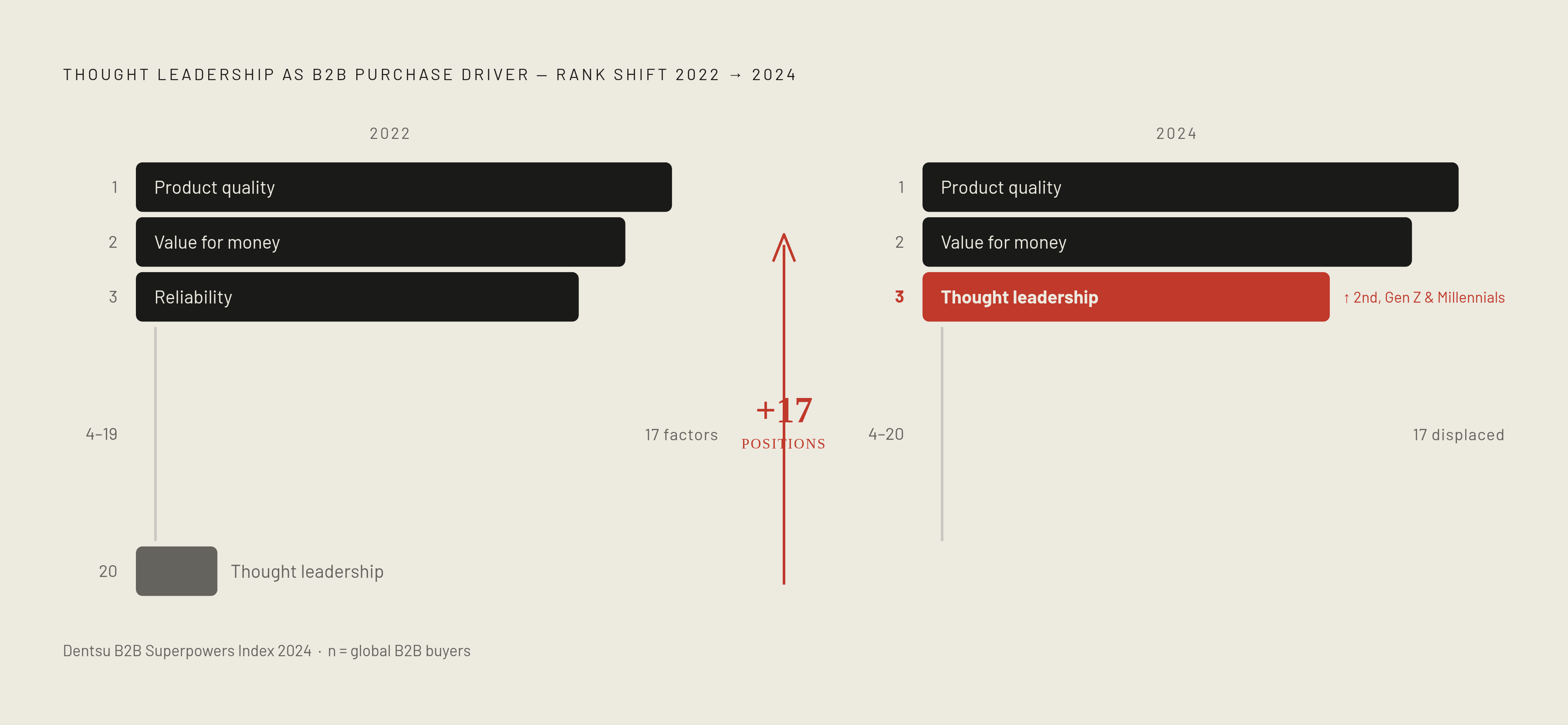
Track the trajectory and the shift looks less like a trend and more like a reordering of priorities. Dentsu's 2024 B2B Superpowers Index found that "being seen as an active thought leader in my category" climbed from the 20th most important purchase driver to the 3rd since 2022. That's a decision factor jumping past seventeen others in two years, not incremental movement. Among Gen Z and Millennial B2B buyers specifically, it already ranks second, and those buyers only gain more purchasing authority as they age into director and VP roles. Whatever ranks highly with them now compounds for the next decade.
The 2024 Edelman-LinkedIn B2B Thought Leadership Impact Report, drawing on nearly 3,500 management-level professionals across seven countries, put numbers behind the mechanism. Seventy-five percent of decision-makers and C-suite executives said a piece of thought leadership led them to research a product or service they weren't previously considering. That's pipeline creation, happening before a sales rep ever picks up the phone. Sixty percent said thought leadership revealed a business opportunity they hadn't realized they were missing, the moment a vendor starts looking like an advisor instead of a supplier. And 60% said they'd pay a premium to work with companies that show strong thought leadership, a hard thing for a skeptical finance team to credit at first glance when the thing driving the premium is an essay.
Nearly three-quarters of decision-makers said they trust thought leadership more than a company's marketing materials when judging its capabilities. Sit with that one, because it's one of the only channels where credibility can outrun brand recognition. A familiar logo doesn't need to prove anything; an unfamiliar one does, and thought leadership is how it proves it without a nine-figure ad budget. Little wonder, then, that the Thinkers360 2025 B2B Thought Leadership Outlook Report found more than a third of B2B professionals now rank thought leadership as their number one priority in sales and marketing strategy for the year. Priority doesn't guarantee competence, though, and that gap gets its own section next.
The hidden buyer problem that mid-market brands are least equipped to solve
Who actually kills a B2B deal? Rarely the person taking the sales call. The 2025 Edelman-LinkedIn report, covering nearly 2,000 professionals across seven markets, centers on what it calls hidden buyers: the finance, operations, legal, compliance, and procurement stakeholders who weigh in on a purchase without ever showing up on a vendor's radar. Nobody names them in the CRM. Nobody tracks their engagement. And more than 40% of B2B deals stall specifically because of misalignment inside that invisible buying group, not because the primary contact went cold.
Calling them box-checkers would be a mistake. These are people who think about vendor risk, integration cost, and long-term fit as seriously as anyone with "decision-maker" in their job title. They just don't get a seat at the demo.
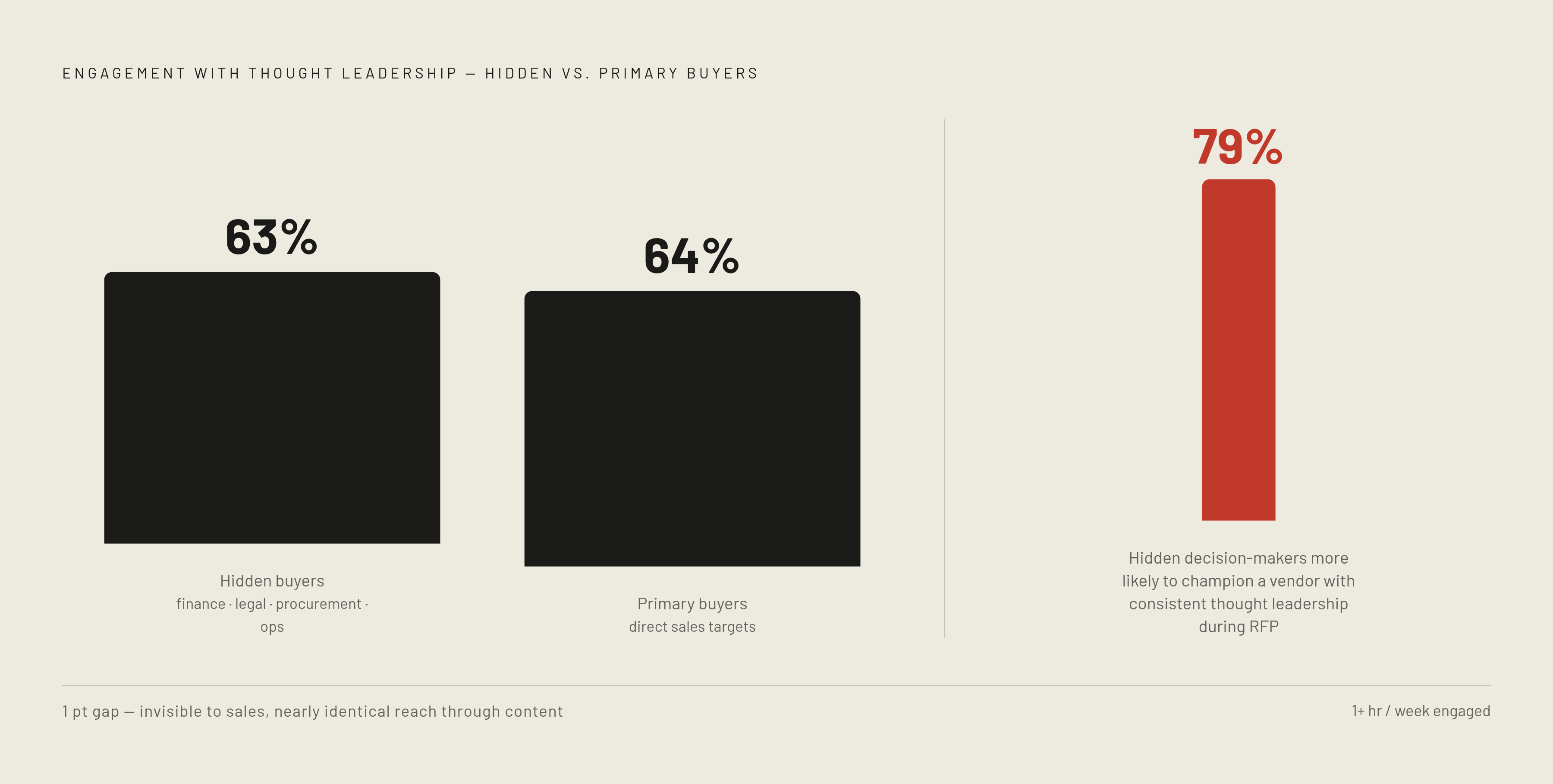
Here's the finding that should reorganize how a mid-market team spends its next quarter: hidden buyers consume content at almost the same rate as primary buyers. Sixty-three percent of hidden buyers spend more than an hour a week engaged with thought leadership, against 64% of primary target buyers. Invisible to the sales process, entirely reachable through what a company publishes. Seventy-nine percent of hidden decision-makers said they're more likely to champion a vendor that shows consistent, high-quality thought leadership during an RFP, which means content does advocacy work inside rooms the vendor was never invited into.
And then there's the number that should reorder how mid-market marketing teams think about competing with enterprise incumbents: 53% of B2B decision-makers say that when a company's thought leadership is strong, brand recognition matters less. That's the exact mechanism by which a smaller, lesser-known vendor displaces a household name at the final stage of a deal. Enterprise competitors have account teams whose whole job is managing a buying committee face to face, dinner by dinner, follow-up email by follow-up email. Mid-market brands have to build the same relationships at scale, through what they publish, for people they'll likely never meet.
Why most thought leadership programs fail to deliver on this potential
So if the upside is this well-documented, why do so few programs actually deliver it? Start with the quality gap, because it's the whole story in miniature. Only 26% of B2B buyers rate brands highly on their thought leadership, per Dentsu's 2024 Index, down from 31% in 2022. Investment is rising while perceived quality is falling: about as clear a signal of misallocated effort as a market research report is likely to produce. The Edelman-LinkedIn numbers are worse: decision-makers consistently rate the overall quality of thought leadership they consume as falling well short of expectations, which means the majority of content isn't clearing a bar most readers would consider reasonably low.
The Omnia Strategy Group's 2024 study of more than 200 marketing leaders gets specific about why, and the causes read like a checklist of avoidable dysfunction. Only 44% of B2B tech thought leadership programs reach "very effective" status. Fifty-six percent cite internal politics, meaning the editorial process gets hijacked by stakeholders pushing product messaging or risk-averse legal language instead of an actual point of view. Sixty-nine percent say there's too much emphasis on lead generation, meaning short-term conversion pressure crowds out the slower trust-building work that produces pipeline six months later. And 38% cite plain differentiation failure: nobody can say what makes their perspective different from the next company writing about the same topic.
Here's the part most teams get backwards: they treat that differentiation failure as a writing problem, something an editor or a better freelancer can fix. It isn't. It's a positioning problem wearing a writing costume. Measurement makes the dysfunction visible from a different angle. One in five B2B companies have no process at all for measuring whether their thought leadership works. Forty-two percent rely solely on website traffic, a metric that says almost nothing about whether the content moved anyone closer to a purchase decision. Fewer than a third can trace a sales lead back to a specific piece of content, and half say they're simply too under-resourced to produce anything better. What results is a program that looks active on a dashboard and produces nothing measurable in the pipeline: busy, expensive, and quietly pointless.
For a mid-market brand, that failure mode costs more than it does for an enterprise competitor with money to burn and brand equity to fall back on. There's no cushion. Wasted content spend is just wasted spend, full stop.
How AI is simultaneously devaluing mediocre content and raising the ceiling for genuine insight
Nearly 76% of B2B marketers now use AI-generated content in some form, according to Affinco's 2026 analysis, and the Content Marketing Institute's B2B Benchmarks put generative tool adoption at 72% in its 2024 outlook. Put those numbers together and the picture is a market flooding with content that reads fine, structures fine, and says almost nothing. Grammatically sound and substantively empty, in roughly equal measure.
Buyers have noticed. Foundry's 2024 research found that 85% of tech leaders describe uncertainty about whether content is AI-generated as an actual barrier to finding material they can trust. More content than ever exists, and less of it earns belief. Trust has become the scarce resource, which is genuinely useful for smaller brands to understand, because trust doesn't scale with ad budget the way impressions do.
That shift also resets the baseline. A well-researched, competently written piece used to be a differentiator. Now it's the entry fee, table stakes, the thing every competitor can produce with a laptop and a subscription. Differentiation has to come from somewhere AI structurally cannot reach: original thinking, grounded in actual operating experience. Marketers broadly recognize that original research remains more valuable for trust and credibility than AI-generated content. The research phase gets faster. The insight doesn't get manufactured.
The smarter operators already know this, treating AI as a research and analysis tool rather than a ghostwriter. That's the correct division of labor. Let the tool compress the hours spent synthesizing competitor content and scanning for what's already been said. Reserve human judgment for the argument itself: the counterintuitive framing, the specific example nobody else has access to because nobody else ran that operation.
For mid-market brands, this is an opening, not a threat, however backwards that sounds at first. AI drives down the cost of producing content that's merely adequate, but it can't invent proprietary expertise from nothing, and most mid-market companies sit on more of that expertise than they've bothered to write down. A brand that pairs AI-assisted production with real subject-matter knowledge can now publish at a pace that used to need an agency retainer and a much bigger budget.
The strategy-first framework mid-market brands need to compete on thought leadership
Every constraint mid-market teams operate under, limited budget, limited production capacity, long buying cycles, buying committees they can't see, should shape the framework rather than sit outside it as an excuse. Four pieces hold that framework together, and the order matters more than the checklist.
Own a specific point of view within a topic area, first and before anything else gets built. That 38% differentiation failure from the Omnia data is almost always a positioning problem in disguise: brands write broadly about "the future of the industry" instead of staking out something a competitor would actually disagree with. A mid-market team can't out-resource an enterprise content shop, but it can out-think one, provided it's willing to name the two or three questions where its own operators hold a genuine, experience-based view that cuts against conventional wisdom.
Build for the whole buying committee, not just the person who signs. The hidden buyer data, that 63% weekly engagement figure, says finance, legal, and procurement are reachable through content even when sales never talks to them directly. Content briefs should map to committee roles, not just to the persona of whoever holds the pen. The real goal is arming the internal champion with something to forward to a skeptical CFO: doing the persuasion work a vendor's sales team physically can't do in person.
Invest in original research as the anchor asset, because it's the one thing an AI-generated roundup structurally cannot copy. Research-based content consistently earns high marks for driving engagement and leads effectively, which lines up with the trust premium decision-makers reported elsewhere. Mid-market brands don't need an enterprise-scale survey budget to pull this off. A focused study of a few hundred respondents in one specific vertical produces a data point nobody else owns.
Match format to how hidden buyers actually consume content, and stop assuming that means a blog post. Video interviews, live and virtual events, and interactive formats are widely recognized as top performers, and interactive content is widely reported to increase repeat engagement, yet relatively few teams build it with any consistency. Short-form social video has emerged as a strong ROI driver for B2B video marketers, a format that doesn't demand a broadcast budget. LinkedIn itself remains the most efficient channel for reaching a hidden buying committee without paying for reach.
Measure what connects to pipeline over what's easy to pull from Google Analytics. That 42%-rely-on-traffic statistic from earlier means most programs optimize for a number with no relationship to revenue. Better metrics: engagement broken out by buyer role, how much content a prospect consumed before first sales contact, deal velocity for accounts with documented thought leadership exposure. Imperfect attribution tied to late-stage deal activity beats a flawless traffic report every time.
Producing thought leadership at mid-market speed without sacrificing editorial quality
Half of B2B companies say under-resourcing is the reason their thought leadership quality suffers, and that number points to a shortage of plumbing, the systems needed to turn ideas into finished, edited, published work on a schedule, not a shortage of ideas themselves.
Mid-market teams tend to assume they're choosing between two bad options: publish often and generically, or publish rarely and well. That tradeoff dissolves once AI gets deployed correctly, meaning it speeds up human expertise instead of replacing it. A workflow built around that principle starts with the point of view, not the content calendar. The first question is what the company believes that its buyers don't yet know or accept, not what topic is due Thursday. AI takes over research synthesis, competitive scanning, and structural drafting, the parts of the job that eat hours without needing anyone's hard-won expertise. Human editorial judgment stays locked onto the insight layer: the actual argument, the framing nobody else uses, the specific example pulled from real operating experience that a language model has no way of knowing.
None of that works without a repeatable system behind it: a consistent brief format, a defined review process, a cadence that doesn't require reinventing the wheel every time a new piece goes into production. That internal politics problem from the Omnia data, 56% citing it as a drag on effectiveness, tends to show up exactly where this structure is missing. No clear owner, no defined scope, and thought leadership slowly turns into product marketing dressed up in different language. The fix isn't complicated, even if it's rarely implemented. Name an editorial owner with actual authority to say no, and keep thought leadership content structurally separate from anything with a call-to-action attached to a product page.
Tooling matters here too, more than most budget conversations give it credit for. Marketing teams that own their production process, rather than routing every draft through an agency's multi-week cycle, can respond to a market shift or a competitor's misstep in days instead of months. Platforms built around AI-assisted drafting combined with real editorial workflow and brand governance, going beyond generic text generation, create an actual speed advantage for teams that don't have agency-scale resources to spare.
The payoff compounds in a way paid media never does. A research report published two years ago still generates inbound interest today, still gets forwarded inside buying committees the original vendor never met. Ad spend disappears the day the budget runs out. A library of genuinely well-made thought leadership just sits there, working, long after anyone remembers what quarter it was published in.