In-House Content Team Structure for Mid-Size Brands
How to restructure a content team as it scales from generalists to specialists.

Mid-size content teams fail because of production bottlenecks that exist regardless of hires or strategy. They fail because the org structure that worked at six people quietly stops working at twelve, and nobody notices until output stalls and everyone's calendar is full of meetings that produce nothing. This piece maps the three structural phases a content team moves through as it scales, the roles and hiring order that make Phase 2 work, and the decision points that tell a team it's time to change shape again.
The founding instinct is to hire generalists. At two or three people, that's correct: speed matters more than specialization, and one person who can write, edit, post to social, and pull a Google Analytics report is worth more than three narrow specialists who can't cover for each other. The problem shows up later, when that same generalist structure gets stretched to ten or twelve people and the coordination required to keep everyone pointed the same direction starts eating the very time it was supposed to save.
The three structural phases mid-size content teams move through
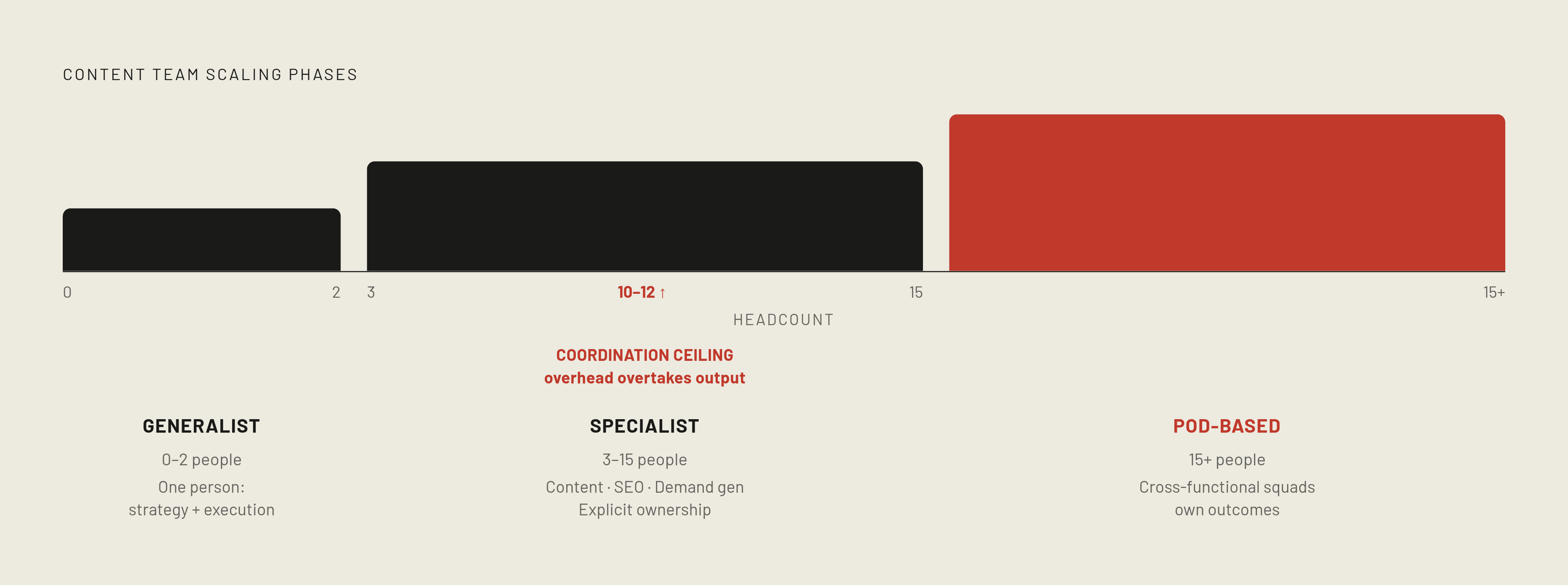
Phase 1 is founder-led or single-leader generalist, usually zero to two marketers. One person owns strategy and execution both, and content is whatever that person or their first hire can physically ship in a week. There's no org chart to speak of because there's no org to chart.
Phase 2 is the specialist transition, roughly three to fifteen people. Functional roles split apart: content, demand gen, SEO, marketing ops. This is where teams start needing explicit ownership of specific outcomes instead of assuming everyone will just figure out who does what. It's also where most mid-size teams currently sit, and where most of the structural damage happens.
Phase 3 is pod-based, generally 15 or more people. Cross-functional squads own specific outcomes (a growth pod, a product-launch pod, a customer-expansion pod), and coordination gets capped at the pod boundary rather than spread across the whole org.
The thread running through all three phases is the same: clear ownership, coordination overhead kept low, and data that's centralized enough that reporting doesn't eat into the time people should spend making things. Teams that try to skip Phase 2 and jump straight to pods before roles are actually specialized end up with fragmented ownership and duplicated work. Teams that stay in Phase 2 too long run into a hard ceiling, and per research from Improvado, that ceiling typically hits around 10 to 12 headcount, where coordination overhead starts growing faster than actual output. This isn't a fixed rulebook. Company stage, product complexity, and how the business actually goes to market all shift exactly where a given team sits on this curve.
What the Phase 2 specialist team actually looks like: roles, ownership, and hiring order
Six functional categories need coverage in a Phase 2 team, whether the work happens in-house or through some hybrid setup. Leadership sits at the top (Head of Content, VP of Content, or a Content Marketing Manager depending on scale). Strategy comes next, usually a Content Strategist or Managing Editor who sets the editorial direction and builds the content plan. Technical work falls to an SEO Manager, a role that's increasingly responsible for AI-driven discovery as much as traditional search rankings. Distribution covers Social Media Manager and Email Marketing Manager. Creative production includes writers, editors, designers, and video or short-form producers. And operations, the Marketing Ops role, is the one most teams hire far too late.
That last point deserves more weight than it usually gets. Ops should come on board early in the team-building sequence, well before the coordination cost becomes visible. Skip it, and every specialist ends up spending 15 to 25% of their time on manual reporting and data reconciliation instead of actual marketing work, according to Improvado. That's a substantial share of the total. That's a full day a week, per person, lost to spreadsheet work that a properly built data pipeline would eliminate.
Role clarity also matters more than job titles do. When content, product marketing, and demand gen responsibilities blur together, that's not a personality clash or a communication problem, it's a structural one, and it costs real hours per person per week in duplicated effort. Reporting lines matter too: creator and content strategy roles belong inside brand marketing, where voice and ownership live, with a dotted line into performance marketing for measurement. Teams that get routed into IT, procurement, or some generic "digital" bucket lose marketing fluency fast, and it shows in the output.
The investment is paying off, for what it's worth. Per data cited by marketerhire.com, 61% of technology marketers said content marketing helped generate sales or revenue in the last 12 months, up from 48% the year before. That's not just brand lift. That's a meaningful year-over-year gain in content's reported revenue contribution.
Centralized, functional, hub-and-spoke, or embedded: choosing the right organizational model at each phase
Four models cover most of how mid-size teams actually organize themselves.
The centralized model puts one core team in charge of all content and social activity across the organization. It's the default for most mid-size companies, and for good reason: brand voice stays consistent, and there's no risk of two departments publishing contradictory messages. The tradeoff is speed. Every request funnels through one team, and that team becomes the chokepoint everyone waits on.
The functional model suits teams of roughly three to eight people. Responsibilities for content creation, community management, paid, and analytics get distributed, and it works well as long as one shared tool governs how work gets delegated and tracked.
Hub-and-spoke is harder to run well. A central hub sets strategy and brand standards, and regional or departmental spokes handle execution. The moment the hub loses visibility into what the spokes are actually publishing, brand consistency starts to crack. This model lives or dies on communication, full stop.
The embedded model places content or social professionals directly inside other departments, sales, customer support, HR. Brand consistency risk gets managed through strong style guides and regular cross-functional syncs, and it tends to work best at large organizations with the governance infrastructure to support it. Without that governance, it's risky.
For growing mid-size teams, a blended approach tends to outperform any single model on its own: channel managers handle cohesive strategy and prioritization, while specialists in SEO, paid, content, and social handle execution quality underneath them. That combination avoids both the centralized chokepoint and the fragmentation that embedded models can produce. And no model should be treated as permanent. The signal to switch is usually the same 10 to 12 headcount coordination ceiling mentioned earlier, or a visible drop in output speed even though staffing looks adequate on paper.
When to build in-house versus when to outsource or hire fractional
Mid-market companies, defined here as 100 to 999 employees, outsource 54% of their content activities. That's a meaningful share, and it reflects real capacity constraints rather than simple preference.
Roughly 76% of organizations have dedicated content resources in-house, while the remaining 24% handle content alongside other job responsibilities. Both groups still use external specialists, just for different reasons: both groups rely on outside specialists, even if the balance and reasons differ by how much internal capability they've already built.
Fractional senior hires can fill senior functional gaps without the overhead of a full agency retainer or the cost of a full-time hire before headcount justifies it. Functions like brand voice, editorial strategy, and performance data ownership are commonly cited as higher-risk areas to hand off externally, where losing direct control tends to create downstream risk. The signal that it's time to bring a function in-house is typically some combination of rising coordination overhead and output quality from outside work consistently falling short.
An industry trade group flagged significant strain on creative resources across in-house teams in a March 2025 publication on balancing resources. "Just do it ourselves" isn't automatically the cheaper option once the coordination cost of managing that work internally gets counted honestly.
How the content team's role is shifting as AI changes how buyers discover brands
AI chatbot referral traffic hit 1.1 billion visits in June 2025, up 357% year over year, according to Similarweb's 2025 Generative AI report. That audience has grown into a substantial share of the total. It's a real channel.
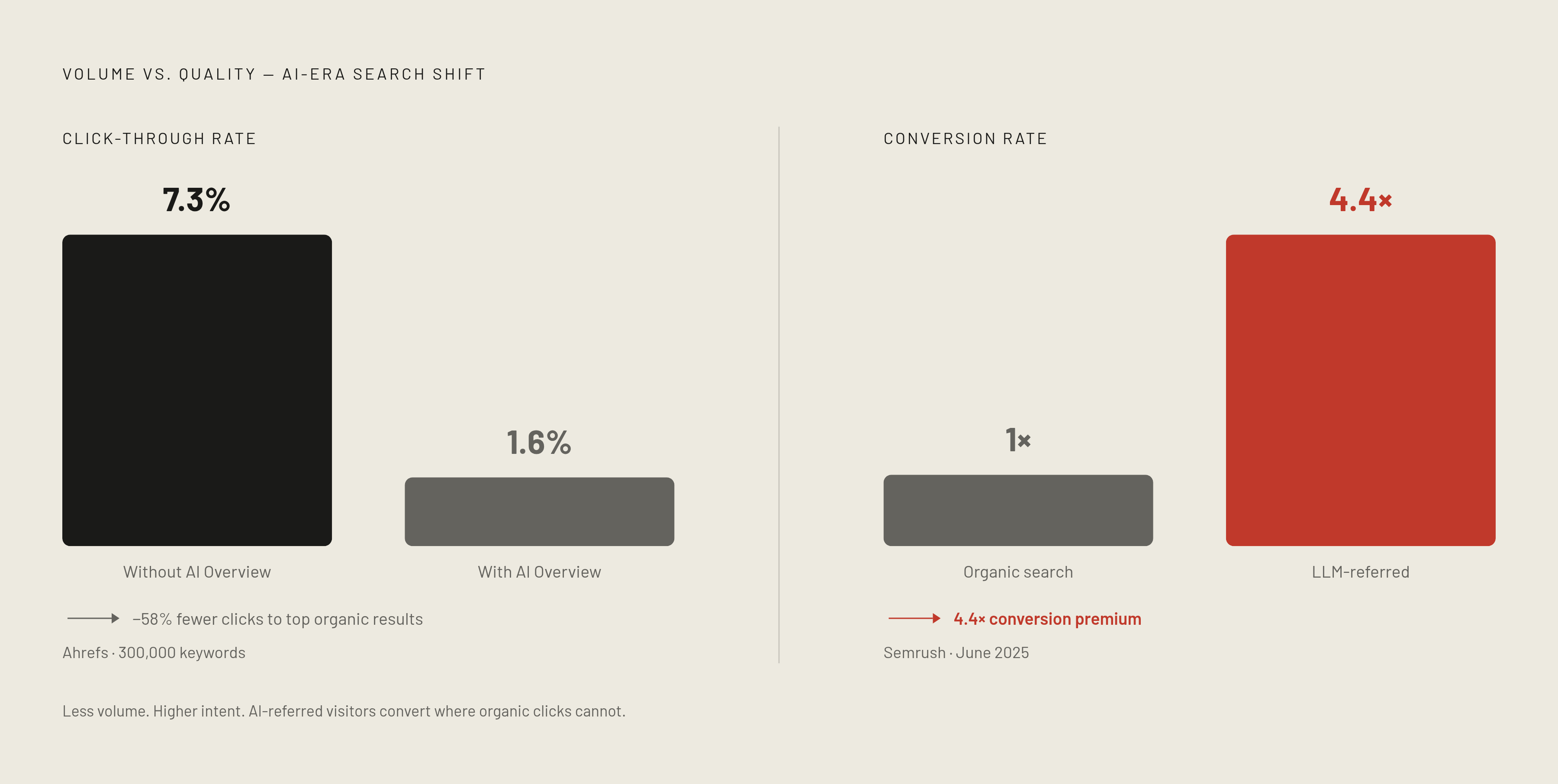
At the same time, AI Overviews are cutting into traditional organic clicks hard. Ahrefs analyzed 300,000 keywords and found that where AI Overviews appear, click-through rates for the top-ranking organic page drop by up to 58%, from 7.3% down to 1.6% on those keywords. A content team still optimizing purely for traditional rankings is optimizing for a slice of traffic that's shrinking in real time.
Brands that get cited inside AI Overviews still pull more clicks than brands that don't. So presence in that AI layer still matters, even as the overall click pool available to grab shrinks. And the traffic that does show up from AI platforms converts unusually well: Semrush's June 2025 study found LLM visitors convert at 4.4 times the rate of average organic search visitors. Volume is still modest at most brands today, but the quality premium on that traffic is real and growing.
None of this is a side project to bolt onto an existing SEO role. It changes what the SEO or content strategist actually has to own, how content gets written (authoritative, backed by evidence, structured in a way machines can extract cleanly), and what metrics leadership tracks on a weekly dashboard. Over 90% of marketers now use AI somewhere in their content workflow. The question facing content teams now is how AI touches the work. It's whether the team's structure has caught up to that fact.
The emerging GEO function: what it requires and where it sits in the org
Generative Engine Optimization, GEO for short, is the discipline of structuring content and brand presence so that systems like ChatGPT, Perplexity, and Claude cite and recommend the brand inside generated answers. It's broader than AEO, which mostly covers featured snippets and AI Overviews, because GEO also covers share of model, sentiment, and citation authority across the wider generative AI ecosystem.
The GEO Specialist role barely existed two years ago. By mid-2026, Indeed carried 883 open Generative Engine Optimization postings across a range of industries, though some employers still call the role AEO or AI visibility instead. Pay bands are reported to run roughly $90,000 to $150,000 depending on scope, tracking close to what a senior SEO lead or content strategist earns. That's the market treating this as senior specialist work, not an entry-level add-on tacked onto someone's existing job.
A Princeton study on GEO (Aggarwal et al.) isolated which content changes moved the needle most on AI citation. Adding quotations, statistics, and citations each produced roughly 25 to 40% more AI visibility. Those are the exact signals a GEO function needs to build into production standards, not vague guidance about "quality content."
GEO breaks down as roughly 80% strategic work (positioning, ecosystem presence, brand authority) and only 20% technical. That split means the function fits naturally next to content strategy and SEO, not buried inside IT or spun off into some standalone "AI team" that nobody in marketing talks to. Mid-size brands have three real options here: expand the SEO Manager's scope to explicitly cover GEO, hire a dedicated GEO or AI Visibility Specialist once search volume justifies the cost, or work with an agency partner whose account teams can actually speak to AI visibility with some fluency. The one option that doesn't work is leaving the function unowned and hoping it sorts itself out.
PwC's 2025 Global AI Jobs Barometer found workers with AI-related skills commanded a 56% wage premium in 2024, and skill requirements inside AI-exposed roles are shifting significantly faster than in roles AI hasn't touched yet. Hiring ahead of that curve costs less than trying to catch up to it later.
What content job postings in 2026 reveal about where teams are actually investing
Job posting data tells a clear story about where the market's money is going. "Content Producer" listings jumped 1,261%, and "Content Creator" listings rose 410%. Together, those two roles now make up 34% of the total content job market analyzed. That's a hiring signal, and what it signals is a shortage of hands-on execution capacity, not strategy.
Titles that combine content ownership with SEO now account for 20% of all listings, tied with "Content Creator" for the highest volume of any title tracked. That's a strong market signal that content and search or AI discovery are merging into single roles rather than remaining separate lanes on an org chart.
Senior leadership demand is climbing too. "Head of Content Marketing" postings grew 376%, and "VP of Content" postings grew 308%. Teams aren't just stacking up executors, they're investing in strategic ownership at the top of the org as well.
Structurally, this points somewhere specific: mid-size brands that keep "content" and "SEO/discovery" as separate boxes on their org chart are building against the direction the market's actually moving. The model taking shape integrates production, strategy, and AI-surface optimization under one shared owner. A sequencing risk is buried in these numbers: 1,261% growth in Content Producer roles against only 376% growth in Head of Content Marketing roles suggests a lot of teams are hiring producers faster than they're hiring the strategic layer meant to direct them. That's the same hiring-order mistake covered earlier, just showing up at the market level instead of inside one company.
How data infrastructure determines whether a content team's structure actually works
Teams spending 15% or more of their time on manual reporting, data pulls, or spreadsheet reconciliation aren't under-resourced. They're structurally constrained, per the same HubSpot data cited by Improvado referenced earlier, and the fix isn't more headcount, it's better plumbing.
Here's the specific failure pattern. Most mid-size teams already run Google Analytics, a CRM, and an ad platform dashboard or two. None of them talk to each other. So every attribution question turns into a multi-day project, and every weekly report gets rebuilt from scratch instead of pulled from something that already exists.
Centralized data infrastructure is what lets pod structures stay autonomous in Phase 3 without fragmenting into silos. Without it, pods optimize for their own local metrics, and leadership loses visibility into how anything is performing across the whole team. This compounds fast in multi-brand or agency settings, where each brand reporting independently means a lesson learned in one place never travels to the others. Centralize the data, and a hook format or content angle that drives strong click-through for one brand can get briefed into the next brand's content plan immediately instead of getting rediscovered from scratch six months later.
Marketing ops is the function that makes everyone else on the team more productive. It's core to the work itself. It's the layer that eliminates manual work, standardizes how processes run, and keeps the data infrastructure functioning well enough that decisions can actually get made on it. Hiring this function late remains one of the most common, and most expensive, structural mistakes a growing content team makes.
AI visibility tracking adds an entirely new layer on top of all this. Share of voice inside AI-generated answers, citation frequency, sentiment in AI responses: none of that flows out of a standard analytics setup. Teams building GEO capability need to plan for that measurement infrastructure directly. It won't show up for free just because the content production side is working.
The decision points that tell a team it's time to restructure
Moving from Phase 1 to Phase 2 has a clear tell: generalists start reproducing each other's work instead of complementing it, the founder or first hire becomes a bottleneck that every content decision has to pass through, and output volume plateaus even though everyone's putting in the hours.
Moving from Phase 2 into pod-based Phase 3 has its own tell, and it's the 10 to 12 headcount coordination ceiling arriving right on schedule. Meetings multiply, Slack volume climbs, and the team somehow ships less with more people on it than it did with fewer. Specialists start spending more time negotiating who owns what than actually executing.
Within any phase, if a substantial share of the team's time is going to manual reporting instead of marketing, fix the data infrastructure before adding a single new hire. More people working inside a broken data environment just adds payroll cost without adding any real velocity.
And one more trigger sits outside the traditional phase model entirely: if the team has no named owner for GEO or AEO, and no way to measure how the brand shows up inside AI-generated answers, the structure is already behind. That gap won't announce itself the way a headcount ceiling does. It just shows up later, in traffic and conversion numbers nobody can quite explain, from a channel nobody assigned anyone to own.